
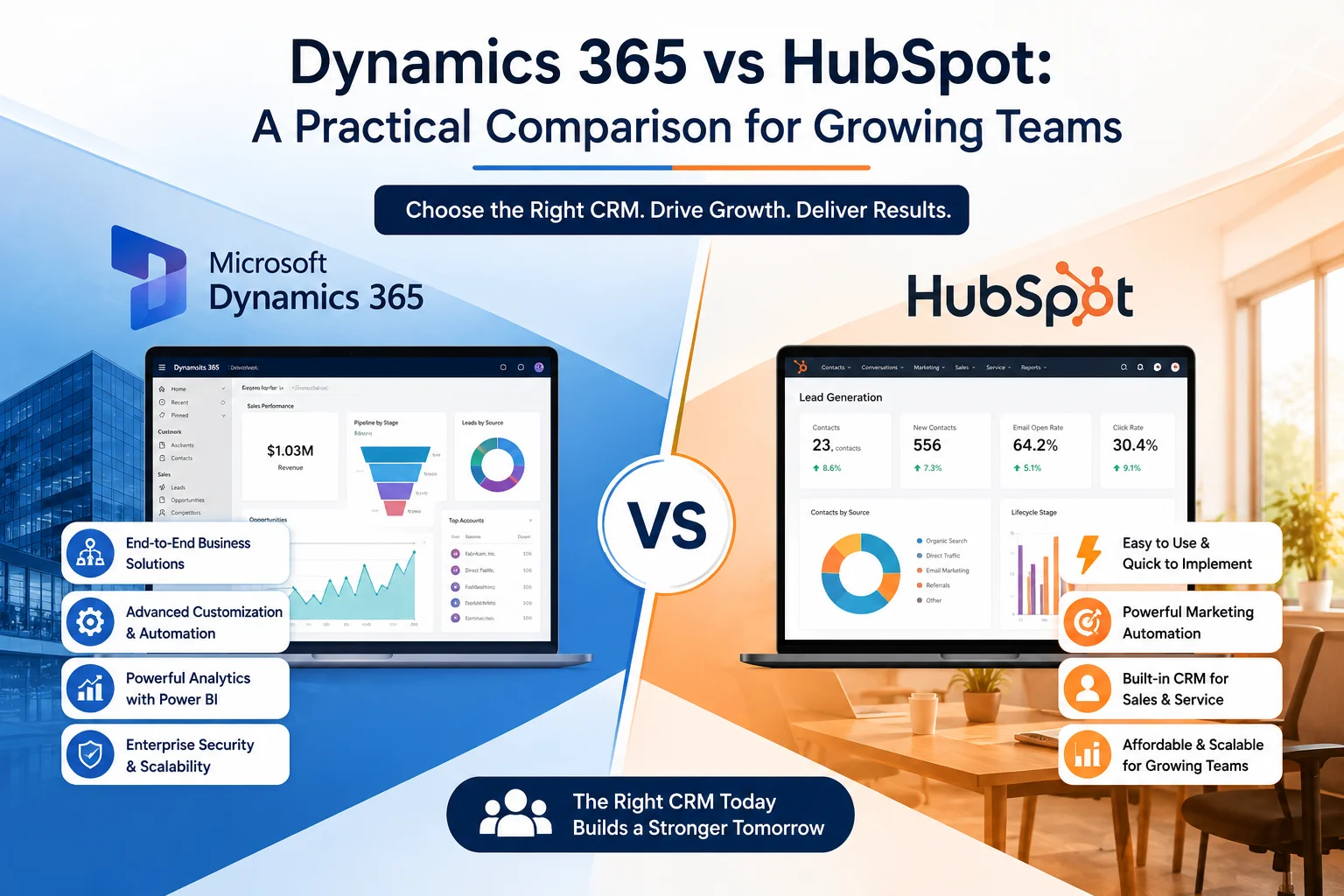
As businesses grow, choosing the right Customer Relationship Management (CRM) platform becomes increasingly important. While both Microsoft Dynamics 365 and HubSpot are popular CRM solutions, they serve different business needs, budgets, and growth strategies.
Therefore, if your team is evaluating CRM platforms, understanding the practical differences between Dynamics 365 and HubSpot can help you make an informed decision.
This guide provides a real-world comparison based on functionality, scalability, customization, automation capabilities, and long-term business value.
Why Choosing the Right CRM Matters
A CRM is no longer just a sales tool. Today, it acts as the operational hub connecting sales, marketing, customer service, reporting, and automation.
The right CRM should help your organization:
- Improve customer engagement
- Automate repetitive processes
- Increase sales productivity
- Deliver actionable insights
- Scale alongside business growth
- Integrate with existing systems
However, not all CRM platforms are built for the same type of business.
Dynamics 365 vs HubSpot at a Glance
| Feature | Microsoft Dynamics 365 | HubSpot CRM |
|---|---|---|
| Best For | Mid-sized to enterprise businesses | Small to mid-sized businesses |
| Customization | Extensive | Moderate |
| Scalability | Very High | Moderate to High |
| Automation | Advanced | Good |
| Reporting & Analytics | Enterprise-grade | User-friendly |
| AI Capabilities | Microsoft Copilot | HubSpot AI Tools |
| Integration Ecosystem | Deep Microsoft ecosystem | Strong marketing ecosystem |
| Pricing Structure | Flexible but complex | Simpler entry pricing |
| Industry-Specific Solutions | Extensive | Limited |
| ERP Integration | Native with Business Central, Finance, SCM | Limited |
Understanding Microsoft Dynamics 365
Microsoft Dynamics 365 is a comprehensive business platform combining CRM, ERP, AI, analytics, and automation capabilities.
It is particularly suitable for organizations that require:
- Complex business processes
- Multiple departments working together
- Advanced reporting
- Enterprise-grade security
- Deep customization
- Global scalability
Because it integrates seamlessly with Microsoft technologies, many growing organizations prefer Dynamics 365 for long-term digital transformation initiatives.
Core Dynamics 365 Applications
Sales
Manage opportunities, pipelines, forecasts, and customer interactions.
Customer Service
Provide omnichannel customer support and case management.
Marketing
Automate campaigns, customer journeys, and lead nurturing.
Field Service
Manage technicians, work orders, and service scheduling.
Customer Insights
Create unified customer profiles and predictive analytics.
Understanding HubSpot CRM
HubSpot started primarily as a marketing automation platform and later expanded into CRM, service, and sales solutions.
Consequently, HubSpot is widely adopted by startups and growing businesses looking for a quick-to-deploy solution.
HubSpot excels in:
- Marketing automation
- Lead generation
- Content marketing
- Email campaigns
- Ease of use
- Faster implementation
For organizations with relatively straightforward processes, HubSpot can deliver rapid value.
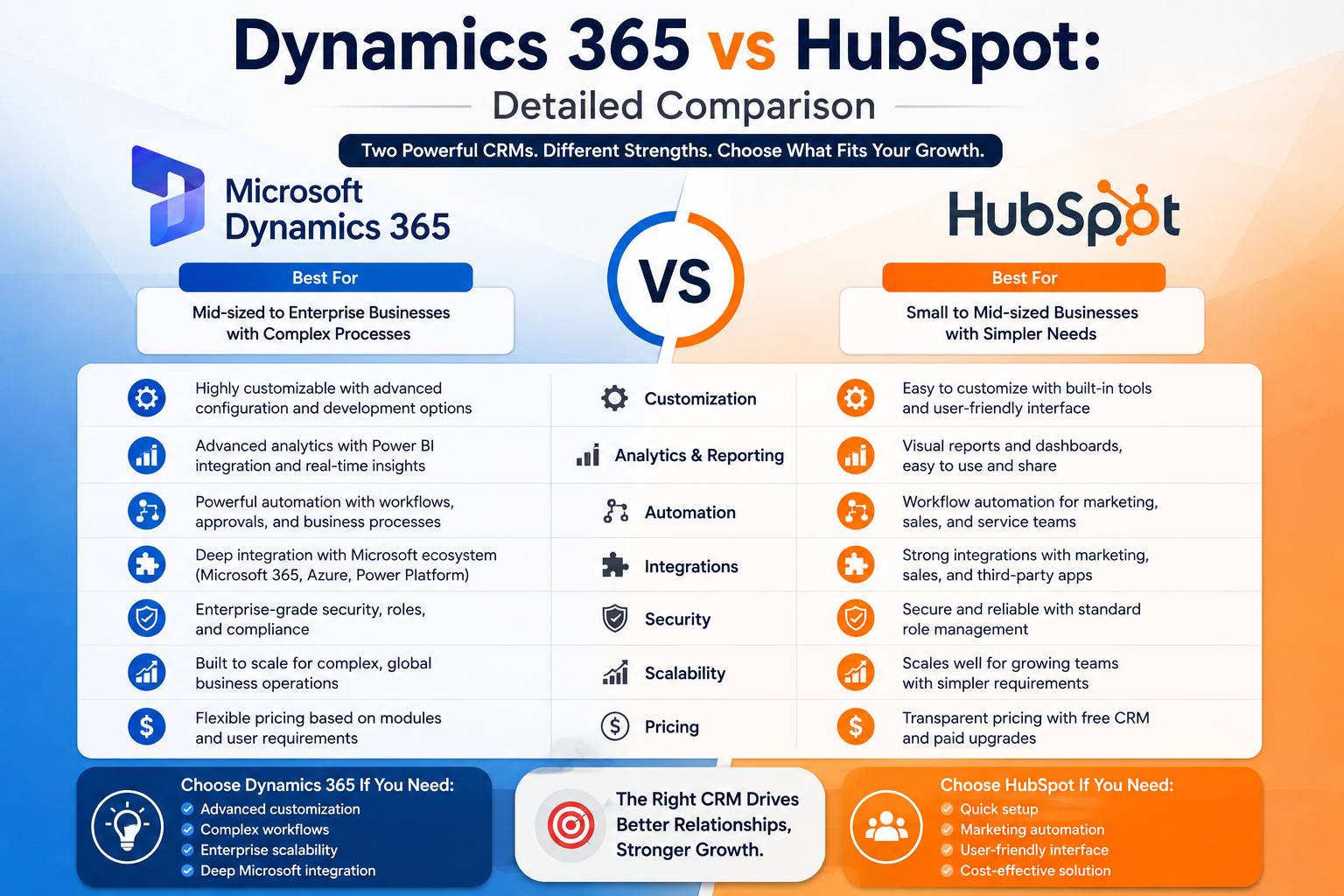
Dynamics 365 vs HubSpot: Detailed Comparison
1. Ease of Implementation
HubSpot
HubSpot is known for its intuitive interface and fast deployment.
Advantages include:
- Quick onboarding
- Minimal technical expertise required
- User-friendly dashboards
- Short learning curve
Dynamics 365
Dynamics 365 implementation generally requires planning and configuration.
However, businesses benefit from:
- Tailored workflows
- Department-specific processes
- Advanced governance
- Greater flexibility
Winner
For rapid deployment: HubSpot
For tailored business processes: Dynamics 365
2. Customization and Flexibility
Growing organizations often outgrow standard CRM capabilities.
Dynamics 365
Dynamics 365 offers:
- Custom entities and tables
- Role-based security
- Custom business processes
- Advanced workflow automation
- Low-code development using Microsoft Power Platform
- Custom applications through Power Apps
HubSpot
HubSpot provides customization options, yet these are comparatively limited.
Users can customize:
- Pipelines
- Properties
- Reports
- Dashboards
Nevertheless, highly complex business processes may require external solutions.
Winner
🏆 Microsoft Dynamics 365
3. Sales Automation Capabilities
Sales automation directly impacts team productivity.
Dynamics 365 Capabilities
- Opportunity scoring
- Automated approvals
- AI-driven recommendations
- Forecasting
- Territory management
- Relationship intelligence
HubSpot Capabilities
- Email automation
- Meeting scheduling
- Task reminders
- Sequences
- Sales playbooks
Although both platforms support automation, Dynamics 365 provides deeper enterprise automation.
Winner
🏆 Microsoft Dynamics 365
4. Marketing Automation
Marketing teams often prioritize campaign management and lead nurturing.
HubSpot Strengths
- Inbound marketing tools
- Landing pages
- Email marketing
- Blogging platform
- SEO recommendations
- Social media management
Dynamics 365 Strengths
- Customer journey orchestration
- Advanced segmentation
- Event management
- Personalized engagement
- Multi-channel campaigns
For content-driven organizations, HubSpot may offer faster marketing execution.
Winner
🏆 HubSpot
5. Reporting and Business Intelligence
Data-driven decision-making requires robust reporting.
Dynamics 365
Dynamics integrates natively with Microsoft Power BI, enabling:
- Executive dashboards
- Real-time reporting
- Cross-department analytics
- Predictive insights
- Enterprise KPIs
HubSpot
HubSpot provides visually appealing reports and dashboards.
However, advanced analytics often require additional tools.
Winner
🏆 Microsoft Dynamics 365
6. Integration Ecosystem
Dynamics 365 Integrations
Native integration with:
- Microsoft 365
- Teams
- Outlook
- SharePoint
- Power Platform
- Azure
- Business Central
- Finance & Operations
HubSpot Integrations
HubSpot integrates with:
- Gmail
- Slack
- Zoom
- Shopify
- Salesforce
- Numerous third-party applications
Both ecosystems are strong. Yet organizations heavily invested in Microsoft typically achieve greater operational efficiency with Dynamics 365.
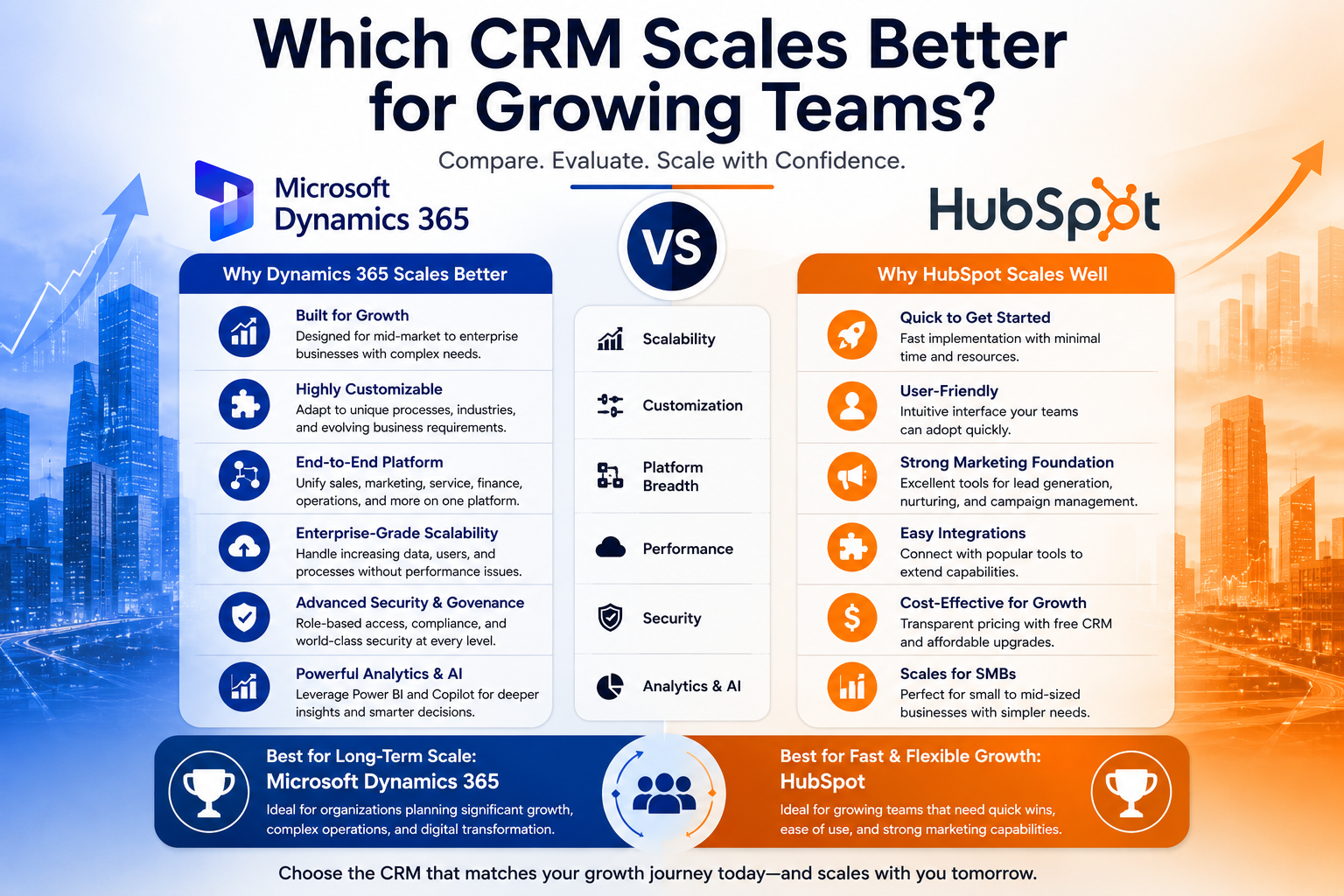
Which CRM Scales Better for Growing Teams?
Choose HubSpot If:
- You are a startup or small business.
- You need quick implementation.
- Marketing is your primary focus.
- Your business processes are relatively simple.
- You have limited technical resources.
Choose Microsoft Dynamics 365 If:
- You expect significant growth.
- Multiple departments need a shared platform.
- You require advanced automation.
- You need deep customization.
- You operate across multiple locations.
- You want a connected business ecosystem.
Real-World Scenario
Imagine a company with:
- Sales team
- Marketing department
- Customer support division
- Finance operations
- Field service technicians
Initially, HubSpot may meet immediate needs.
However, as complexity increases, organizations often require:
- ERP integration
- Advanced automation
- Custom applications
- Enterprise reporting
- Governance and security
This is where Microsoft Dynamics 365 becomes a strategic long-term investment.
How Sky Soft Connections Helps Businesses Succeed with Dynamics 365
Selecting the right CRM is only the first step. Successful implementation requires experienced consultants who understand both technology and business processes.
At Sky Soft Connections, we help organizations design, implement, customize, and optimize Microsoft business solutions.
Our services include:
- Microsoft Dynamics 365 implementation
- Dynamics 365 customization and development
- CRM migration from HubSpot and legacy systems
- Microsoft Power Platform consulting
- Power Apps development
- Power Automate workflow automation
- Power BI dashboards and reporting
- Microsoft Copilot integration
- System integration and data migration
Whether you are migrating from HubSpot or implementing a new CRM strategy, our experts help ensure a smooth digital transformation journey.
Read more : Choosing a Dynamics 365 Implementation Partner in the UAE: A Buyer’s Checklist
Frequently Asked Questions (FAQs)
It depends on business requirements. Dynamics 365 is generally better for organizations requiring advanced customization, automation, and scalability, while HubSpot is ideal for businesses seeking simplicity and fast deployment.
Yes. Organizations frequently migrate from HubSpot to Dynamics 365 as their operational complexity grows.
HubSpot often has lower entry costs. However, total ownership costs should be evaluated based on future growth requirements.
Yes. Dynamics 365 Customer Insights includes powerful marketing automation, customer journeys, segmentation, and campaign management capabilities.
Final Thoughts
Both Microsoft Dynamics 365 and HubSpot are excellent CRM platforms. Nevertheless, the right choice depends on your growth plans, operational complexity, and long-term business objectives.
If your organization requires simplicity and rapid adoption, HubSpot is a strong contender.
Conversely, if you are building a scalable, integrated, and future-ready business ecosystem, Microsoft Dynamics 365 offers significantly greater flexibility and long-term value.