
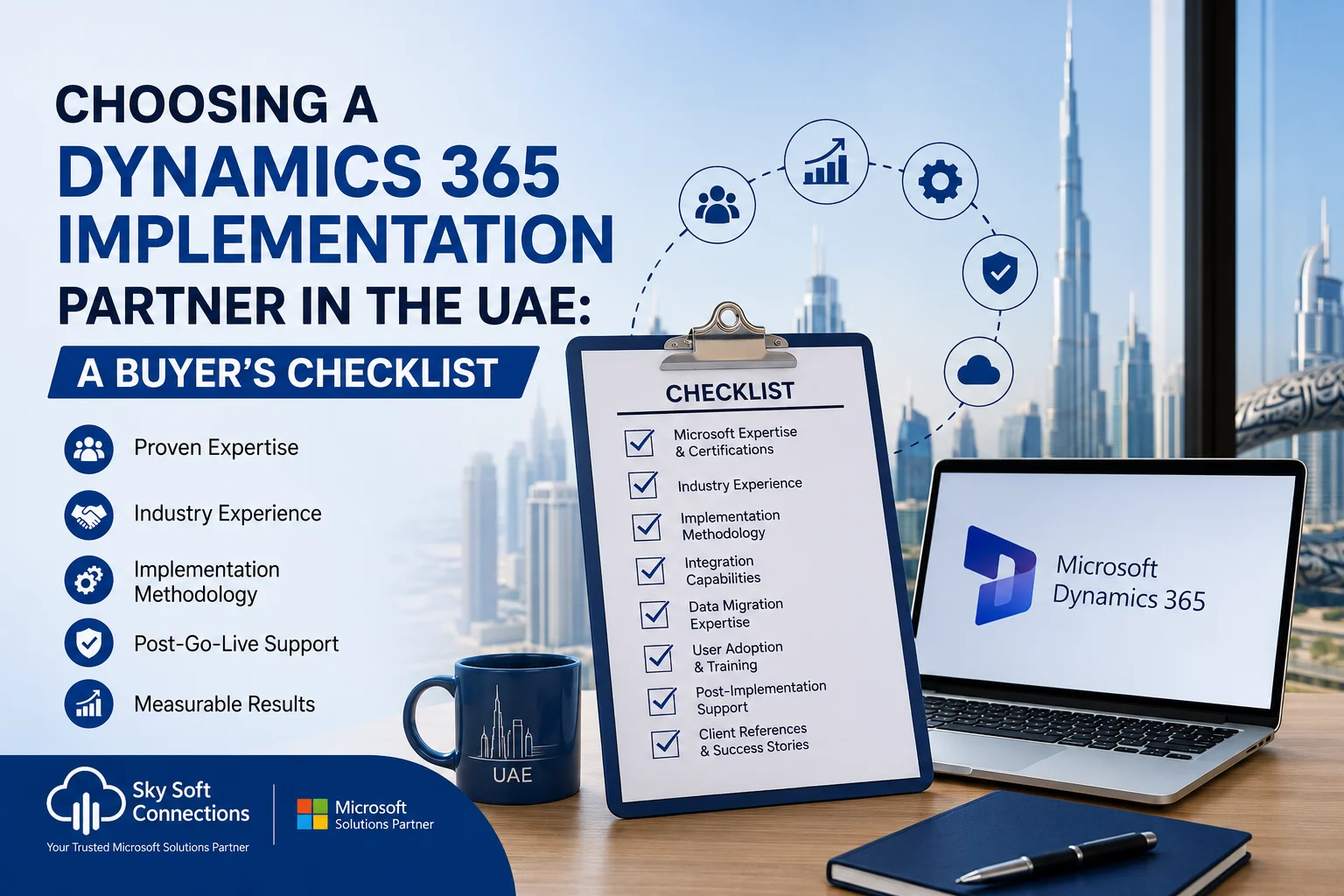
Modern organisations across the UAE are investing heavily in digital transformation initiatives. However, purchasing Microsoft Dynamics 365 is only the first step. The real business value depends largely on selecting the right implementation partner.
A poor implementation can lead to budget overruns, low user adoption, delayed go-lives, and disappointing ROI. Conversely, an experienced Dynamics 365 implementation partner can streamline deployment, optimise business processes, and ensure long-term success.
This buyer’s checklist will help UAE businesses evaluate and choose the right Microsoft Dynamics 365 partner with confidence.
Why Selecting the Right Dynamics 365 Partner Matters
Many organisations assume that all implementation providers offer similar services. In reality, the capabilities, methodologies, industry experience, and support models can vary significantly.
The right partner does more than deploy software. They:
- Understand your business goals.
- Align technology with operational requirements.
- Recommend best practices.
- Reduce implementation risks.
- Drive user adoption.
- Provide long-term support and optimisation.
As a result, organisations achieve faster returns on their Microsoft investment.
Common Challenges UAE Businesses Face During CRM Implementations
Before selecting a partner, it is important to understand common implementation pitfalls.
| Challenge | Business Impact |
|---|---|
| Poor requirement gathering | Misaligned CRM functionality |
| Limited user adoption | Reduced ROI |
| Lack of industry expertise | Inefficient processes |
| Budget overruns | Increased project costs |
| Inadequate training | Low employee productivity |
| Weak post-go-live support | Operational disruptions |
| Integration failures | Data silos and manual work |
Therefore, evaluating implementation capabilities thoroughly is essential.
Dynamics 365 Implementation Partner Buyer’s Checklist
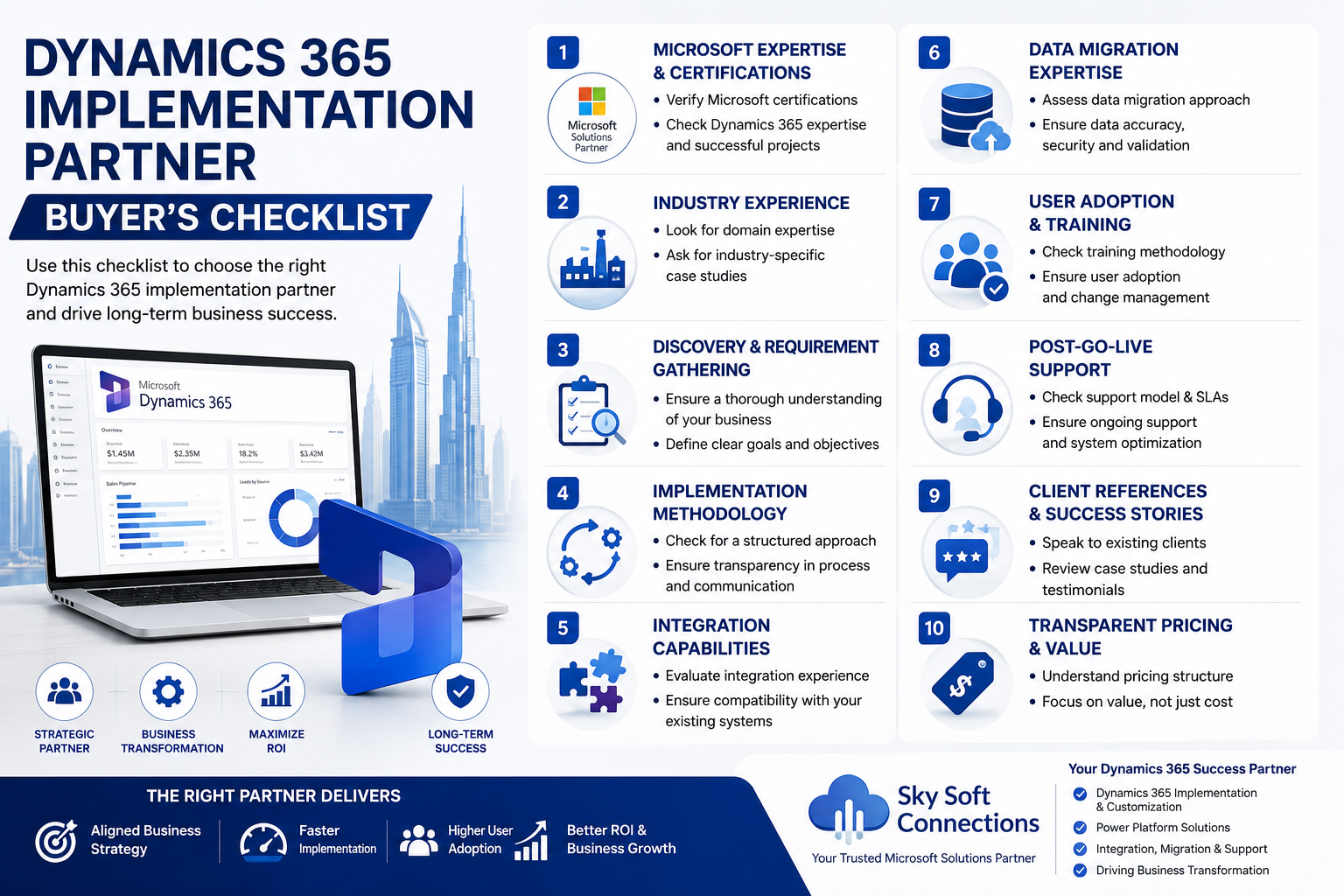
1. Verify Microsoft Expertise and Certifications
First and foremost, ensure the implementation partner possesses proven Microsoft expertise.
Ask:
- Are they specialised in Microsoft technologies?
- Do they have certified Dynamics 365 consultants?
- Are they experienced with the Microsoft ecosystem?
- Can they demonstrate successful implementations?
A qualified partner should possess deep expertise in:
- Microsoft Dynamics 365 CRM
- Microsoft Power Platform
- Microsoft Azure
- Microsoft Dataverse
- Microsoft Copilot
- Power Automate
- Power BI
- Power Apps
Moreover, they should stay updated with Microsoft’s evolving roadmap.
Questions to Ask
- How many Dynamics 365 projects have you completed?
- Which Dynamics 365 applications do you specialise in?
- What certifications does your team hold?
2. Assess Industry Experience
Industry expertise significantly influences project success.
For example, implementation requirements differ greatly between:
- Manufacturing
- Construction
- Real Estate
- Professional Services
- Healthcare
- Retail
- Financial Services
- Oil & Gas
A partner familiar with your industry understands:
- Regulatory requirements
- Standard workflows
- Business challenges
- Industry KPIs
- Compliance needs
Consequently, implementation timelines become shorter and risks decrease.
Red Flags
❌ Generic implementation approach.
❌ No industry-specific case studies.
❌ Inability to discuss sector challenges.
3. Evaluate Their Discovery and Requirement Gathering Process
Successful implementations begin with detailed discovery sessions.
An experienced partner should invest substantial time understanding:
Business Processes
- Lead management
- Sales workflows
- Customer service processes
- Reporting requirements
- Approval workflows
Existing Systems
- ERP platforms
- Legacy CRM systems
- Third-party applications
- Data sources
Strategic Objectives
- Revenue growth goals
- Productivity targets
- Customer experience improvements
Without a thorough discovery phase, implementation risks increase dramatically.
4. Review Their Implementation Methodology
Every Dynamics 365 implementation should follow a structured framework.
A mature methodology typically includes:
Phase 1: Discovery & Business Analysis
- Workshops
- Stakeholder interviews
- Process mapping
- Gap analysis
Phase 2: Solution Design
- Functional design documents
- Architecture planning
- Security model definition
Phase 3: Configuration & Customisation
- CRM configuration
- Workflow automation
- Custom development
Phase 4: Integration & Migration
- Data migration
- System integrations
- Testing
Phase 5: User Acceptance Testing
- End-user validation
- Process verification
Phase 6: Go-Live & Support
- Deployment
- Hypercare
- Ongoing optimisation
Therefore, always request implementation methodology documentation.
5. Confirm Integration Capabilities
Today’s businesses rarely operate with a standalone CRM.
Instead, Dynamics 365 must integrate with multiple business applications.
Typical integrations include:
- ERP systems
- Microsoft 365
- Outlook
- SharePoint
- Finance systems
- HR platforms
- Marketing platforms
- E-commerce systems
- Third-party applications
Ask potential partners about previous integration experience.
Important Integration Technologies
| Technology | Purpose |
|---|---|
| Power Automate | Workflow automation |
| Azure Integration Services | Enterprise integrations |
| APIs | System connectivity |
| Dataverse | Unified data platform |
| Power Apps | Custom applications |
| Azure Functions | Advanced business logic |
6. Assess Data Migration Expertise
Data migration remains one of the most critical project components.
Unfortunately, poor migration planning often causes project delays.
An experienced implementation partner should provide:
- Data assessment
- Cleansing strategy
- Migration mapping
- Test migrations
- Validation procedures
- Rollback plans
Ask These Questions
- How do you handle duplicate records?
- What migration tools do you use?
- How many test migrations are included?
- How do you validate migrated data?
7. Evaluate User Adoption and Training Strategy
Technology alone does not guarantee success.
People drive digital transformation.
Consequently, user training and change management should form a core part of the implementation.
A strong partner should provide:
- Role-based training
- User manuals
- Video tutorials
- Administrator training
- Change management workshops
- Go-live support
Signs of a Strong Adoption Strategy
End-user involvement.
Super-user programmes.
Continuous training plans.
Feedback sessions.
8. Examine Post-Go-Live Support Services
Implementation is not the finish line.
In fact, continuous improvement delivers the greatest long-term value.
Ensure your partner offers:
- SLA-based support
- Issue resolution
- System health checks
- Enhancement services
- Performance optimisation
- Security updates
- Managed services
Furthermore, verify local support availability within the UAE time zone.
9. Review Client References and Success Stories
Nothing validates expertise better than successful client engagements.
Request:
- Customer references
- Case studies
- Testimonials
- Similar project examples
During reference calls, ask:
- Was the project delivered on time?
- Was it delivered within budget?
- How responsive was the support team?
- Would you work with them again?
10. Understand Total Project Cost
The lowest proposal is not always the best choice.
Instead, evaluate total value.
Consider:
Direct Costs
- Licensing
- Implementation
- Customisation
- Integrations
- Data migration
Ongoing Costs
- Support
- Enhancements
- Training
- Infrastructure
- Managed services
A transparent partner will clearly define all project costs upfront.
Essential Questions to Ask Every Dynamics 365 Partner
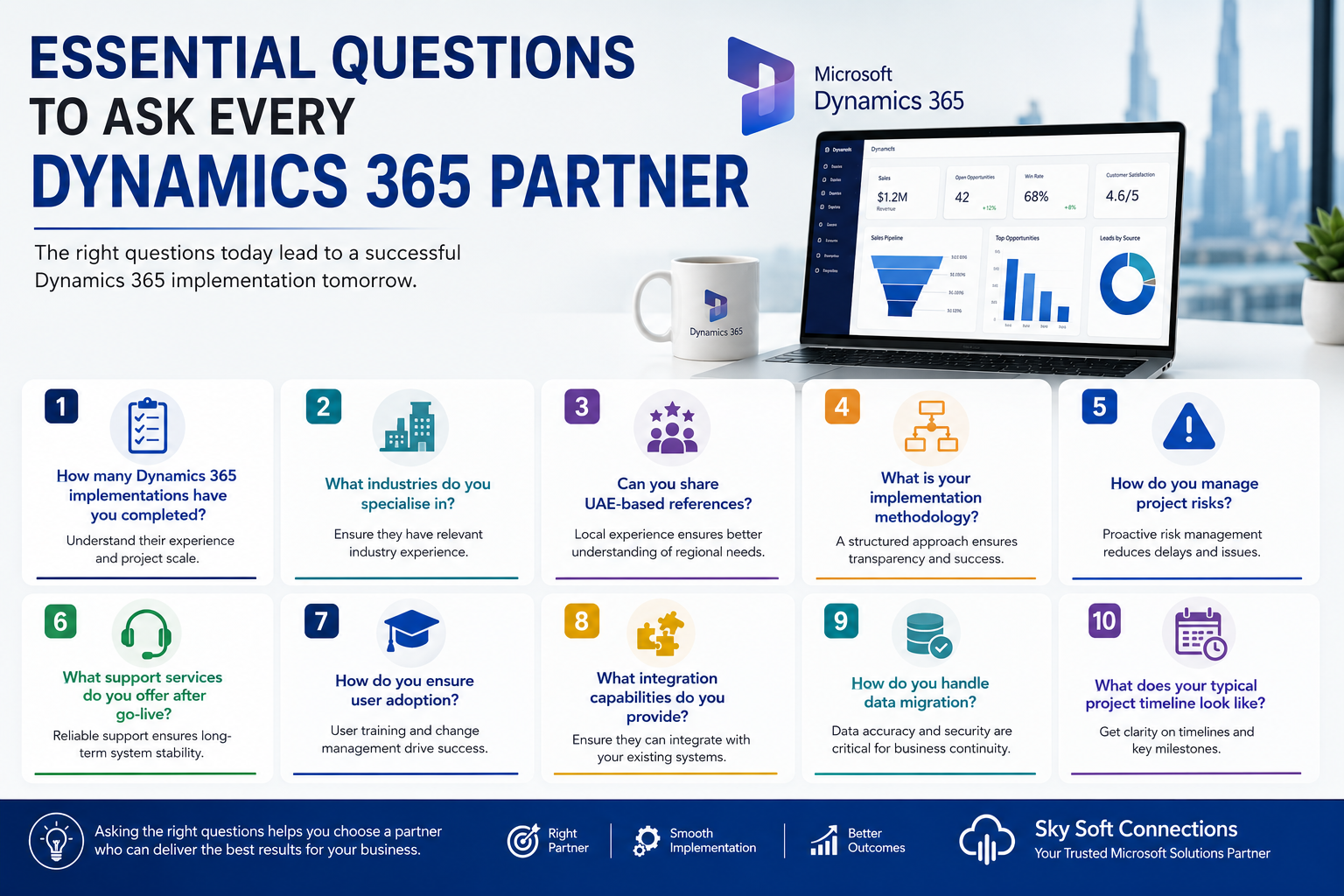
- How many Dynamics 365 implementations have you completed?
- What industries do you specialise in?
- Can you share UAE-based references?
- What is your implementation methodology?
- How do you manage project risks?
- What support services do you offer after go-live?
- How do you ensure user adoption?
- What integration capabilities do you provide?
- How do you handle data migration?
- What does your typical project timeline look like?
Why UAE Businesses Choose Sky Soft Connections
At Sky Soft Connections, we help organisations across the UAE successfully implement, customise, integrate, and optimise Microsoft technologies.
Our services include:
Microsoft Dynamics 365 Services
- Microsoft Dynamics 365 CRM implementation
- Dynamics 365 customisation
- CRM consulting and strategy
- Sales and customer service automation
- CRM integration services
- Dynamics 365 upgrades and migrations
[fusion_button enable_hover_text_icon=”no” target=”_self” aria_role_button=”0″ color=”default” stretch=”default” icon_position=”left” icon_divider=”no” hover_transition=”none” animation_direction=”left” animation_speed=”0.3″ animation_delay=”0″ hide_on_mobile=”small-visibility,medium-visibility,large-visibility” sticky_display=”normal,sticky” padding_top=”10″ padding_right=”10″ padding_bottom=”10″ padding_left=”10″ margin_left=”20″ margin_top=”20″ modal=”dynamics-checklist”]Get Your Free Dynamics 365 CRM Health Check Checklist[/fusion_button]
[fusion_modal title=”Get Your Free Dynamics 365 CRM Health Check Checklist” size=”large” show_footer=”yes” name=”dynamics-checklist”]
[fusion_form form_post_id=”7835″ hide_on_mobile=”small-visibility,medium-visibility,large-visibility”][/fusion_form]
[/fusion_modal]
Microsoft Power Platform Services
- Power Apps development
- Power Automate implementation
- Power BI dashboards and analytics
- Microsoft Copilot Studio solutions
- Low-code application development
[fusion_button enable_hover_text_icon=”no” target=”_self” aria_role_button=”0″ color=”default” stretch=”default” icon_position=”right” icon_divider=”no” hover_transition=”none” animation_direction=”left” animation_speed=”0.3″ animation_delay=”0″ hide_on_mobile=”small-visibility,medium-visibility,large-visibility” sticky_display=”normal,sticky” modal=”power-automate-checklist” icon=”fa-arrow-alt-circle-down fas”]Download Power Automate Process Assessment Checklist[/fusion_button]
[fusion_modal title=”Dynamics 365 CRM: Power Automate Process Assessment Checklist” size=”large” show_footer=”yes” name=”power-automate-checklist”]
[fusion_form form_post_id=”7886″ hide_on_mobile=”small-visibility,medium-visibility,large-visibility”][/fusion_form]
[/fusion_modal]
Azure and Integration Services
- Azure cloud solutions
- Enterprise system integration
- Data migration services
- API development
- Custom portal development
Our implementation approach focuses on:
✓ Business process alignment
✓ User adoption
✓ Scalable architecture
✓ Long-term business value
✓ Continuous optimisation
As a result, our clients achieve faster deployments, improved productivity, and measurable ROI.
Final Thoughts
Choosing a Dynamics 365 implementation partner in the UAE is a strategic business decision.
While software capabilities matter, implementation expertise ultimately determines success.
Therefore, evaluate potential partners carefully. Review their methodology, industry knowledge, technical capabilities, support model, and customer success record.
Most importantly, choose a partner that understands your business objectives—not just the technology.
The right Dynamics 365 partner will not simply deploy software. They will become a long-term digital transformation advisor for your organisation.
Read more : What Happens When CRM, Reporting, Automation, and Cloud Infrastructure Work Together
Frequently Asked Questions (FAQs)
Implementation timelines vary depending on complexity. Small projects may take 6–8 weeks, whereas enterprise deployments can require several months.
Businesses should evaluate Microsoft expertise, industry experience, implementation methodology, integration capabilities, support services, and client references.
Low adoption reduces ROI. Effective training and change management ensure employees use the system efficiently.
Yes. Dynamics 365 integrates with ERP systems, Microsoft 365, third-party applications, finance platforms, and custom applications using APIs and Microsoft integration technologies.
Yes. Sky Soft Connections provides Microsoft Dynamics 365 implementation, customisation, integration, Power Platform, Azure, and business automation services for organisations across the UAE.