
Customer relationship management (CRM) has evolved significantly over the past few years. Traditionally, businesses used CRM systems to store customer information, track sales activities, manage leads and maintain communication records. However, modern businesses need much more than a digital customer database. They need intelligent systems that can analyse customer behaviour, identify opportunities, automate repetitive tasks and support better business decisions.
This is where AI-powered CRM is changing the way organisations manage customer relationships.
By combining artificial intelligence (AI), machine learning, predictive analytics and workflow automation, businesses can transform their CRM platforms into intelligent decision-making systems. Instead of simply recording what happened, an AI-powered CRM can help businesses understand what is happening, predict what might happen next and recommend what actions to take.
For organisations already using Microsoft Dynamics 365 CRM, Power Platform and other Microsoft business applications, AI creates opportunities to improve sales performance, customer service and operational efficiency.
In this guide, we explore how AI-powered CRM works, its practical business applications, key benefits, implementation challenges and how businesses can use intelligent CRM solutions to make smarter decisions.
Table of contents
- What Is AI-Powered CRM?
- Traditional CRM vs AI-Powered CRM: What Has Changed?
- How AI-Powered CRM Turns Customer Data into Smarter Business Decisions
- Key AI Technologies Powering Modern CRM Systems
- Practical Business Applications of AI-Powered CRM
- Microsoft Dynamics 365: Bringing AI into CRM Operations
- How SkySoft Connections Helps Businesses Build Smarter CRM Solutions
- Challenges Businesses Should Consider Before Implementing AI in CRM
- How to Implement AI-Powered CRM: A Practical Roadmap
- How to Measure the Success of AI-Powered CRM
- The Future of AI-Powered CRM: What Businesses Can Expect
- Conclusion: Turning CRM Data into Business Intelligence
- FAQ’s
What Is AI-Powered CRM?
AI-powered CRM is a customer relationship management system that uses artificial intelligence to analyse customer data, automate business processes, predict customer behaviour and provide actionable insights.
Unlike traditional CRM software, which mainly stores and organises information, AI-powered CRM actively helps employees understand customer needs and make informed decisions.
For example, a traditional CRM system might show that a sales representative has contacted a customer three times without receiving a response. An AI-powered CRM can analyse previous interactions, identify engagement patterns and recommend the next appropriate action.
It can also help businesses:
- Predict which leads are more likely to convert.
- Identify customers who may stop using their services.
- Recommend relevant products or services.
- Automatically summarise customer conversations.
- Prioritise sales opportunities based on potential value.
- Identify patterns in customer complaints.
- Automate repetitive administrative tasks.
Therefore, AI-powered CRM is not simply about adding AI features to existing software. It is about turning customer information into practical business intelligence.
Traditional CRM vs AI-Powered CRM: What Has Changed?
Traditional CRM platforms remain valuable for managing customer relationships. However, they often depend on employees to review information, identify patterns and decide what action to take.
AI-powered CRM introduces an additional layer of intelligence that supports these activities.
| Business area | Traditional CRM | AI-powered CRM |
|---|---|---|
| Customer data | Stores customer information | Analyses customer information |
| Lead management | Tracks leads and activities | Predicts lead conversion potential |
| Sales forecasting | Uses manually updated pipelines | Supports predictive forecasting |
| Customer service | Records support requests | Analyses requests and suggests responses |
| Customer communication | Stores interaction history | Summarises conversations and identifies intent |
| Decision-making | Relies heavily on manual analysis | Provides data-driven recommendations |
| Workflow management | Uses predefined automation | Combines automation with AI-driven insights |
| Customer retention | Tracks existing customers | Identifies potential churn risks |
The biggest difference is the shift from reactive customer management to proactive customer engagement.
For example, instead of waiting until a customer complains about a service, an intelligent CRM can identify declining engagement and help the account management team take action earlier.
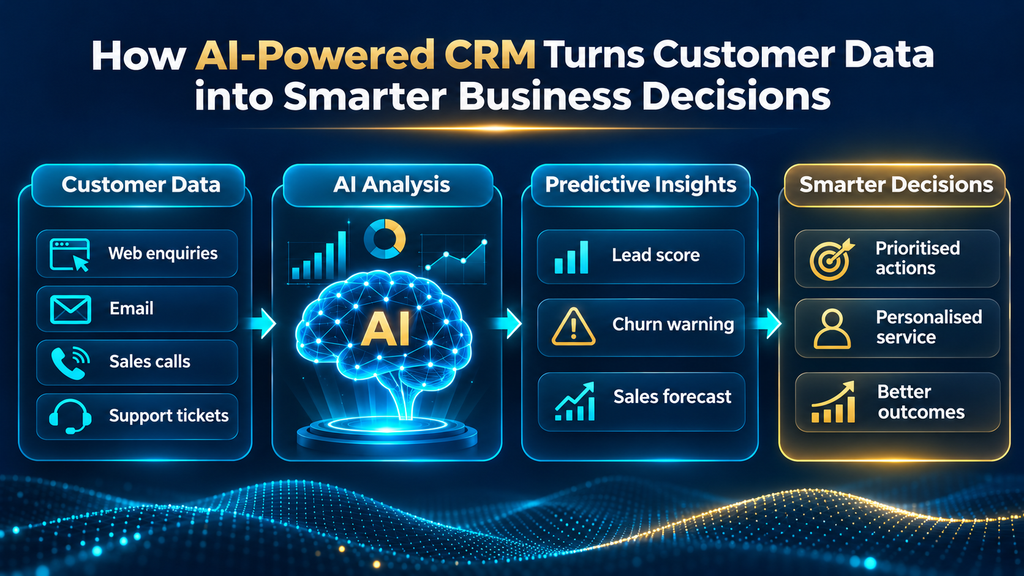
How AI-Powered CRM Turns Customer Data into Smarter Business Decisions
Customer data is one of the most valuable business assets. However, collecting information alone does not automatically improve business performance.
The real value comes from analysing that information and using it to guide business decisions.
AI-powered CRM helps businesses achieve this through several connected capabilities.
1. Intelligent Customer Data Analysis
Businesses collect customer information from multiple sources, including:
- Website enquiries and contact forms.
- Email conversations.
- Sales calls and meeting records.
- Customer support tickets.
- Previous purchases and transactions.
- Marketing campaigns.
- Social media interactions.
However, this information is often spread across different systems. Consequently, employees may struggle to understand the complete customer journey.
AI-powered CRM can analyse available customer information and identify useful patterns.
For example, a business may discover that customers who request a product demonstration and engage with follow-up emails are more likely to purchase within 30 days.
Sales managers can use this insight to prioritise similar prospects and improve follow-up strategies.
2. Predictive Analytics for Better Sales Decisions
Predictive analytics is one of the most valuable applications of AI in CRM.
Rather than relying entirely on historical reports, predictive models analyse existing data to estimate future outcomes.
For example, AI can help predict:
- Which sales leads have the highest conversion probability.
- Which opportunities may close within a particular period.
- Which customers are likely to purchase additional services.
- Which accounts may require additional attention.
- Which sales activities are associated with successful outcomes.
Consider a company with 500 active sales leads.
Without intelligent prioritisation, sales representatives may spend similar amounts of time on every lead. However, an AI-powered CRM can help identify the prospects showing stronger buying signals.
As a result, sales teams can focus their time on opportunities with greater potential.
Practical example: If a prospect repeatedly visits pricing pages, attends a product demonstration and responds positively to follow-up emails, an AI model may assign that lead a higher engagement or conversion score.
However, predictions should be treated as decision support rather than guaranteed outcomes. Their accuracy depends on data quality, model design and regular evaluation.
3. Personalised Customer Experiences
Customers increasingly expect businesses to understand their requirements and provide relevant communication.
AI-powered CRM makes this easier by analysing customer preferences, previous interactions, purchasing behaviour and service history.
For example, an organisation offering multiple software solutions can use CRM insights to identify which services may be relevant to a particular customer.
Instead of sending the same marketing message to every contact, the business can create more relevant communication based on customer interests.
AI can support:
- Personalised email recommendations.
- Customer-specific product suggestions.
- Relevant sales follow-up messages.
- Customer segmentation.
- Targeted marketing campaigns.
- Context-aware customer support.
Consequently, businesses can improve customer engagement while reducing irrelevant communication.
4. Automated Customer Interaction Summaries
Sales and customer service employees spend considerable time reviewing conversations, updating CRM records and preparing meeting notes.
AI can reduce this administrative workload.
Modern AI-enabled CRM solutions can analyse supported communication channels and generate summaries that capture important information.
For example, after a customer meeting, an AI assistant might identify:
| Information | AI-generated summary |
|---|---|
| Customer requirement | Needs a cloud-based inventory solution |
| Main concern | Integration with existing ERP |
| Budget | Requires internal approval |
| Decision timeline | Expected within 30 days |
| Next action | Arrange a technical demonstration |
Instead of manually writing every detail, employees can review the generated summary, correct any inaccuracies and save the relevant information.
This helps maintain more consistent CRM records and allows employees to spend more time interacting with customers.
5. Better Customer Retention Through Churn Prediction
Acquiring new customers can be expensive. Therefore, retaining existing customers is an important business priority.
AI-powered CRM can analyse customer engagement, support history, purchasing patterns and other relevant indicators to identify potential churn risks.
For example, warning signs may include:
- A decline in product usage.
- Repeated unresolved support requests.
- Reduced communication with account managers.
- Missed renewals.
- Decreased purchasing frequency.
- Negative customer feedback.
When these patterns appear together, AI can flag an account for further review.
Customer success teams can then investigate the underlying issue and take appropriate action.
Importantly, a churn prediction does not automatically mean a customer will leave. It simply provides an early indication that the account may need attention.
Key AI Technologies Powering Modern CRM Systems
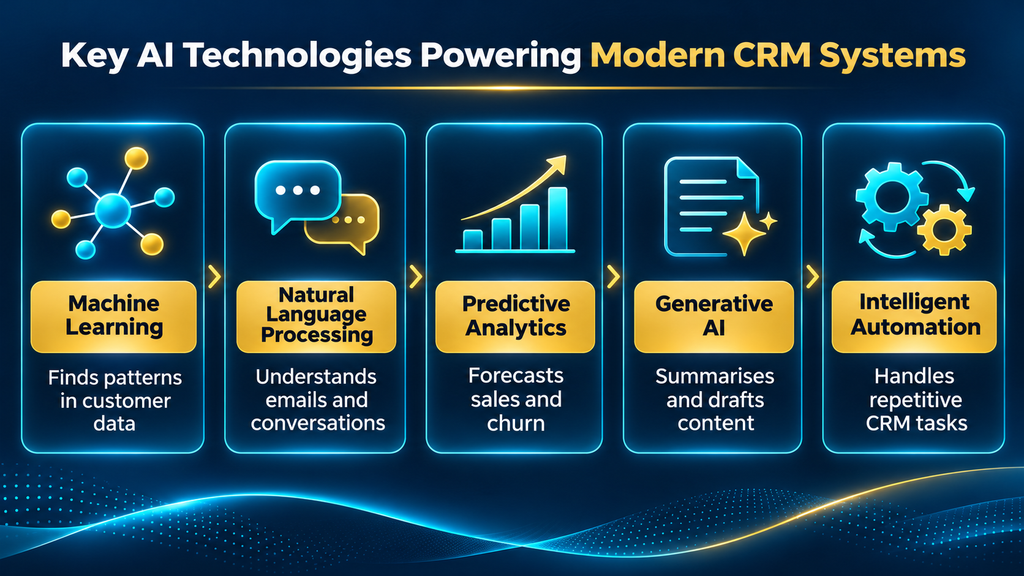
AI-powered CRM is not based on a single technology. Instead, it combines several intelligent technologies to improve customer data management and business operations.
Here are the most important technologies businesses should understand.
1. Machine Learning
Machine learning enables CRM systems to identify patterns in historical customer data and improve predictions over time.
For example, machine learning models can analyse previous sales opportunities to identify characteristics commonly associated with successful deals.
Businesses can use these insights to improve lead scoring, sales forecasting and customer segmentation.
2. Natural Language Processing (NLP)
Natural Language Processing allows AI systems to understand and analyse human language.
Within CRM environments, NLP can be used to:
- Analyse customer emails and messages.
- Identify customer intent.
- Detect sentiment in feedback.
- Categorise incoming enquiries.
- Extract important information from conversations.
For example, when a customer emails a support team about a delayed order, NLP can identify the main issue and help categorise the request before an employee reviews it.
3. Generative AI
Generative AI is becoming an important part of modern CRM platforms.
It can generate useful content based on available customer and business information.
Common applications include:
- Drafting customer emails.
- Preparing meeting summaries.
- Generating sales proposals.
- Creating customer service responses.
- Summarising account histories.
- Preparing reports and business insights.
However, generated content should be reviewed before it is shared with customers, especially when it includes pricing, contractual commitments or sensitive business information.
4. Predictive Analytics
Predictive analytics uses historical and current data to estimate future outcomes.
For example, a CRM platform may analyse previous sales performance, customer engagement and opportunity stages to identify potential revenue trends.
This helps management move beyond basic reporting and make more informed decisions about sales resources, customer engagement and business priorities.
5. Intelligent Workflow Automation
AI becomes even more valuable when connected with business process automation.
For example, when a new customer enquiry arrives, an integrated CRM workflow could:
- Capture the enquiry.
- Extract relevant customer information.
- Categorise the enquiry using AI.
- Assign it to the appropriate sales representative.
- Create a follow-up activity.
- Notify the responsible team.
- Track the enquiry until it is resolved.
This reduces manual work while improving process consistency.
Practical Business Applications of AI-Powered CRM
AI-powered CRM is useful across different departments, not just sales teams. Its value becomes clearer when businesses apply it to everyday operational challenges.
Here are some practical use cases.
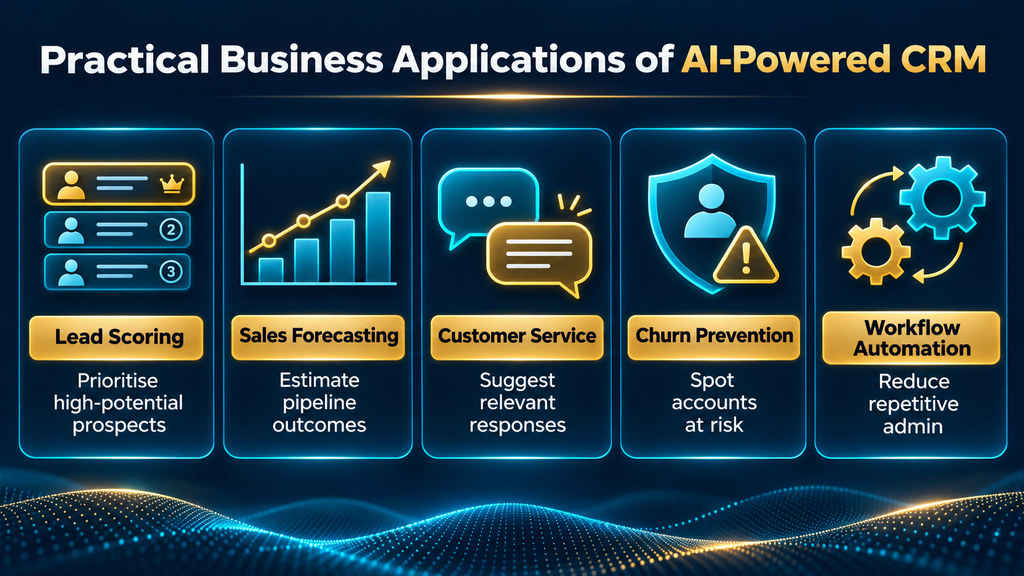
1. AI-Powered Lead Qualification
Business challenge: Sales teams receive hundreds of enquiries, but not every prospect is ready to purchase.
AI-powered approach: AI analyses available lead information, engagement history, customer requirements and previous conversion patterns.
Business outcome: Sales representatives can prioritise promising leads instead of spending equal time on every enquiry.
2. Automated Email Classification and Lead Assignment
Business challenge: Customer emails arrive in shared inboxes, making it difficult to identify their purpose and assign them quickly.
AI-powered approach: AI analyses incoming emails, identifies intent, extracts relevant details and categorises each message.
Business outcome: Emails can be routed to the appropriate department or CRM queue, reducing manual sorting and improving response management.
3. Intelligent Sales Forecasting
Business challenge: Sales forecasts may become unreliable when opportunity information is outdated or depends entirely on manual estimates.
AI-powered approach: AI analyses historical sales performance, current opportunities, deal progression and other available indicators.
Business outcome: Management receives additional insights to support revenue planning and resource allocation.
4. Customer Support Automation
Business challenge: Support employees repeatedly answer similar questions and manually review customer records.
AI-powered approach: AI assistants can retrieve authorised information, summarise previous interactions and suggest relevant responses.
Business outcome: Support teams can resolve routine enquiries more efficiently while focusing on complex customer problems.
5. Customer Segmentation and Targeted Marketing
Business challenge: Marketing teams often use broad customer segments that do not reflect actual customer behaviour.
AI-powered approach: AI analyses customer preferences, interactions, purchasing patterns and engagement.
Business outcome: Marketing campaigns can become more relevant, helping businesses improve engagement and campaign performance.
Microsoft Dynamics 365: Bringing AI into CRM Operations
Microsoft Dynamics 365 is an important platform for organisations looking to improve customer relationship management through connected business applications and AI capabilities.
It brings together sales, customer service, marketing and other business functions within an integrated Microsoft ecosystem.
With AI capabilities such as Microsoft Copilot and related intelligent features, organisations can improve how employees access information, manage customer interactions and complete everyday tasks.
Here are some ways Microsoft technologies support AI-powered CRM.
1. Dynamics 365 Sales and AI-Driven Sales Management
Dynamics 365 Sales provides tools for managing leads, accounts, contacts and opportunities.
Its AI capabilities can help sales teams:
- Understand customer interactions.
- Prepare meeting summaries.
- Draft contextual email responses.
- Identify sales priorities.
- Gain insights into opportunities.
- Improve sales pipeline visibility.
For example, a sales manager can use CRM information and available AI-generated insights to identify opportunities that require additional attention.
However, the exact features available depend on the Dynamics 365 application, licensing, configuration and Microsoft service availability.
2. Microsoft Copilot for CRM Productivity
Microsoft Copilot brings generative AI assistance into supported Microsoft business applications.
Within CRM workflows, Copilot can help employees reduce time spent on routine activities.
For example, a sales representative may use Copilot to:
- Summarise an account’s recent activities.
- Prepare for an upcoming customer meeting.
- Draft a follow-up email.
- Review relevant opportunity information.
- Generate summaries from available records.
This makes customer information easier to work with, particularly when employees manage large numbers of accounts and opportunities.
3. Power Platform for AI-Driven Business Automation
Microsoft Power Platform extends CRM capabilities by connecting applications, data and business processes.
It includes several important tools:
| Microsoft technology | Role in AI-powered CRM |
|---|---|
| Power Apps | Builds custom business applications for customer-facing and internal processes |
| Power Automate | Automates workflows, notifications and CRM activities |
| Power BI | Converts business data into interactive reports and dashboards |
| Copilot Studio | Helps build AI agents and conversational business experiences |
| Dataverse | Provides a structured data platform for connected business applications |
For example, a company can build a custom customer onboarding application using Power Apps, store relevant information in Dataverse and automate approval workflows through Power Automate.
AI capabilities can then be incorporated where appropriate to classify information, extract details or support employee decisions.
4. Connecting CRM with Other Business Systems
AI-powered CRM becomes more useful when it has access to relevant and reliable business information.
Many organisations operate separate systems for:
- Enterprise resource planning (ERP).
- Finance and accounting.
- Customer support.
- Marketing automation.
- Inventory management.
- Document management.
Integrating these systems can provide a more complete picture of customer relationships.
For instance, connecting Dynamics 365 CRM with Microsoft Dynamics 365 Business Central can help authorised employees access relevant customer and operational information across both platforms.
This reduces information silos and supports better coordination between sales, finance and operations.
How SkySoft Connections Helps Businesses Build Smarter CRM Solutions
Implementing AI-powered CRM requires more than enabling an AI feature. Businesses need the right technology architecture, reliable data, connected applications and workflows that match their actual operations.
This is where SkySoft Connections helps organisations get more value from their Microsoft technology stack.
SkySoft Connections provides Microsoft technology expertise across Dynamics 365 CRM, Business Central, Power Platform and related business solutions.
The focus is on helping businesses connect their systems, improve processes and build solutions that support practical business requirements.
1. Dynamics 365 CRM Implementation and Customisation
Every organisation manages customers differently. Therefore, a standard CRM configuration may not always support its specific sales and service processes.
SkySoft Connections helps businesses work with Dynamics 365 CRM to support their operational requirements.
This can include:
- CRM implementation and configuration.
- Custom entities and business processes.
- Sales pipeline optimisation.
- Customer data management.
- Custom dashboards and reporting.
- Integration with other business applications.
A well-configured CRM provides a stronger foundation for introducing AI because customer information and business processes are organised more effectively.
2. Power Platform Development and Workflow Automation
Many organisations still rely on spreadsheets, manual emails and disconnected applications to manage everyday activities.
SkySoft Connections helps businesses use Microsoft Power Platform to build custom applications and automate workflows.
For example, a business can automate its customer enquiry management process:
- A customer submits an enquiry through a website.
- The information is captured in CRM.
- Power Automate triggers the relevant workflow.
- AI can classify the enquiry where appropriate.
- The enquiry is assigned to the responsible employee.
- Notifications and follow-up activities are created.
This approach reduces repetitive administration and improves visibility across the customer management process.
3. AI and Business Process Automation
AI creates more value when it addresses a clearly defined business problem.
SkySoft Connections can help organisations identify opportunities where AI and automation can improve existing Microsoft business processes.
Potential applications include:
- AI-powered email classification.
- Automated customer enquiry processing.
- Intelligent document and data extraction.
- AI-assisted customer communication.
- Workflow automation using Power Automate.
- AI-powered internal support assistants.
The objective should be to improve a measurable business process rather than introduce AI simply because the technology is available.
4. Microsoft Business Central and CRM Integration
Customer information is often spread across sales and finance systems.
By connecting Dynamics 365 CRM with Business Central, businesses can improve information flow between customer-facing and operational teams.
For example, sales employees may need visibility into relevant customer transactions, invoice information or order status.
With appropriate integration and access controls, this information can be made available through connected business processes.
It also creates opportunities for more informed reporting and AI-assisted business analysis.
5. Microsoft Technology Consulting and Ongoing Support
Successful CRM transformation requires continuous improvement.
As business requirements change, organisations may need to update their CRM configuration, automate additional processes, improve integrations or introduce new AI capabilities.
SkySoft Connections supports businesses with Microsoft technology expertise to help ensure their solutions continue to meet operational requirements.
Looking to make your CRM more intelligent and connected? Explore SkySoft Connections to learn how Dynamics 365 CRM, Business Central and Power Platform expertise can help improve your business operations.
Challenges Businesses Should Consider Before Implementing AI in CRM
Although AI-powered CRM offers significant opportunities, implementation should be approached carefully.
Introducing AI without considering data quality, security and operational requirements can create additional problems rather than solve existing ones.
Here are some important challenges to address.
1. Poor Customer Data Quality
AI systems depend on the information available to them.
If CRM records contain duplicate contacts, outdated details, incomplete information or inconsistent formats, AI-generated insights may become unreliable.
Practical recommendation:
Before implementing AI:
- Remove duplicate customer records.
- Standardise important data fields.
- Review outdated information.
- Define mandatory CRM fields.
- Establish data ownership responsibilities.
- Introduce regular data quality checks.
Clean and structured customer data creates a stronger foundation for AI adoption.
2. Data Privacy and Security
CRM systems often contain sensitive customer and business information.
Therefore, businesses must understand how their AI tools access, process and use customer data.
Important considerations include:
- Role-based access permissions.
- Data protection requirements.
- Customer consent where applicable.
- Secure system integrations.
- Data retention policies.
- Appropriate AI service configurations.
AI should only access the information required to perform its intended business function.
3. Integration with Existing Business Applications
Many businesses already use multiple applications to manage their operations.
Connecting an AI-powered CRM with existing systems can become challenging when applications use different data structures, APIs or authentication methods.
A proper integration strategy should define:
- Which systems need to exchange information.
- Which application owns each data field.
- How frequently information should synchronise.
- How integration errors will be handled.
- Which employees can access integrated information.
This is particularly important for organisations using Dynamics 365 CRM alongside Business Central and custom Microsoft applications.
4. Employee Adoption and Training
Even the most advanced CRM solution will deliver limited value if employees do not use it correctly.
Some employees may be unfamiliar with AI-generated recommendations or concerned about changes to existing workflows.
Businesses should introduce AI gradually and explain how it supports employees rather than simply adding another layer of technology.
Useful adoption practices include:
- Providing practical employee training.
- Demonstrating real business use cases.
- Explaining how AI recommendations work.
- Establishing review and approval processes.
- Collecting employee feedback.
- Monitoring actual system usage.
5. Incorrect AI Recommendations
AI systems can produce inaccurate summaries, misleading predictions or incomplete recommendations.
For example, an AI assistant might misunderstand a customer’s requirement or generate an email containing incorrect information.
Consequently, businesses should introduce human review for important decisions and customer-facing communications.
AI should support employees, not remove accountability from business processes.
How to Implement AI-Powered CRM: A Practical Roadmap
Businesses do not need to transform their entire CRM environment at once.
A phased implementation approach is generally more practical because it allows organisations to identify problems, test solutions and measure results before expanding AI adoption.
The following roadmap provides a useful starting point.
| Implementation stage | Key activities | Expected outcome |
|---|---|---|
| 1. Business assessment | Identify CRM challenges and operational requirements | Clear implementation objectives |
| 2. Data preparation | Clean customer records and standardise information | More reliable CRM data |
| 3. Process review | Identify repetitive and time-consuming activities | Opportunities for automation |
| 4. AI use case selection | Prioritise lead scoring, summaries or email classification | Defined AI implementation scope |
| 5. Technical implementation | Configure CRM, integrations and AI capabilities | Working AI-enabled processes |
| 6. Testing and validation | Check accuracy, permissions and workflow performance | More reliable solution |
| 7. Employee training | Train users and introduce practical guidance | Better adoption |
| 8. Performance monitoring | Measure outcomes and improve the solution | Continuous business improvement |
Start with One High-Value Business Problem
One common implementation mistake is trying to introduce multiple AI capabilities simultaneously.
Instead, select one business process where AI can deliver measurable value.
For example, if your sales team spends several hours every day sorting incoming enquiries, start with AI-powered email classification and lead assignment.
Measure the results, collect employee feedback and improve the process.
Once the initial solution delivers consistent results, expand into other areas such as predictive lead scoring, sales forecasting and customer retention.
How to Measure the Success of AI-Powered CRM
Implementing AI does not automatically mean business performance will improve.
Organisations should measure whether AI is actually reducing operational effort, improving customer engagement and supporting better decisions.
The following key performance indicators (KPIs) can help evaluate results.
| KPI | What it measures | Why it matters |
|---|---|---|
| Lead conversion rate | Percentage of leads converted into customers | Measures sales effectiveness |
| Lead response time | Time taken to respond to new enquiries | Indicates sales responsiveness |
| Sales cycle length | Time required to close a deal | Measures sales process efficiency |
| Customer retention rate | Percentage of customers retained | Evaluates customer relationship quality |
| Customer satisfaction | Customer experience and feedback | Measures service performance |
| CRM data completeness | Percentage of records containing required information | Evaluates data quality |
| Task automation rate | Percentage of eligible tasks automated | Measures automation adoption |
| Forecast accuracy | Difference between predicted and actual sales | Evaluates forecasting reliability |
Example: Measuring the Impact of AI Email Classification
Imagine a business receives 300 customer emails every working day.
Previously, employees manually reviewed and categorised each message before forwarding it to the appropriate department.
After introducing an AI-assisted classification workflow, the business measures:
- Average email processing time.
- Number of emails correctly classified.
- Number of emails requiring manual correction.
- Time saved by employees.
- Average customer response time.
These measurements help management determine whether the solution is delivering genuine operational value.
Importantly, the organisation should establish baseline figures before implementation so that improvements can be compared accurately.
The Future of AI-Powered CRM: What Businesses Can Expect
AI-powered CRM will continue to evolve as artificial intelligence becomes more deeply integrated into everyday business applications.
Several developments are likely to influence how organisations manage customer relationships.
1. More Advanced AI Agents
AI agents are moving beyond answering questions and generating content.
In supported business environments, they can perform multi-step tasks, interact with business applications and assist employees with operational processes.
For example, an AI agent could help review a customer enquiry, retrieve relevant CRM information, prepare a response and initiate an approval workflow.
However, actions involving financial commitments, sensitive information or important customer decisions should retain appropriate human oversight.
2. More Connected Business Intelligence
Future CRM platforms will increasingly connect customer information with financial, operational and service data.
This will help management understand how different business activities influence customer relationships and revenue.
For instance, combining CRM sales information with ERP transaction data can provide better visibility into customer purchasing patterns and account performance.
3. Conversational Business Intelligence
Employees will increasingly be able to interact with business information using natural language.
Instead of manually creating multiple reports, a manager may ask questions such as:
- Which sales opportunities need attention this week?
- Which customers have not been contacted recently?
- What are the main reasons for lost sales?
- Which customer accounts have declining engagement?
AI-powered assistants can help retrieve and summarise relevant information, subject to available data, permissions and system capabilities.
4. More Personalised Customer Engagement
AI will help businesses understand customer requirements at a more detailed level.
As a result, organisations can deliver more relevant communication, improve service experiences and identify opportunities to strengthen long-term customer relationships.
The businesses that benefit most will be those that combine intelligent technology with reliable data and a clear understanding of customer needs.
Conclusion: Turning CRM Data into Business Intelligence
AI-powered CRM represents an important shift in how organisations manage customer relationships.
Traditional CRM systems primarily help businesses record and organise customer information. However, AI introduces additional capabilities that help organisations analyse data, predict customer behaviour, automate repetitive activities and make more informed decisions.
From intelligent lead qualification and predictive sales forecasting to automated customer communication and churn prediction, AI can improve multiple areas of business operations.
Nevertheless, successful implementation depends on more than technology. Businesses need clean customer data, appropriate integrations, secure access controls and employees who understand how to use AI effectively.
Microsoft Dynamics 365, Copilot and Power Platform provide opportunities to build connected and intelligent business processes.
With the right implementation strategy and technical expertise, SkySoft Connections can help organisations make better use of their Microsoft technology stack, improve CRM operations and move towards smarter, more connected business management.
The real opportunity is not simply adopting AI. It is using AI to turn everyday customer information into decisions that create measurable business value.
Read more : Why Your Business Needs an Exception Management Strategy, Not Just More Automation
FAQ’s
An AI-powered CRM system uses artificial intelligence, machine learning and predictive analytics to analyse customer information, automate tasks, identify opportunities and support business decisions. It helps businesses move beyond basic customer data management.
AI improves CRM by automating repetitive tasks, analysing customer behaviour, predicting sales opportunities, identifying potential churn risks and supporting personalised communication. Consequently, employees can spend more time on valuable customer interactions.
Yes. Microsoft Dynamics 365 offers AI capabilities through supported features such as Microsoft Copilot and other intelligent services. These capabilities can assist with sales activities, customer insights, communication summaries and business productivity. Availability depends on licensing and configuration.
Yes. Small and medium-sized businesses can benefit from AI-powered CRM by automating customer enquiries, improving lead management and reducing administrative work. They can begin with specific use cases and expand as their requirements grow.
Businesses should start by assessing their current CRM processes, improving data quality and identifying repetitive activities. They can then introduce suitable AI capabilities, integrate relevant applications, train employees and monitor performance.