
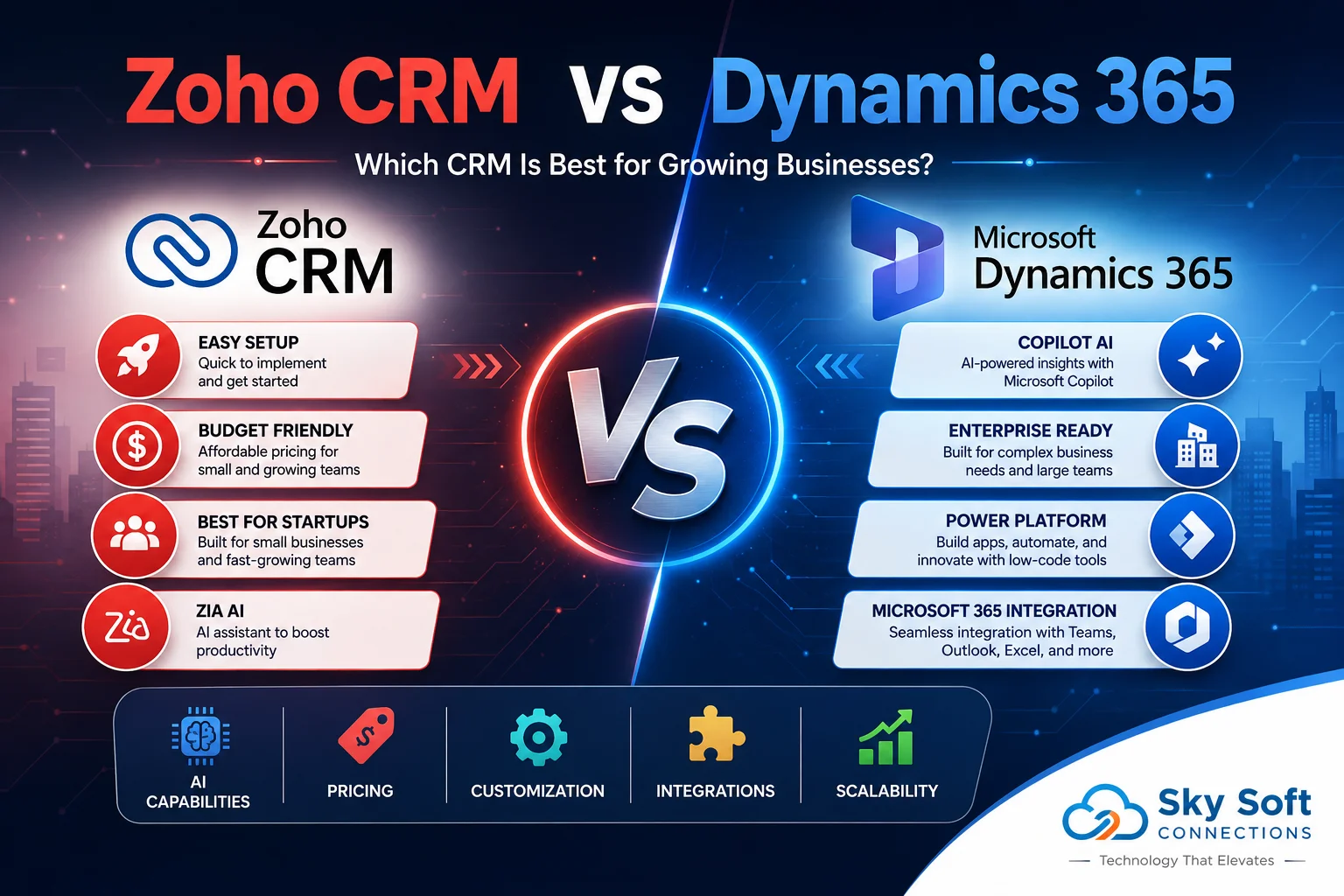
Choosing the right CRM is one of the most important technology decisions a growing business can make. While many companies compare Zoho CRM vs Dynamics 365, the answer isn’t simply about choosing the platform with the most features. Instead, it depends on your business goals, team size, future growth plans, and existing technology ecosystem.
At first glance, Zoho CRM appears to be an affordable and easy-to-use solution. On the other hand, Microsoft Dynamics 365 offers enterprise-grade capabilities, deep Microsoft integration, advanced AI, and exceptional scalability.
So, which CRM should your business choose?
This comprehensive comparison explains the differences honestly without unnecessary hype so you can make an informed decision.
Quick Comparison: Zoho CRM vs Dynamics 365
| Feature | Zoho CRM | Microsoft Dynamics 365 |
|---|---|---|
| Best For | Small businesses & startups | Growing businesses & enterprises |
| Ease of Setup | Very Easy | Moderate |
| Customization | Good | Excellent |
| AI Capabilities | Zia AI | Microsoft Copilot AI |
| Integration | Zoho Ecosystem | Microsoft 365, Azure, Teams, Power Platform |
| Reporting | Standard dashboards | Advanced Power BI analytics |
| Automation | Basic to Advanced | Enterprise-grade workflows |
| Scalability | Medium | Very High |
| Security | Strong | Enterprise-level security & compliance |
| Industry Solutions | Limited | Extensive industry-specific solutions |
| Mobile App | Yes | Yes |
| Long-Term Growth | Moderate | Excellent |
Why Businesses Compare Zoho CRM and Dynamics 365
Businesses usually compare these CRMs because both promise to improve customer relationships, automate sales processes, and increase productivity.
However, they serve different audiences.
Generally:
- Zoho CRM focuses on affordability and simplicity.
- Dynamics 365 focuses on scalability and digital transformation.
Therefore, the better CRM depends on where your company is heading—not just where it is today.
What is Zoho CRM?
Zoho CRM is a cloud-based customer relationship management platform designed primarily for startups, small businesses, and mid-sized organizations.
It helps companies manage:
- Leads
- Contacts
- Sales pipelines
- Email campaigns
- Customer support
- Workflow automation
Additionally, Zoho offers an entire suite of business applications that integrate with its CRM.
Advantages of Zoho CRM
- Lower upfront cost
- Quick implementation
- Easy user interface
- Good automation
- Large app marketplace
Limitations
- Limited enterprise functionality
- Less powerful reporting
- Custom development can become complex
- Fewer enterprise integrations
What is Microsoft Dynamics 365?
Microsoft Dynamics 365 is a cloud business platform that combines CRM and ERP capabilities into one ecosystem.
Instead of only managing customer relationships, Dynamics 365 helps businesses streamline sales, marketing, customer service, finance, operations, field service, and project management.
Furthermore, it integrates seamlessly with:
- Microsoft Teams
- Outlook
- Excel
- SharePoint
- Azure
- Power BI
- Power Apps
- Power Automate
- Microsoft Copilot AI
As a result, organizations can centralize operations while reducing software silos.
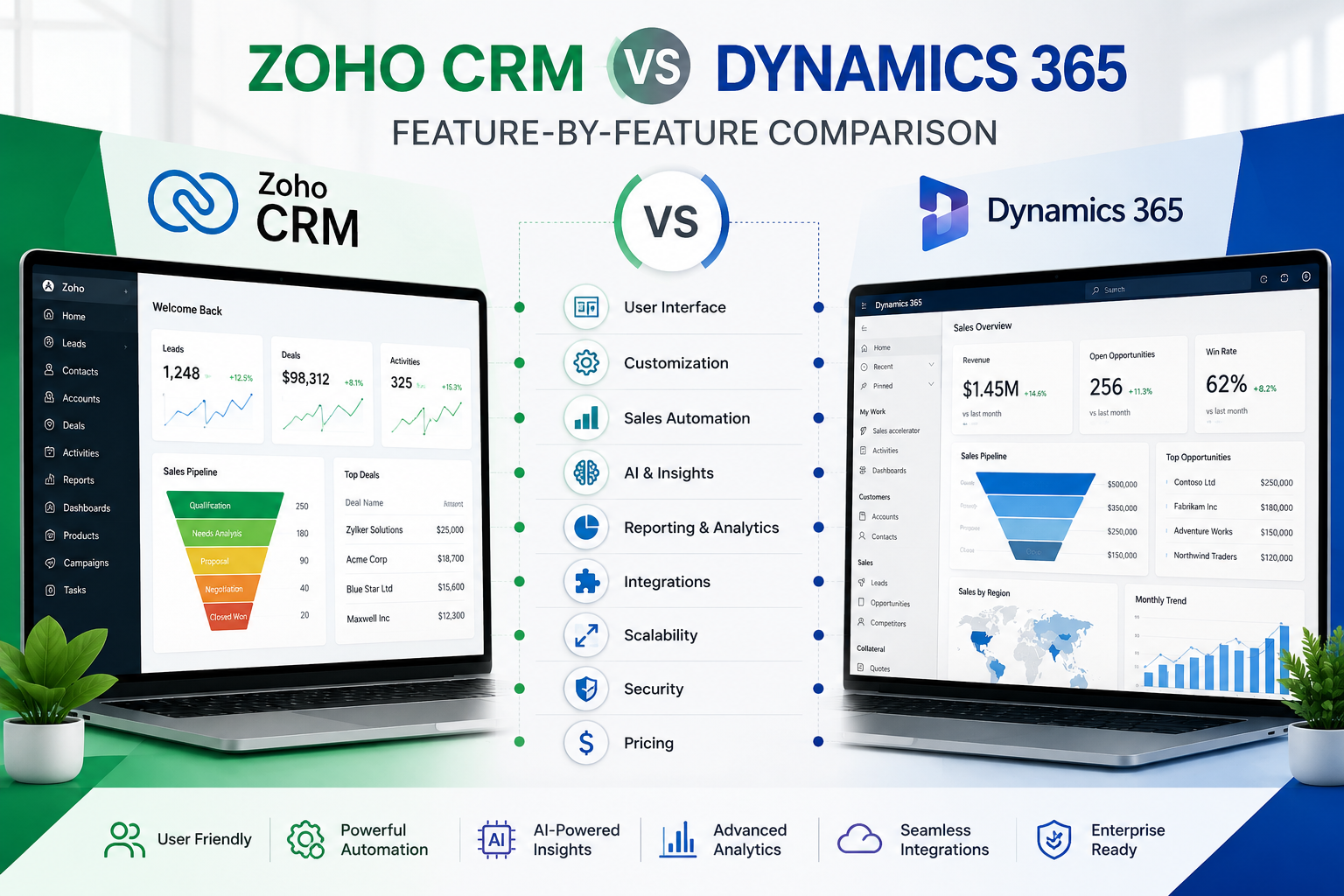
Zoho CRM vs Dynamics 365: Feature-by-Feature Comparison
1. User Interface
Zoho CRM
Zoho offers a clean interface that is easy for new users to understand.
Pros:
- Simple navigation
- Minimal learning curve
- Fast onboarding
However, advanced customization may require additional training.
Dynamics 365
Dynamics 365 provides a modern Microsoft interface.
While it contains more functionality, users familiar with Outlook or Microsoft 365 adapt quickly.
Winner: Tie
- Small teams → Zoho
- Larger organizations → Dynamics 365
2. Customization
Customization determines how well your CRM supports unique business processes.
Zoho CRM
Supports:
- Custom modules
- Fields
- Layouts
- Workflows
However, highly complex business logic may require developer involvement.
Dynamics 365
Provides virtually unlimited customization through:
- Custom entities
- Business process flows
- Power Apps
- Power Automate
- Plugins
- JavaScript
- Azure Functions
- APIs
Winner: Dynamics 365
3. Sales Automation
Both CRMs automate repetitive sales tasks.
Zoho CRM Includes
- Lead scoring
- Workflow rules
- Email automation
- Assignment rules
- Blueprint processes
Dynamics 365 Includes
- Sales forecasting
- Opportunity management
- Relationship intelligence
- AI recommendations
- Automated follow-ups
- Copilot-generated emails
- Pipeline analytics
Winner: Dynamics 365
4. Artificial Intelligence (AI)
AI has become a major deciding factor when selecting a CRM.
Zoho Zia AI
Offers:
- Predictions
- Lead scoring
- Sales forecasting
- Basic conversational AI
Microsoft Copilot
Dynamics 365 includes Microsoft Copilot, which helps users:
- Summarize customer interactions
- Draft emails
- Generate meeting notes
- Recommend next actions
- Analyze sales opportunities
- Create reports using natural language
Winner: Dynamics 365
5. Reporting & Analytics
Reporting drives better decision-making.
Zoho CRM
Provides:
- Standard dashboards
- Custom reports
- Forecast reports
Dynamics 365
Offers:
- Interactive dashboards
- Power BI integration
- Predictive analytics
- AI insights
- Executive reporting
- Real-time KPIs
Winner: Dynamics 365
6. Integration Capabilities
Zoho CRM Integrates With
- Zoho Apps
- Google Workspace
- Slack
- Mailchimp
- QuickBooks
Dynamics 365 Integrates With
- Microsoft 365
- Outlook
- Teams
- SharePoint
- Azure
- SQL Server
- SAP
- Salesforce
- Third-party APIs
- Power Platform
Winner: Dynamics 365
7. Scalability
Growing companies should think beyond today’s requirements.
| Business Size | Recommended CRM |
|---|---|
| Startup | Zoho CRM |
| Small Business | Zoho CRM |
| Medium Business | Dynamics 365 |
| Enterprise | Dynamics 365 |
| Multi-country Organization | Dynamics 365 |
8. Security & Compliance
Both platforms offer robust security.
However, Dynamics 365 benefits from Microsoft’s enterprise-grade infrastructure.
Features include:
- Multi-factor authentication
- Role-based security
- Data encryption
- Audit logs
- Compliance certifications
- Advanced identity management
Winner: Dynamics 365
Pricing Comparison
Pricing often influences CRM decisions. However, the cheapest solution isn’t always the most cost-effective in the long run.
| Factor | Zoho CRM | Dynamics 365 |
|---|---|---|
| Initial Cost | Lower | Higher |
| Long-Term ROI | Good | Excellent |
| Enterprise Features | Limited | Extensive |
| Flexibility | Medium | Very High |
| Licensing Options | Simple | Modular |
Tip: Evaluate the total cost of ownership (TCO), including customization, integrations, user training, and future expansion—not just the monthly subscription fee.
Which CRM Is Better for Different Business Types?
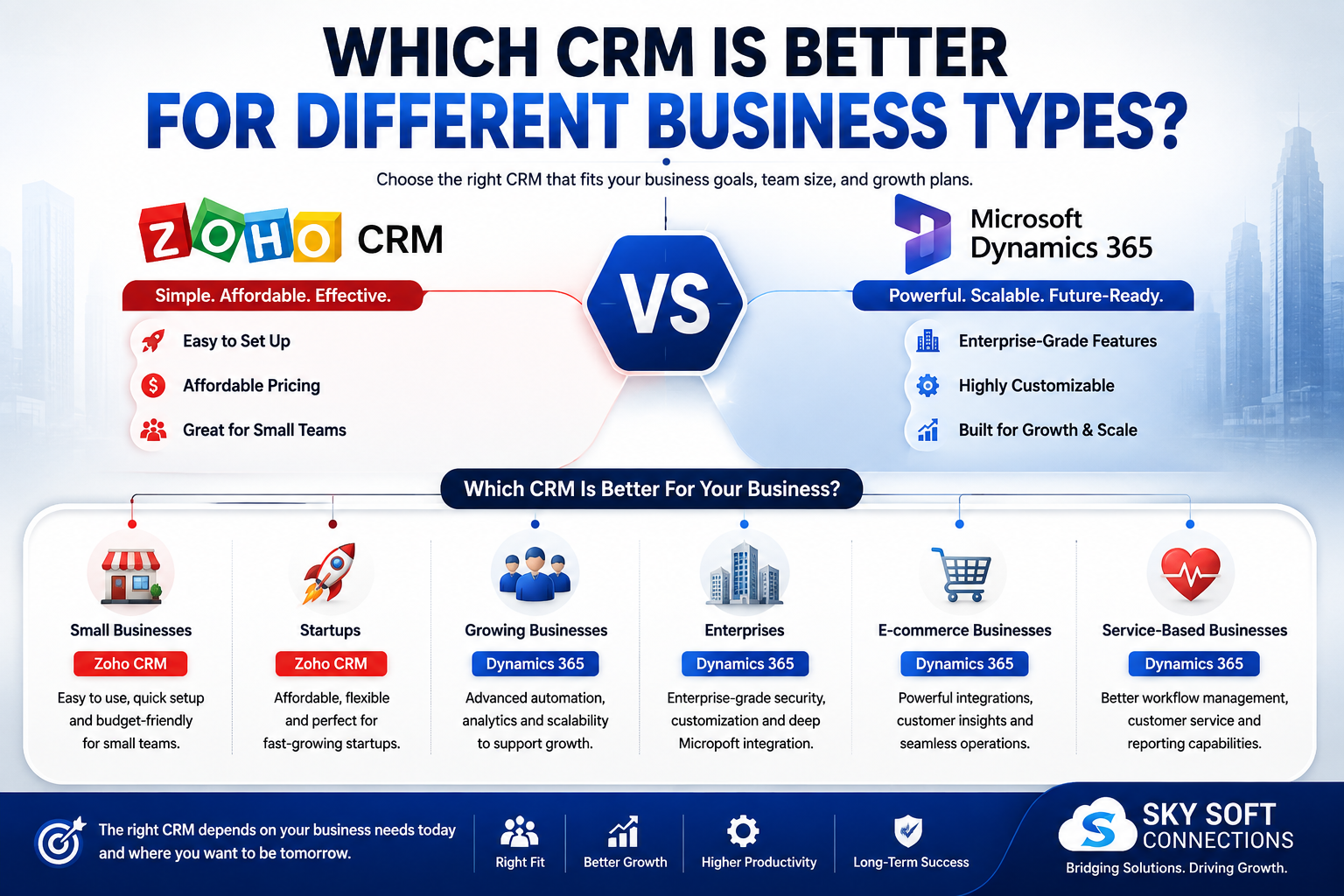
Choose Zoho CRM if you:
- Have a limited budget
- Need a CRM quickly
- Operate a small sales team
- Prefer simple workflows
- Don’t require deep Microsoft integration
Choose Dynamics 365 if you:
- Expect rapid business growth
- Already use Microsoft 365
- Need advanced automation
- Want AI-powered productivity
- Require enterprise-level security
- Need extensive customization
- Plan to integrate multiple business systems
Zoho CRM vs Dynamics 365: Pros and Cons
| Zoho CRM | Dynamics 365 |
|---|---|
| Lower cost | Advanced AI |
| Easier learning curve | Enterprise scalability |
| Faster setup | Extensive customization |
| Good for startups | Microsoft ecosystem integration |
| Flexible pricing | Powerful analytics |
| Limited enterprise features | Higher implementation complexity |
Common Mistakes Businesses Make When Choosing a CRM
Many organizations focus solely on pricing. However, this approach can lead to costly migrations later.
Avoid these common mistakes:
- Choosing based only on monthly subscription cost
- Ignoring future business growth
- Underestimating user adoption and training
- Overlooking integration requirements
- Failing to define CRM objectives
- Neglecting data migration planning
- Skipping process mapping before implementation
Why Dynamics 365 Is Often the Better Long-Term Investment
Although Zoho CRM is an excellent choice for many startups, growing businesses frequently outgrow its capabilities.
Dynamics 365 is designed to evolve alongside your organization. As your needs expand, you can add modules such as:
- Sales
- Customer Service
- Marketing
- Field Service
- Finance
- Supply Chain
- Project Operations
- Customer Insights
Consequently, you avoid switching platforms as your business grows.
How Sky Soft Connections Helps Businesses Implement Dynamics 365
Selecting the right CRM is only the first step. Successful implementation requires strategic planning, customization, integration, user training, and ongoing optimization.
At Sky Soft Connections, we help businesses maximize the value of Microsoft Dynamics 365 through tailored CRM solutions.
Our Dynamics 365 Services
- Dynamics 365 CRM Consulting
- CRM Strategy & Digital Transformation
- Dynamics 365 Sales Implementation
- Customer Service Implementation
- Marketing Automation
- Power Apps Development
- Power Automate Workflows
- Power BI Dashboards
- Azure Integrations
- CRM Data Migration
- Custom Plugin Development
- API Integrations
- CRM Health Checks
- User Training & Support
- Ongoing Managed Services
Whether you’re migrating from Zoho CRM or implementing Dynamics 365 for the first time, our certified consultants ensure a smooth, secure, and scalable transition aligned with your business goals.
Frequently Asked Questions (FAQ)
For businesses seeking advanced customization, AI capabilities, enterprise security, and scalability, Dynamics 365 is generally the stronger long-term choice. However, Zoho CRM remains a solid option for startups and smaller teams with straightforward requirements.
Yes. Zoho CRM typically has a lower initial subscription cost. Nevertheless, it’s important to consider the total cost of ownership, including integrations, customizations, and future scalability.
Yes. Businesses can migrate customer data, leads, contacts, opportunities, activities, and workflows. A well-planned migration minimizes downtime and preserves data integrity.
Microsoft Dynamics 365, powered by Microsoft Copilot, delivers more advanced AI features, including content generation, predictive insights, opportunity analysis, and workflow assistance. Zoho’s Zia AI provides useful automation but is less comprehensive.
Dynamics 365 integrates natively with Outlook, Teams, Excel, SharePoint, Azure, and the Power Platform, making it the preferred choice for organizations already invested in the Microsoft ecosystem.
Final Verdict
Both Zoho CRM and Microsoft Dynamics 365 are capable platforms, but they cater to different stages of business growth.
If your priority is affordability and a quick deployment for a small team, Zoho CRM is a practical solution. However, if your organization is expanding, relies on Microsoft technologies, or needs advanced automation, AI, and enterprise-grade scalability, Dynamics 365 offers greater long-term value.
Ultimately, the right CRM is the one that aligns with your current needs while supporting your future ambitions. Investing in a scalable platform today can reduce costly migrations and operational disruptions tomorrow.
Read more : Webhooks vs. Azure Service Bus vs. Logic Apps