
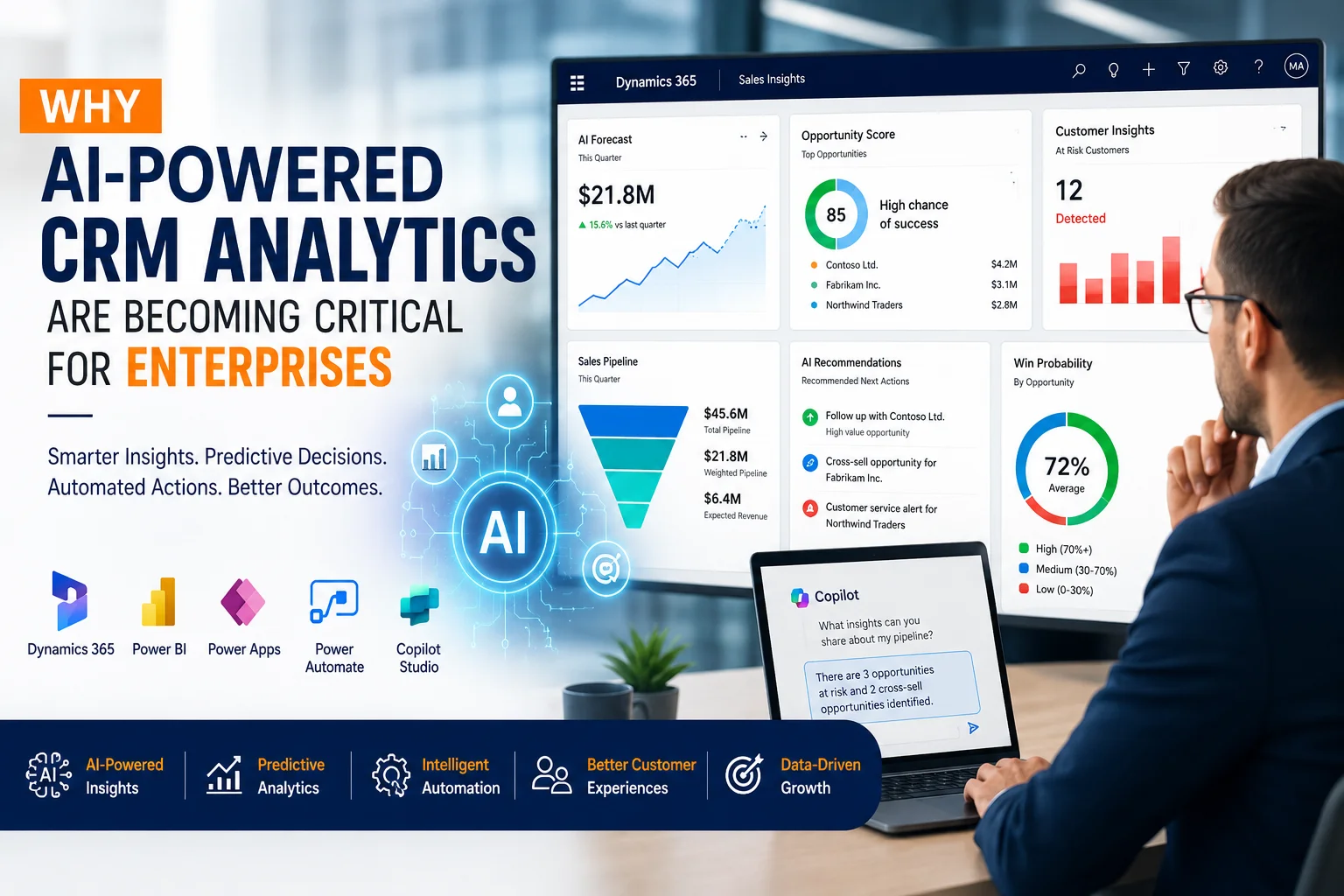
Enterprises no longer struggle because they lack customer data. Instead, they struggle because they cannot transform that data into timely decisions.
Sales teams miss opportunities hidden within their pipelines. Customer service managers fail to identify emerging dissatisfaction trends. Operations leaders struggle to forecast demand accurately. Meanwhile, executives spend valuable time reviewing static reports that explain what happened rather than what will happen next.
This is exactly why AI-powered CRM analytics are becoming essential rather than optional.
Organizations using platforms such as Microsoft Dynamics 365 CRM, Power BI, Power Automate, and Microsoft Copilot Studio can move beyond descriptive reporting and begin making predictive, proactive, and automated decisions.
At Sky Soft Connections, we frequently see enterprises investing heavily in CRM systems yet failing to unlock their true analytical value. The problem rarely lies within the technology itself. Instead, businesses often lack an intelligent framework that converts CRM data into actionable insights.
The Operational Challenge Enterprises Face
Most enterprises experience several common CRM challenges:
- Large volumes of disconnected customer data
- Delayed reporting cycles
- Inconsistent forecasting accuracy
- Manual analysis processes
- Limited visibility into customer behavior
- Reactive decision-making
- Difficulty identifying at-risk opportunities
Consequently, teams spend more time preparing reports than acting upon them.
Traditional CRM dashboards answer questions such as:
“What happened last month?”
However, AI-powered CRM analytics answer far more valuable questions:
- Which deals are most likely to close?
- Which customers show signs of churn?
- Which activities drive the highest conversion rates?
- Which accounts require immediate attention?
- What actions should teams prioritize today?
This shift transforms CRM systems from record-keeping platforms into strategic decision engines.
What Are AI-Powered CRM Analytics?
AI-powered CRM analytics combine customer relationship management data with artificial intelligence, machine learning, and automation technologies to generate predictive insights and recommendations.
These capabilities often include:
- Predictive opportunity scoring
- Sales forecasting models
- Customer sentiment analysis
- Automated anomaly detection
- Next-best-action recommendations
- Behavioral segmentation
- Intelligent workflow triggers
- Natural language querying through copilots
Within Microsoft ecosystems, these capabilities frequently leverage:
- Microsoft Dynamics 365 CRM
- Microsoft Power BI
- Power Automate
- Power Apps
- Microsoft Copilot Studio
- Azure AI services
Together, they enable organizations to anticipate business outcomes rather than simply documenting historical performance.
Why AI-Powered CRM Analytics Matter More Than Ever
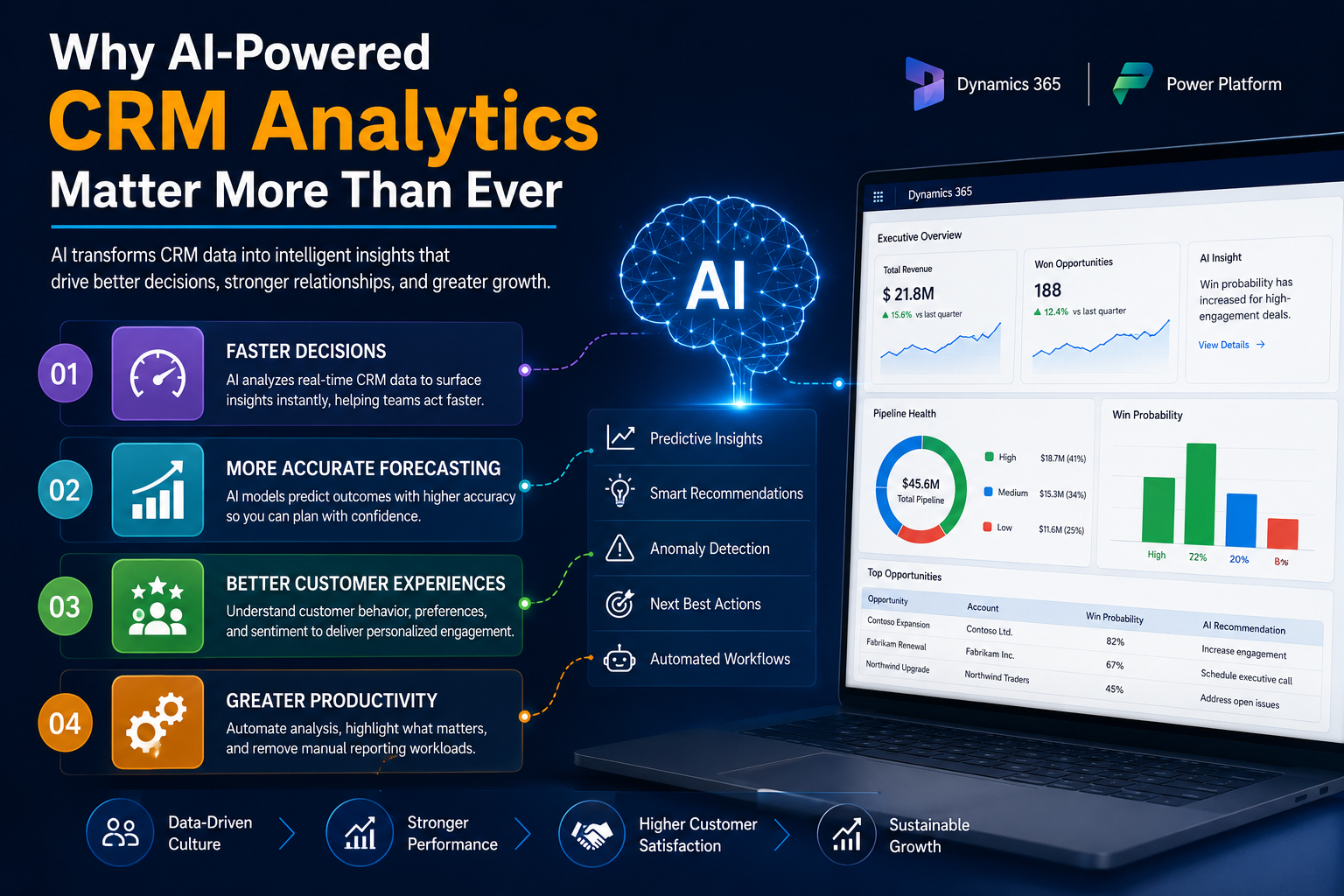
1. Enterprises Need Faster Decisions
Market conditions evolve rapidly.
Therefore, waiting until month-end reporting cycles is no longer practical.
AI-driven dashboards continuously monitor CRM activity and highlight emerging risks or opportunities as they occur.
As a result, leadership teams can intervene earlier.
2. Sales Forecasting Requires Greater Accuracy
Traditional forecasting often relies heavily on manager intuition.
However, AI models evaluate factors such as:
- Historical conversion patterns
- Engagement frequency
- Deal velocity
- Opportunity age
- Activity completion trends
- Customer interactions
Consequently, forecasts become significantly more reliable.
3. Customer Expectations Continue to Rise
Customers expect personalized experiences.
AI analytics identify:
- Buying preferences
- Service usage patterns
- Upselling opportunities
- Early warning signs of dissatisfaction
This enables customer-facing teams to respond proactively.
4. Enterprises Must Improve Productivity
Many employees spend excessive time extracting and consolidating data.
AI reduces manual reporting workloads by:
- Automating analysis
- Generating summaries
- Prioritizing actions
- Triggering workflows
Therefore, teams focus more on execution.
Traditional CRM Reporting vs AI-Powered CRM Analytics
| Capability | Traditional CRM Reporting | AI-Powered CRM Analytics |
|---|---|---|
| Reporting Frequency | Periodic | Continuous |
| Insights | Historical | Predictive |
| Decision Support | Manual interpretation | Automated recommendations |
| Risk Detection | Reactive | Proactive |
| Forecast Accuracy | Moderate | Higher confidence |
| Customer Intelligence | Limited segmentation | Behavioral insights |
| Workflow Integration | Minimal | Embedded automation |
| Executive Visibility | Static dashboards | Dynamic decision support |
Practical Workflow Example: AI-Driven Sales Intelligence
Consider an enterprise sales team using Dynamics 365 CRM.
Traditional Workflow
- Sales representatives update opportunities.
- Managers export CRM reports weekly.
- Forecast meetings review outdated data.
- Risks emerge late.
- Revenue targets become harder to achieve.
AI-Powered Workflow
- Opportunities are updated within Dynamics 365 CRM.
- Power BI analyzes pipeline trends continuously.
- AI identifies deals with declining engagement.
- Power Automate notifies sales managers automatically.
- Copilot generates recommended intervention actions.
- Managers focus attention on high-priority opportunities.
- Forecast accuracy improves.
This workflow illustrates how AI transforms CRM from a reporting system into an operational guidance platform.
How Sky Soft Connections Helps Enterprises Implement AI-Powered CRM Analytics
Successful implementation extends beyond activating AI features.
Organizations must align analytics initiatives with business objectives.
Sky Soft Connections supports enterprises by delivering:
Dynamics 365 CRM Implementation
- Sales automation design
- Customer service optimization
- Pipeline management frameworks
- Data governance strategies
Power BI Analytics Solutions
- Executive dashboards
- KPI visualization
- Predictive trend analysis
- Cross-functional reporting
Power Automate Workflows
- Automated notifications
- Approval processes
- Escalation workflows
- CRM process automation
Microsoft Copilot Studio Solutions
- Internal assistant development
- Guided CRM interactions
- Conversational analytics access
- Knowledge automation experiences
Power Apps Development
- Mobile business applications
- Role-specific interfaces
- Data capture solutions
- Operational productivity tools
Key Indicators That Your Enterprise Needs AI-Powered CRM Analytics
You should consider implementation if your organization experiences any of the following:
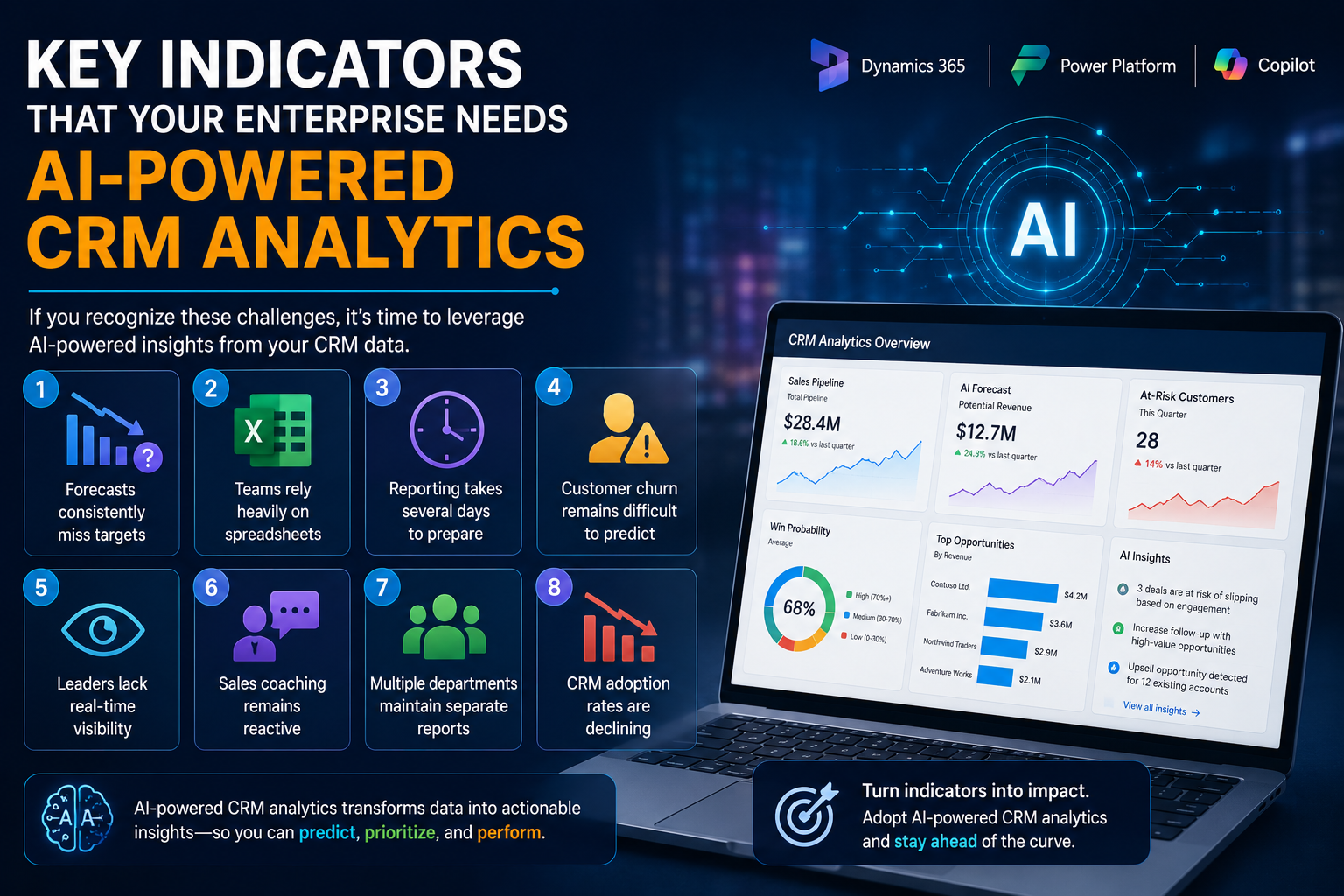
- Forecasts consistently miss targets
- Teams rely heavily on spreadsheets
- Reporting takes several days to prepare
- Customer churn remains difficult to predict
- Leaders lack real-time visibility
- Sales coaching remains reactive
- Multiple departments maintain separate reports
- CRM adoption rates are declining
Addressing these symptoms early often generates substantial operational improvements.
Implementation Considerations for Enterprises
Before launching AI-powered CRM initiatives, organizations should evaluate:
Data Readiness
Ensure:
- Duplicate records are minimized
- Customer information is standardized
- Historical data quality is acceptable
Process Maturity
Document:
- Sales stages
- Service workflows
- Escalation procedures
- Operational KPIs
Change Management
Prepare users through:
- Training programs
- Executive sponsorship
- Communication plans
- Adoption monitoring
Governance
Define:
- Security roles
- Data ownership responsibilities
- Access policies
- Compliance requirements
Organizations that prioritize these areas often achieve faster value realization.
Frequently Asked Questions
AI-powered CRM analytics use artificial intelligence to identify patterns, generate predictions, and recommend actions using CRM data.
Microsoft Dynamics 365 integrates with Power BI, Power Automate, and Copilot capabilities to provide predictive insights and workflow automation.
Yes. Organizations of all sizes can improve forecasting, productivity, and customer engagement through targeted AI implementations.
The first step involves assessing CRM data quality, business processes, and identifying high-value use cases aligned with organizational goals.
Final Thoughts
The future of CRM is not simply collecting more data.
It is empowering teams to make better decisions with the data they already possess.
Enterprises that adopt AI-powered CRM analytics gain earlier visibility into risks, stronger forecasting capabilities, improved customer experiences, and more efficient operations.
Those that delay may continue relying on retrospective reports while competitors act on predictive insights.
If your organization is exploring CRM consultation, workflow assessment, automation strategy development, Dynamics 365 implementation, or broader business process improvement initiatives, Sky Soft Connections can help design practical solutions tailored to your operational goals.
The most valuable CRM systems are no longer the ones that store information.
They are the ones that help businesses decide what to do next.
Read more : How Businesses Reduce CRM Data Errors Using Automation