Table of Content
In today’s data-driven organizations, structuring knowledge isn’t just helpful—it’s essential. However, many businesses still rely on outdated classification methods that limit discoverability and automation. That’s where the debate of ontology vs. taxonomy becomes critical. More importantly, modern tools like Copilot Studio are transforming how enterprises organize, connect, and use their data.
In this guide, you’ll learn the difference between ontology and taxonomy, why it matters, and how Sky Soft Connections helps businesses implement smarter knowledge systems using AI-powered solutions.
What is Taxonomy in Knowledge Management?
A taxonomy is a hierarchical classification system. It organizes information into predefined categories and subcategories.
Key Characteristics of Taxonomy:
- Structured in a tree-like hierarchy
- Uses parent-child relationships
- Easy to understand and implement
- Ideal for basic categorization
Example:
- Industry
→ Oil & Gas
→ Inspection
→ Tank Inspection
Although taxonomy simplifies navigation, it often lacks flexibility. As data grows, rigid structures become harder to maintain.
What is Ontology in Knowledge Management?
In contrast, an ontology goes beyond hierarchy. It defines relationships between concepts, enabling systems to understand context and meaning.
Key Characteristics of Ontology:
- Uses complex relationships (not just parent-child)
- Captures context, semantics, and meaning
- Enables AI-driven insights and automation
- Supports dynamic knowledge mapping
Example:
Instead of just categorizing “Tank Inspection,” ontology connects it with:
- Equipment used
- Inspection methods (MFL, UT)
- Compliance standards
- Risk levels
As a result, ontology allows systems to “think” rather than just “store.”
Ontology vs. Taxonomy: Key Differences
| Feature | Taxonomy | Ontology |
|---|---|---|
| Structure | Hierarchical | Network-based |
| Relationships | Parent-child only | Multiple relationship types |
| Flexibility | Limited | Highly flexible |
| Context Awareness | Low | High |
| AI Integration | Minimal | Strong |
| Scalability | Moderate | High |
Clearly, while taxonomy is useful for simple organization, ontology is essential for intelligent systems.
Why Traditional Categorization Falls Short
Many organizations still rely on static taxonomies. However, this approach creates several challenges:
- Data silos across departments
- Poor search accuracy
- Limited automation capabilities
- Difficulty scaling with growing data
Consequently, businesses struggle to extract meaningful insights from their data
How Copilot Studio Redefines Knowledge Categorization
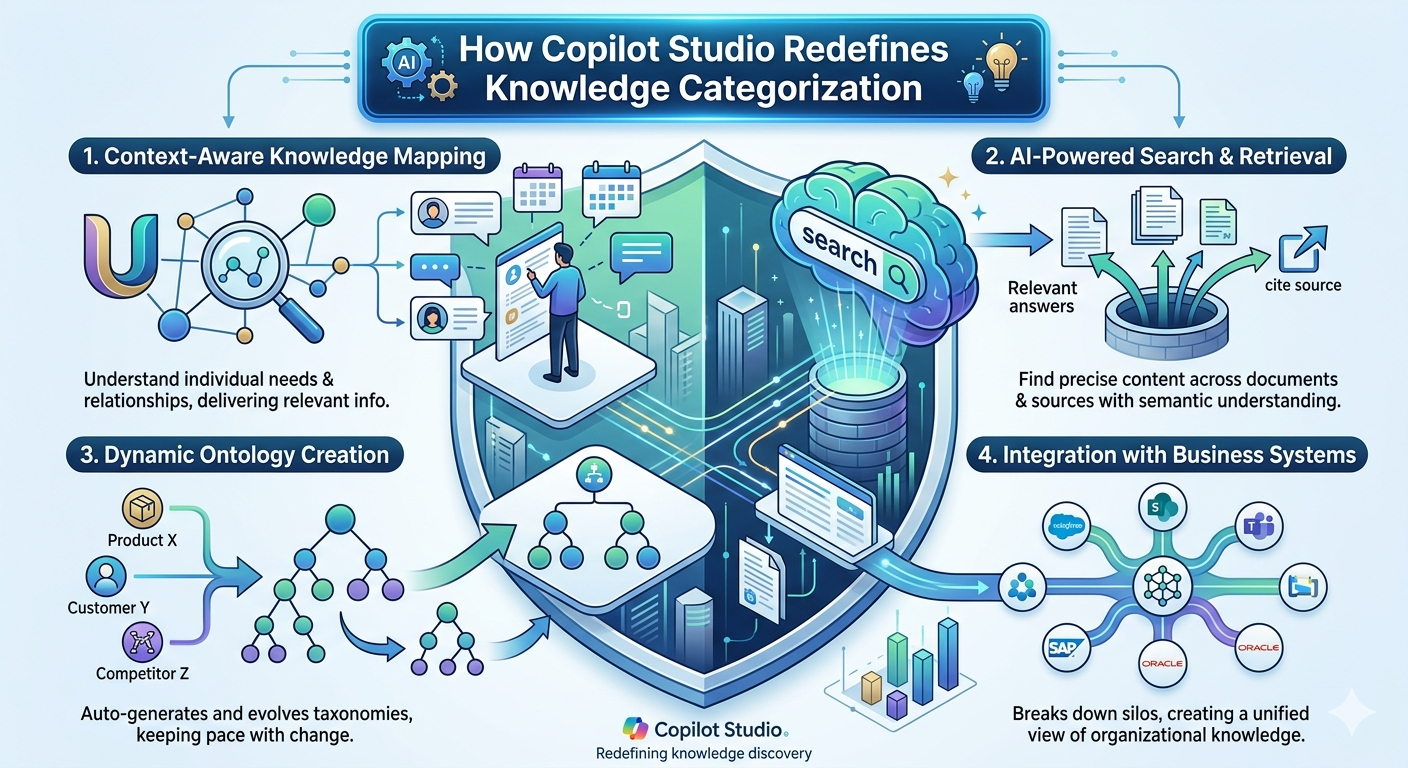
Copilot Studio introduces a smarter way to structure enterprise knowledge. Instead of relying solely on rigid categories, it leverages AI, machine learning, and semantic understanding.
Key Capabilities:
1. Context-Aware Knowledge Mapping
Copilot Studio understands relationships between data points. Therefore, it delivers more relevant results based on user intent.
2. AI-Powered Search & Retrieval
Instead of keyword matching, it uses semantic search. As a result, users find what they need faster.
3. Dynamic Ontology Creation
It continuously evolves as new data is added. This ensures your knowledge base stays relevant.
4. Integration with Business Systems
Copilot Studio connects seamlessly with CRM, ERP, and inspection systems. Hence, it eliminates silos.
Benefits of Ontology-Driven Systems in Enterprises
By shifting from taxonomy to ontology, businesses unlock significant advantages:
- Improved decision-making through connected data
- Enhanced automation using AI workflows
- Better user experience with accurate search results
- Scalable knowledge architecture
- Cross-department data visibility
Moreover, organizations gain a competitive edge by turning data into actionable intelligence.
Real-World Use Case: Oil & Gas Industry
In industries like oil & gas, data complexity is high. For example:
- Inspection reports
- Equipment data
- Compliance standards
- Maintenance schedules
Using taxonomy alone, this data remains fragmented. However, with ontology:
- Inspection data links to asset history
- Maintenance connects to risk analysis
- Compliance ties to regulatory frameworks
This interconnected system significantly improves operational efficiency
How Sky Soft Connections Helps You Implement Smart Knowledge Systems
At Sky Soft Connections, we specialize in building intelligent, scalable solutions using Microsoft Dynamics CRM, Power Platform, and AI tools like Copilot Studio.
Our Key Services:
- Ontology-driven CRM customization
- AI-powered knowledge management systems
- Power BI reporting & data visualization
- System integration & data migration
- Custom Copilot and automation workflows
Why Choose Us?
- Proven expertise with 40,000+ project hours
- 100% success rate on enterprise implementations
- Tailored solutions for industries like oil & gas
Additionally, we integrate ontology-based frameworks into platforms like Inspection Track Software, enabling smarter inspection data management
Taxonomy + Ontology: The Hybrid Approach
While ontology is powerful, combining it with taxonomy often delivers the best results.
Recommended Strategy:
- Use taxonomy for basic structure
- Apply ontology for relationships and intelligence
This hybrid approach ensures both usability and scalability.
Best Practices for Implementing Ontology-Based Systems
To successfully transition, follow these steps:
- Audit your existing data structure
- Identify key entities and relationships
- Choose the right platform (e.g., Copilot Studio)
- Integrate with existing systems
- Continuously refine your ontology
Furthermore, working with experienced partners like Sky Soft Connections accelerates implementation.
Conclusion
The shift from taxonomy to ontology marks a major evolution in knowledge management. While taxonomy organizes data, ontology gives it meaning. With tools like Copilot Studio, businesses can now build intelligent systems that understand, connect, and act on data.
If you want to future-proof your organization, adopting an ontology-driven approach is no longer optional it’s essential.
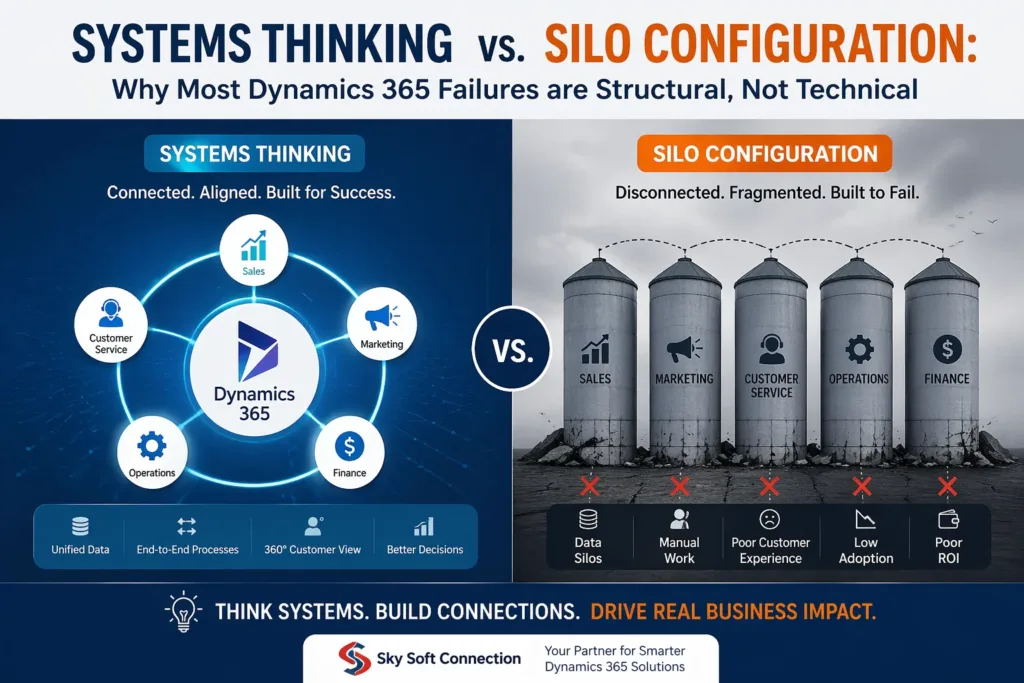
Read more : systems thinking vs silo configuration dynamics 365
FAQ’s
Taxonomy organizes data in a hierarchy, whereas ontology defines relationships and context between data points.
Because AI relies on context and relationships, ontology enables smarter automation and decision-making.
They provide end-to-end implementation, customization, and integration services tailored to your business needs.
 is a software solution company that was established in 2016. Our quality services begin with experience and end with dedication. Our directors have more than 15 years of IT experience to handle various projects successfully. Our dedicated teams are available to help our clients streamline their business processes, enhance their customer support, automate their day-to-day tasks, and provide software solutions tailored to their specific needs. We are experts in Dynamics 365 and Power Platform services, whether you need Dynamics 365 implementation, customization, integration, data migration, training, or ongoing support.