Table of Content
Artificial intelligence is evolving rapidly. However, one challenge continues to puzzle engineers and decision makers alike. How do you manage systems that are designed to behave unpredictably while still expecting reliable outcomes?
This is often described as the ghost in the machine. In simple terms, nondeterministic AI agents can produce different outputs even when given the same input. Therefore, businesses must find ways to control, guide, and trust these systems without removing their intelligence.
In this blog, we will explore how determinism can be introduced into nondeterministic AI systems, why it matters, and how organizations can build more reliable AI driven solutions.
What Is Nondeterministic AI
Nondeterministic AI refers to systems that do not always produce the same output for the same input. This happens because of probabilistic models, randomness in training, and dynamic learning processes.
For example, large language models, recommendation engines, and autonomous agents often behave this way. While this flexibility enables creativity and adaptability, it also introduces uncertainty.
Key Characteristics
- Outputs vary even with identical inputs
- Decisions are influenced by probabilities
- Learning continues over time
- Behavior may change based on context
As a result, managing such systems becomes critical, especially in industries where precision and compliance matter.
Why Determinism Still Matters
Even though AI thrives on flexibility, businesses require consistency. Therefore, determinism plays a crucial role in making AI usable in real world scenarios.
Benefits of Determinism in AI Systems
- Ensures predictable outcomes
- Builds user trust
- Supports regulatory compliance
- Improves debugging and testing
Without some level of control, AI systems can become unreliable and difficult to scale.
The Core Challenge Balancing Flexibility and Control
The real challenge is not eliminating nondeterminism. Instead, it is about controlling it.
On one hand, too much determinism limits the intelligence of AI. On the other hand, too much randomness creates chaos. Therefore, organizations must strike the right balance.
Techniques to Manage Determinism in AI Agents
Several strategies can help bring structure to nondeterministic systems. Let us explore the most effective ones.
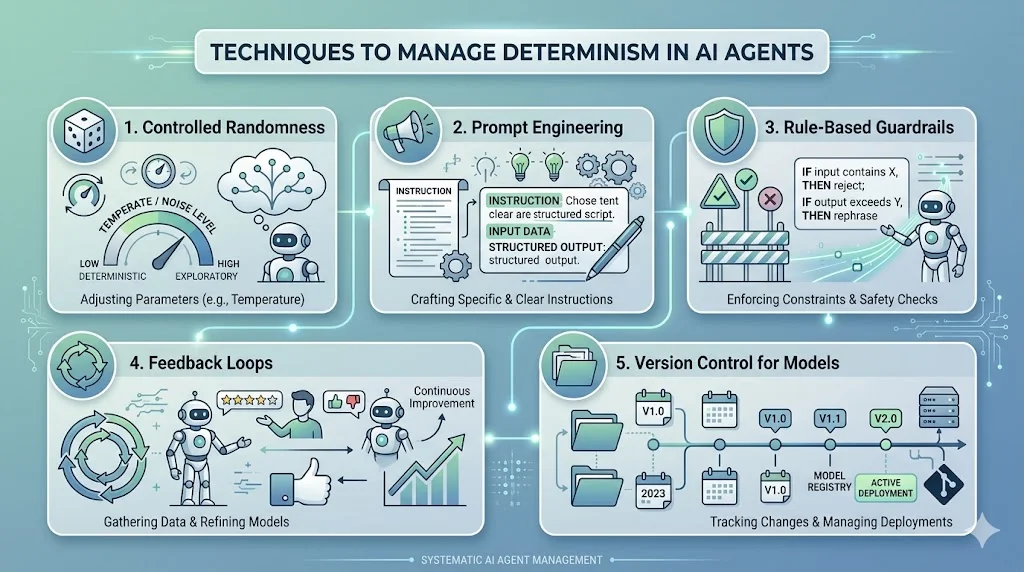
1. Controlled Randomness
You can limit randomness by setting parameters such as temperature in AI models. Lower values lead to more predictable outputs.
2. Prompt Engineering
Well designed prompts guide AI behavior more effectively. As a result, outputs become more consistent and aligned with expectations.
3. Rule Based Guardrails
Adding predefined rules ensures that AI operates within safe boundaries.
- Content filters
- Output validation rules
- Business logic constraints
4. Feedback Loops
Continuous feedback improves reliability over time. Therefore, monitoring and retraining are essential.
5. Version Control for Models
Tracking model versions ensures reproducibility. This helps teams understand changes and maintain consistency.
Deterministic vs Nondeterministic AI Comparison
| Feature | Deterministic AI | Nondeterministic AI |
|---|---|---|
| Output Consistency | Always the same | Varies |
| Flexibility | Limited | High |
| Use Cases | Calculations, rule systems | Language models, recommendations |
| Debugging | Easier | More complex |
| Innovation | Low | High |
This comparison clearly shows why a hybrid approach is often the best solution.
Real World Applications
Managing nondeterminism is essential across various industries.
Healthcare
AI must provide consistent recommendations while adapting to new data.
Finance
Predictable outputs are required for compliance and risk management.
Oil and Gas
Inspection systems and predictive maintenance tools rely on both accuracy and adaptability.
Customer Service
AI chat systems need flexibility in conversation but consistency in brand messaging.
Best Practices for Managing AI Behavior
To ensure success, organizations should follow proven practices.
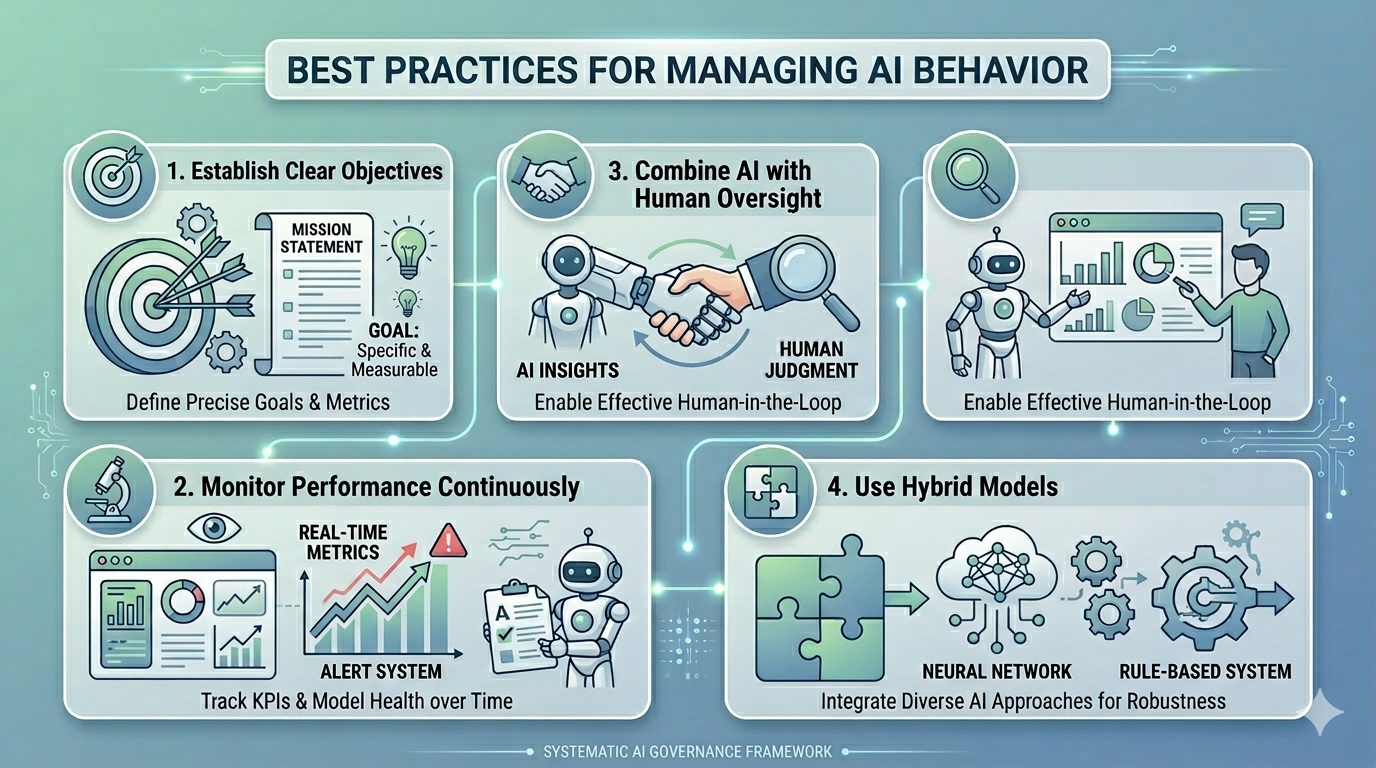
Establish Clear Objectives
Define what level of consistency is required for your use case.
Combine AI with Human Oversight
Human review adds an extra layer of reliability.
Monitor Performance Continuously
Track outputs and identify anomalies early.
Use Hybrid Models
Blend deterministic logic with AI intelligence for better control.
Future of AI Control Systems
As AI continues to evolve, new frameworks and tools will emerge to manage nondeterminism more effectively. Moreover, explainable AI and governance models will play a key role.
Therefore, businesses that invest in structured AI strategies today will gain a significant competitive advantage.
How Sky Soft Connections Can Help
Managing nondeterministic AI is not just a technical challenge. It requires the right strategy, tools, and expertise.
Sky Soft Connections specializes in building intelligent AI driven systems with strong control mechanisms. Their services include:
- Microsoft Dynamics CRM customization
- AI powered automation solutions
- Power Platform development including Power Apps and Power Automate
- Data visualization with Power BI
- Integration and system architecture design
In addition, their team focuses on creating scalable and reliable solutions tailored to business needs. Whether you are implementing AI agents or optimizing existing systems, they ensure the right balance between intelligence and control.
Conclusion
The ghost in the machine is not something to fear. Instead, it is something to manage.
By introducing structured determinism into nondeterministic AI systems, businesses can unlock the full potential of artificial intelligence while maintaining reliability and trust.
Ultimately, success lies in balance. With the right approach, AI can be both intelligent and dependable
Read more : ontology vs taxonomy copilot studio
FAQ’s
AI agents rely on probabilistic models and dynamic learning. Therefore, they can generate varied responses based on context, randomness, and model parameters.
No, it cannot be completely deterministic without losing its intelligence. However, you can control and guide its behavior using techniques like prompt engineering, guardrails, and parameter tuning.
Businesses can improve reliability by combining AI with rule based systems, continuous monitoring, feedback loops, and human oversight to maintain consistency and trust.
 is a software solution company that was established in 2016. Our quality services begin with experience and end with dedication. Our directors have more than 15 years of IT experience to handle various projects successfully. Our dedicated teams are available to help our clients streamline their business processes, enhance their customer support, automate their day-to-day tasks, and provide software solutions tailored to their specific needs. We are experts in Dynamics 365 and Power Platform services, whether you need Dynamics 365 implementation, customization, integration, data migration, training, or ongoing support.