

Customer Relationship Management (CRM) has evolved far beyond storing customer names, phone numbers, and email addresses. Today, modern CRM systems help businesses manage sales, automate repetitive tasks, improve customer experiences, and make smarter business decisions.
However, many organizations still use CRM software primarily as a digital contact database. As a result, they miss opportunities to improve productivity, strengthen customer relationships, and increase revenue.
A modern CRM platform does much more than organize customer information. It connects sales, marketing, customer service, and business operations through a centralized system. When implemented strategically, CRM becomes a powerful driver of business growth.
In this guide, we explore how modern CRM solutions help businesses improve performance, streamline operations, and build stronger customer relationships.
Table of contents
- What Is a Modern CRM System?
- 7 Ways Modern CRM Drives Business Growth
- 1. Turns Customer Data Into Business Opportunities
- 2. Automates Sales Processes and Reduces Manual Work
- 3. Improves Lead Management and Sales Conversion
- 4. Creates Better Customer Experiences
- 5. Connects Sales, Marketing, and Customer Service
- 6. Uses AI to Support Smarter Business Decisions
- 7. Provides Real-Time Reporting and Business Visibility
- Traditional CRM vs. Modern CRM: What’s the Difference?
- How Can Businesses Choose the Right CRM Solution?
- How Sky Soft Connections Helps Businesses Get More From CRM
- Frequently Asked Questions About Modern CRM
- Final Thoughts
What Is a Modern CRM System?
A modern Customer Relationship Management (CRM) system is a centralized platform that helps businesses manage customer interactions, sales activities, marketing campaigns, and service operations.
Unlike traditional contact management tools, modern CRM software connects different business processes and provides actionable insights from customer data.
For example, platforms such as Microsoft Dynamics 365 CRM allow businesses to:
- Manage leads, contacts, accounts, and sales opportunities.
- Track customer interactions across multiple channels.
- Automate sales follow-ups and business workflows.
- Monitor sales performance through dashboards and reports.
- Improve customer service and case management.
- Use AI to identify opportunities and predict customer behavior.
Therefore, CRM is no longer just a system for recording customer information. It has become an essential business growth platform.
7 Ways Modern CRM Drives Business Growth
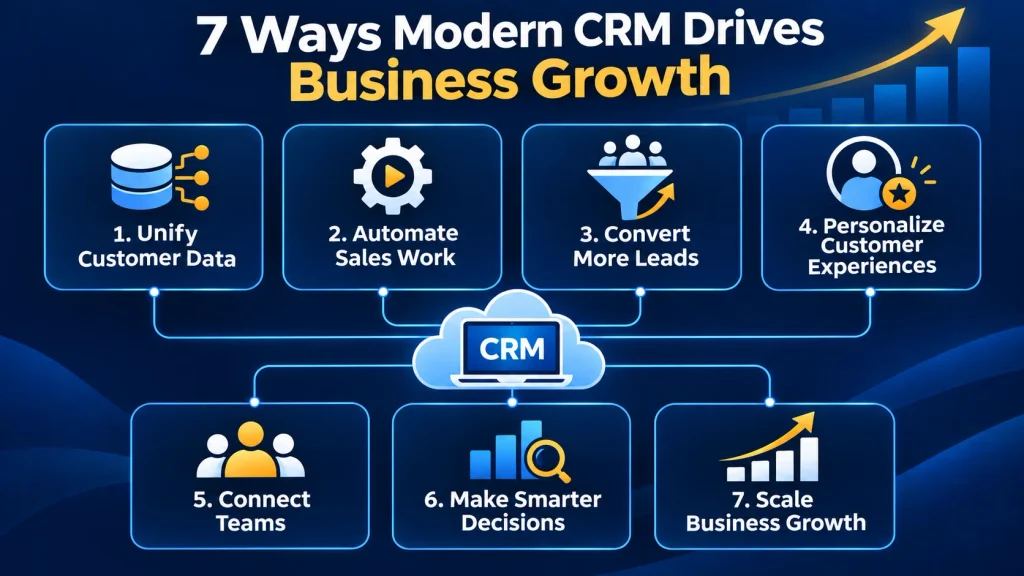
1. Turns Customer Data Into Business Opportunities
Businesses collect valuable customer information every day. However, without the right tools, this information often remains scattered across spreadsheets, emails, and disconnected applications.
Modern CRM software brings this information together in one centralized location.
Sales teams can view customer history, previous interactions, purchasing behavior, open opportunities, and communication records. Consequently, they can identify potential sales opportunities and make more informed decisions.
Business impact: Better customer insights, improved lead management, and more opportunities to generate revenue.
2. Automates Sales Processes and Reduces Manual Work
Sales teams often spend too much time on repetitive administrative activities, including updating records, sending follow-up emails, assigning leads, and preparing reports.
CRM automation reduces this workload by handling routine tasks automatically.
For instance, businesses can configure automated workflows to:
- Assign incoming leads to the right sales representatives.
- Send follow-up reminders after customer interactions.
- Update opportunity stages based on business rules.
- Notify managers when deals require attention.
- Generate tasks when a new lead enters the system.
As a result, employees spend less time managing administrative work and more time building customer relationships.
3. Improves Lead Management and Sales Conversion
Generating leads is important, but converting those leads into paying customers is what drives business growth.
Modern CRM systems help businesses manage the complete sales pipeline, from initial enquiry to final purchase.
Sales managers can monitor every opportunity, identify delayed deals, and understand where prospects are dropping out of the sales process.
Furthermore, AI-powered CRM capabilities can support lead scoring by analyzing customer information, engagement, and previous interactions.
| CRM Capability | Business Benefit |
|---|---|
| Lead management | Organizes incoming enquiries |
| Lead scoring | Helps prioritize promising prospects |
| Sales pipeline tracking | Provides visibility into deal progress |
| Automated follow-ups | Reduces missed opportunities |
| Sales forecasting | Supports better revenue planning |
Consequently, businesses can improve sales visibility, prioritize high-value opportunities, and build a more consistent sales process.
4. Creates Better Customer Experiences
Customer expectations have changed. People want faster responses, personalized communication, and consistent support across different channels.
Modern CRM platforms provide a complete view of customer interactions, helping employees understand each customer’s needs before responding.
For example, when a customer contacts the support team, employees can access previous enquiries, service history, open cases, and communication records.
Moreover, CRM integration with email, websites, WhatsApp, and other communication channels helps businesses deliver more connected customer experiences.
The result: Faster responses, more personalized service, stronger customer relationships, and improved customer retention.
5. Connects Sales, Marketing, and Customer Service
Disconnected departments often create inconsistent customer experiences. For example, marketing may generate leads without knowing their sales status, while customer service may lack access to previous sales conversations.
Modern CRM solutions connect these departments through shared customer information.
With Microsoft Dynamics 365, businesses can connect sales, customer service, marketing, and other business processes within a broader Microsoft business ecosystem.
This creates several advantages:
- Marketing teams can track campaign-generated leads.
- Sales representatives can access marketing engagement history.
- Customer service teams can review customer and account information.
- Management can monitor performance across departments.
As a result, teams work with consistent information rather than maintaining separate records.
6. Uses AI to Support Smarter Business Decisions
Artificial Intelligence is transforming how businesses use CRM systems.
Modern AI-powered CRM solutions can analyze large amounts of customer and sales data, identify patterns, and provide useful recommendations.
Depending on the platform and configuration, AI capabilities can support:
- Predictive lead scoring: Identifying leads with stronger conversion potential.
- Sales forecasting: Analyzing pipeline information to support revenue predictions.
- Customer insights: Identifying purchasing patterns and engagement trends.
- AI-assisted communication: Helping employees prepare customer responses and summaries.
- Opportunity insights: Highlighting potential risks and recommending next actions.
For example, Microsoft Copilot and AI capabilities within the Dynamics 365 ecosystem can help employees access information, summarize activities, and work more efficiently.
However, AI delivers the greatest value when it operates with accurate CRM data and well-designed business workflows.
7. Provides Real-Time Reporting and Business Visibility
Business growth requires informed decisions. Yet, many organizations still depend on manual spreadsheets and outdated reports to understand their performance.
Modern CRM dashboards provide visibility into important business metrics, including:
- Total leads and qualified opportunities.
- Sales pipeline value.
- Deal conversion rates.
- Revenue forecasts.
- Customer service response times.
- Sales representative performance.
Additionally, integration with Microsoft Power BI allows businesses to transform CRM data into interactive dashboards and detailed business reports.
Therefore, decision-makers can identify performance gaps, monitor business trends, and take action using more reliable information.
Traditional CRM vs. Modern CRM: What’s the Difference?
The difference between traditional and modern CRM systems is not simply the number of features. It is how effectively the platform supports business operations and growth.
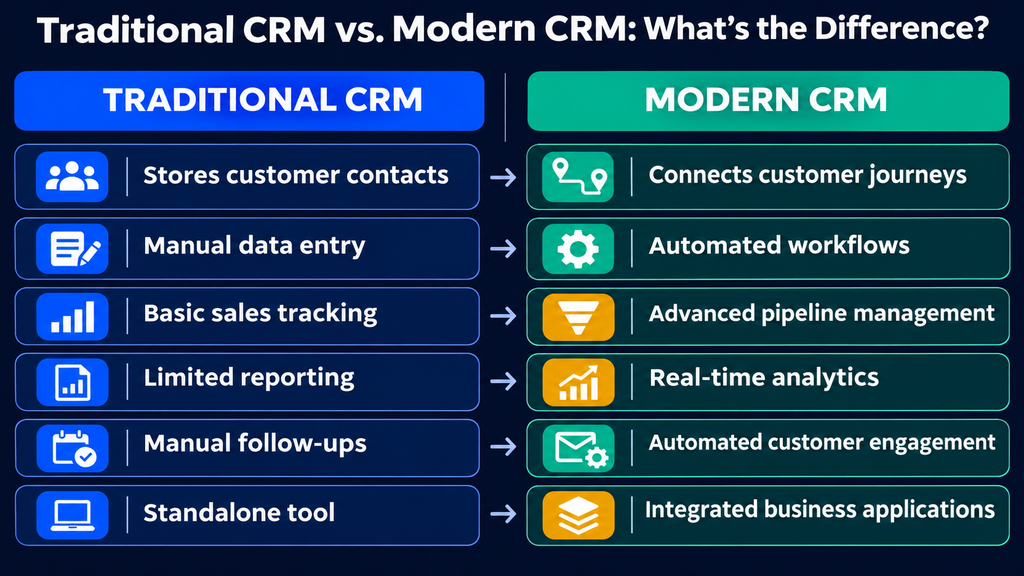
| Traditional CRM | Modern CRM |
|---|---|
| Stores customer contacts | Connects complete customer journeys |
| Focuses on manual data entry | Automates repetitive workflows |
| Provides basic sales tracking | Offers advanced pipeline management |
| Uses limited reporting | Supports real-time analytics |
| Relies heavily on manual follow-ups | Enables automated customer engagement |
| Provides limited intelligence | Uses AI-powered insights |
| Operates as a standalone tool | Integrates with wider business applications |
Modern CRM systems help businesses move from simply managing customer information to actively improving business performance.
How Can Businesses Choose the Right CRM Solution?
Selecting the right CRM software depends on business size, operational requirements, existing systems, and long-term objectives.
Before investing in a CRM platform, consider these important factors:
- Business requirements: Identify the sales, marketing, and customer service processes that need improvement.
- Automation capabilities: Look for tools that reduce repetitive work and improve operational efficiency.
- Integration options: Ensure the CRM connects with existing ERP, email, accounting, and business applications.
- Reporting and analytics: Choose a solution that provides meaningful insights into business performance.
- AI readiness: Consider AI capabilities that can support future business requirements.
- Scalability: Select a platform that can grow alongside your organization.
- Implementation expertise: Work with an experienced CRM partner who understands your business processes.
A successful CRM implementation is not just about installing software. It requires the right strategy, customization, integrations, employee training, and ongoing support.
How Sky Soft Connections Helps Businesses Get More From CRM
At Sky Soft Connections, we help businesses move beyond basic contact management by implementing CRM solutions that support real business objectives.
Our Microsoft Dynamics 365 CRM services are designed to improve customer management, automate business processes, and provide better visibility across operations.
Our services include:
- Dynamics 365 CRM Implementation: Deploying CRM solutions aligned with your sales, customer service, and operational requirements.
- CRM Customization: Configuring CRM entities, workflows, dashboards, forms, and business processes.
- CRM Automation: Using Power Automate to streamline repetitive tasks, approvals, notifications, and follow-ups.
- System Integration: Connecting CRM with ERP platforms, websites, email systems, and third-party applications.
- Data Migration: Moving customer and business information into CRM while maintaining data consistency.
- Power BI Reporting: Building interactive dashboards that help decision-makers understand business performance.
- AI and Copilot Solutions: Exploring AI-powered capabilities that improve customer insights, employee productivity, and business workflows.
- CRM Support and Maintenance: Providing ongoing assistance, optimization, and technical support.
Whether you are implementing CRM for the first time or improving an existing system, our team can help you build a solution that supports your business as it grows.
Read more : CRM Automation vs. Human Decision-Making
Frequently Asked Questions About Modern CRM
CRM helps businesses grow by improving lead management, automating sales activities, strengthening customer relationships, and providing better business insights. It also helps organizations identify opportunities and manage customer interactions more effectively.
No. Modern CRM platforms support multiple departments, including sales, marketing, customer service, and management. They connect customer information and business processes to improve collaboration and customer experiences.
Contact management focuses mainly on storing and organizing customer details. CRM goes further by managing customer relationships, tracking sales opportunities, automating workflows, monitoring interactions, and analyzing business performance.
Yes. AI can support lead scoring, sales forecasting, customer insights, automated summaries, and intelligent recommendations. However, its effectiveness depends on accurate data and proper system configuration.
Microsoft Dynamics 365 is a strong option for businesses that need flexible customer management, sales automation, reporting, integrations, and AI capabilities. The right choice ultimately depends on business requirements, budget, and existing technology.
Final Thoughts
Modern CRM is no longer just a place to store customer information. It is a business growth platform that connects people, processes, customer data, automation, and AI.
By adopting the right CRM strategy, businesses can improve sales performance, deliver better customer experiences, reduce manual work, and make more informed decisions.
However, real results depend on choosing the right platform and implementing it around actual business needs.
Ready to move beyond basic contact management?
Explore how Sky Soft Connections can help your business unlock more value from Microsoft Dynamics 365 CRM through implementation, customization, automation, integration, and AI-powered business solutions.
Visit Sky Soft Connections to discuss your CRM requirements.