
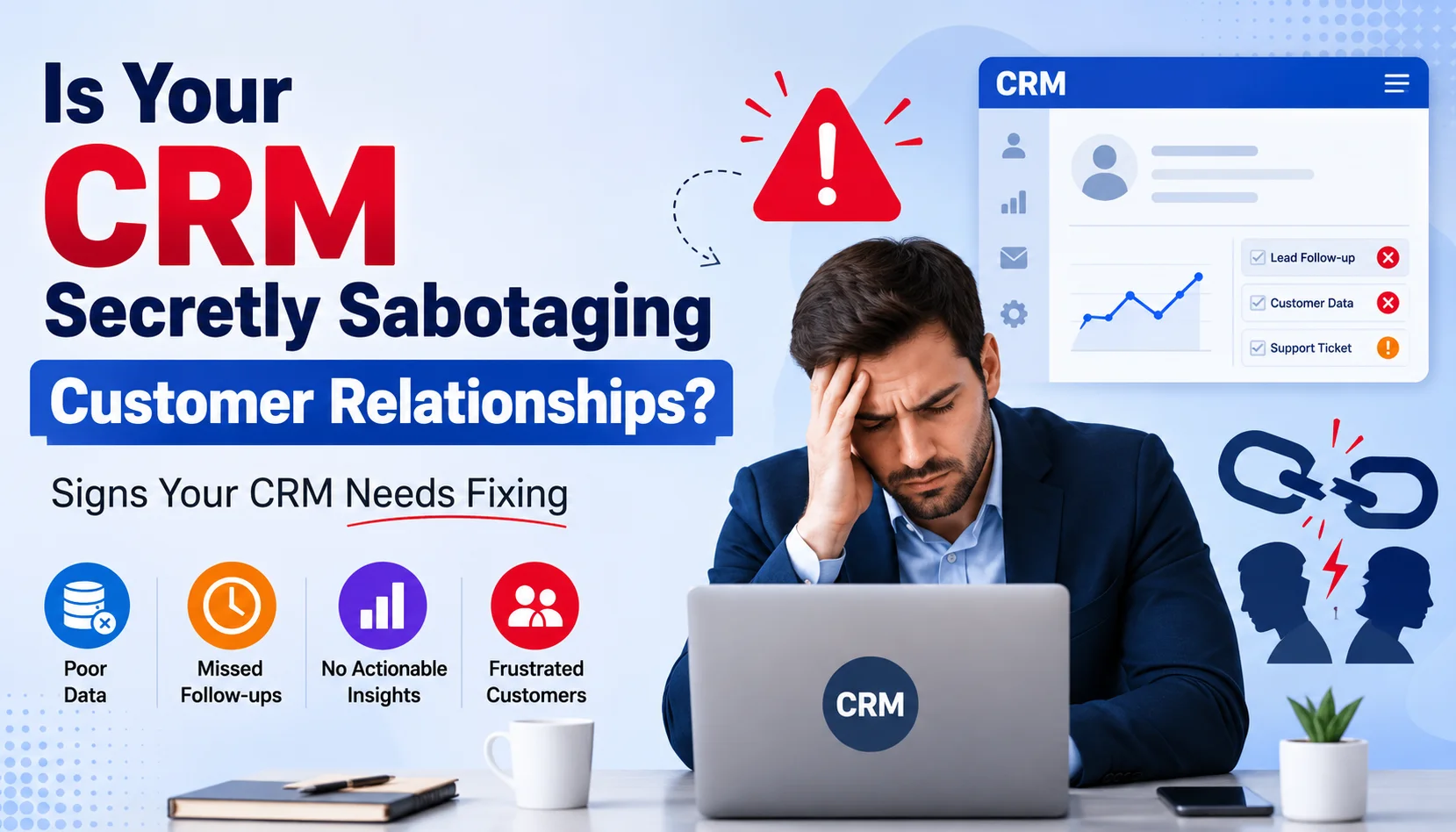
A CRM system is designed to strengthen customer relationships, improve sales visibility, and help businesses deliver better experiences. However, when poorly configured, outdated, or disconnected from business processes, your CRM can quietly become a barrier between your company and your customers.
Many organizations invest in CRM platforms expecting better customer engagement, faster responses, and increased revenue. Yet, they still struggle with missed follow-ups, inaccurate customer data, poor reporting, and frustrated teams.
The problem is not always the CRM software itself. Instead, the issue often comes from poor CRM implementation, lack of automation, outdated processes, and disconnected business systems.
A well-designed CRM should help teams understand customers better. On the other hand, a poorly managed CRM can secretly damage customer relationships without anyone noticing.
What Is a CRM and Why Does It Matter for Customer Relationships?
Customer Relationship Management (CRM) software helps businesses manage interactions with prospects and customers throughout the customer lifecycle.
A modern CRM system allows organizations to:
- Store and organize customer information
- Track sales opportunities
- Automate repetitive tasks
- Improve customer communication
- Monitor customer support activities
- Generate business insights through analytics
However, a CRM only delivers value when it matches your business processes.
For example, a sales team using a CRM with outdated workflows may spend more time managing the system than actually engaging with customers.
Therefore, CRM effectiveness depends on:
- Proper implementation
- Accurate data management
- User adoption
- Process automation
- Continuous optimization
How a Poor CRM System Damages Customer Relationships
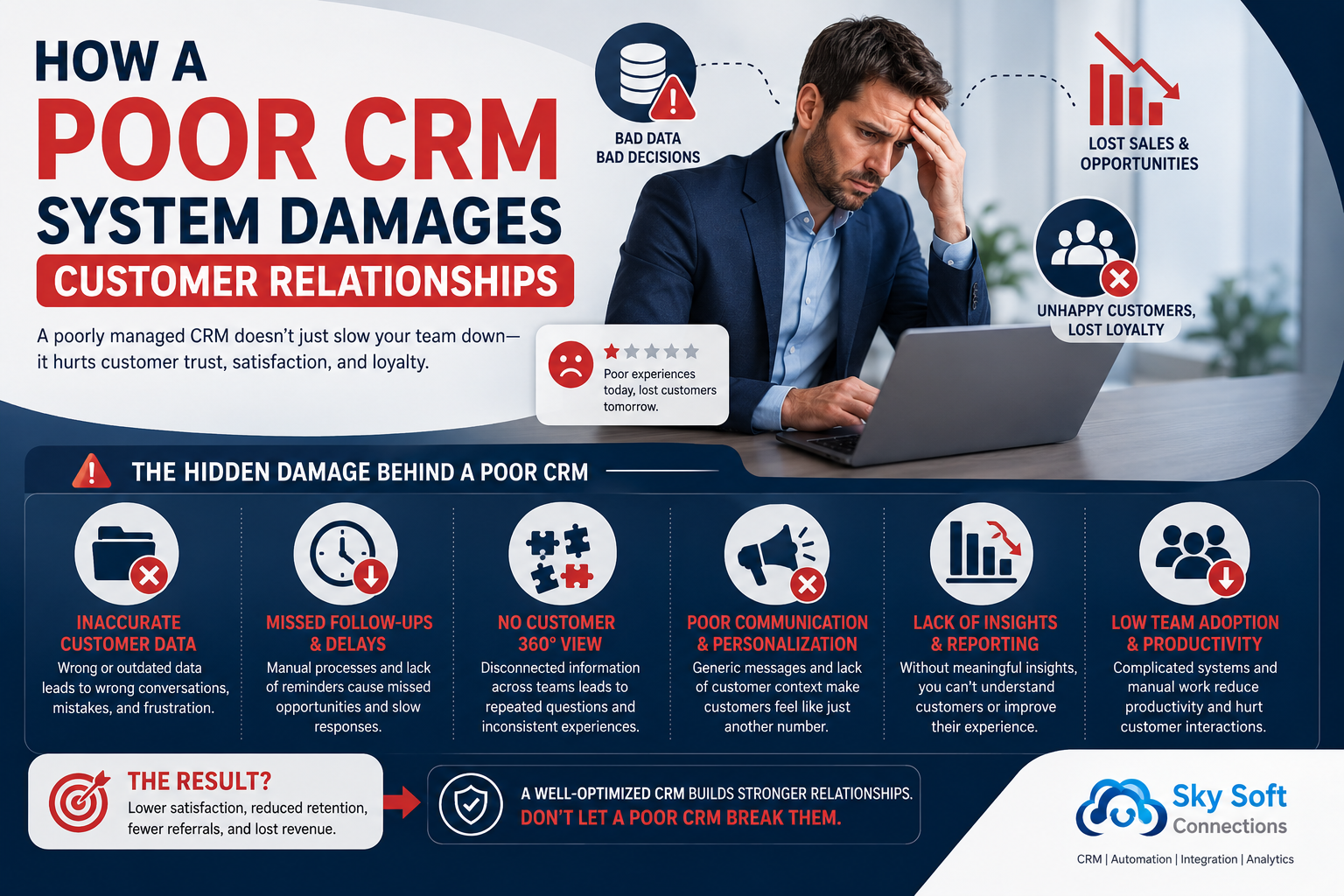
1. Poor Customer Data Creates Bad Customer Experiences
Your CRM database is the foundation of customer interactions. However, inaccurate or incomplete customer data can create serious problems.
When sales and service teams work with incorrect information, customers may experience:
- Repeated questions about previous conversations
- Incorrect product recommendations
- Missed follow-ups
- Delayed responses
- Poor personalization
For example, if a customer has already explained their issue to one department, they should not have to repeat the same information to another team.
A reliable CRM should provide a complete 360-degree customer view.
2. Lack of Automation Slows Down Customer Engagement
Modern customers expect quick responses. However, many businesses still rely on manual CRM processes.
Without automation, teams may struggle with:
- Manual data entry
- Forgotten follow-ups
- Delayed approvals
- Slow lead distribution
- Repetitive administrative work
A CRM should work as a productivity engine, not another manual task.
With CRM automation, businesses can:
- Automatically assign leads
- Send personalized emails
- Create task reminders
- Trigger customer notifications
- Improve response times
3. Your CRM May Have Too Much Data but Too Little Insight
Many companies collect thousands of customer records but fail to turn that information into actionable insights.
This creates a common problem:
More data does not always mean better decisions.
A CRM should answer important business questions:
| Business Question | CRM Capability Needed |
|---|---|
| Which leads are most valuable? | Sales pipeline analytics |
| Why are customers leaving? | Customer behavior tracking |
| Which campaigns perform best? | Marketing reports |
| Which sales activities generate revenue? | Performance dashboards |
| Where are process delays happening? | Workflow analysis |
Without proper reporting and analytics, businesses operate based on assumptions instead of real customer intelligence.
4. Poor CRM Integration Creates Information Silos
A CRM should connect your business operations. However, many organizations use disconnected systems for sales, marketing, finance, customer service, and reporting.
This creates information silos where teams cannot access complete customer information.
Common integration challenges include:
- CRM not connected with ERP systems
- Marketing platforms working separately
- Manual data transfers
- Duplicate customer records
- Limited reporting visibility
Consequently, customers receive inconsistent experiences across different touchpoints.
5. Low User Adoption Makes CRM Investment Fail
Even the most advanced CRM platform cannot succeed if employees avoid using it.
Many CRM projects fail because:
- The system is complicated
- Employees are not properly trained
- Workflows do not match real processes
- Teams see CRM as extra work
Therefore, successful CRM adoption requires:
- User-friendly workflows
- Proper training
- Process alignment
- Continuous improvements
A CRM should make employees’ jobs easier, not harder.
Signs Your CRM Is Secretly Hurting Your Business
Your CRM may be creating customer relationship problems if you notice:
| Warning Sign | Business Impact |
|---|---|
| Duplicate customer records | Confusing customer communication |
| Missing customer history | Poor personalization |
| Manual reporting | Slow decision-making |
| Low CRM usage | Reduced productivity |
| No automation | Increased operational costs |
| Limited integrations | Data visibility problems |
| Outdated workflows | Inefficient processes |
If multiple issues exist, your CRM may need optimization rather than replacement.
CRM Problems vs CRM Optimization Solutions
| CRM Challenge | Optimization Approach |
|---|---|
| Poor data quality | Data cleansing and governance |
| Manual processes | Workflow automation |
| Limited reporting | Advanced dashboards and analytics |
| Low adoption | User-focused CRM customization |
| Disconnected systems | CRM integrations |
| Slow customer response | Automated communication workflows |
How CRM Optimization Improves Customer Relationships
A properly optimized CRM helps businesses create stronger customer connections by providing:
Better Customer Visibility
Teams can access complete customer histories, previous interactions, preferences, and buying patterns.
Faster Response Times
Automation helps businesses respond quickly to customer inquiries and opportunities.
Personalized Customer Experiences
Businesses can deliver relevant communication based on customer behavior and needs.
Improved Team Collaboration
Sales, marketing, and support teams can work from the same customer information.
Smarter Business Decisions
Real-time dashboards and analytics help leaders make informed decisions.
How Sky Soft Connections Helps Businesses Transform Their CRM Systems
At Sky Soft Connections, we help organizations optimize their CRM platforms to improve customer experiences, streamline operations, and increase business efficiency.
Our CRM solutions are designed around your unique business processes instead of forcing your organization to adapt to a rigid system.
Our CRM services include:
Microsoft Dynamics 365 CRM Implementation
We help businesses implement and customize Microsoft Dynamics 365 CRM solutions that improve sales, customer service, and business visibility.
CRM Customization and Workflow Automation
Our team develops customized workflows, automation rules, and business processes that reduce manual work and improve productivity.
Microsoft Power Platform Solutions
We use Microsoft Power Platform tools including Power Apps, Power Automate, and Power BI to extend CRM capabilities.
Businesses can benefit from:
- Custom business applications
- Automated workflows
- Advanced reporting dashboards
- Data-driven decision-making
CRM Integration Services
We connect CRM platforms with existing business systems to eliminate data silos and create a unified business environment.
CRM Data Migration and Optimization
We help businesses clean, organize, and migrate customer data while maintaining accuracy and reliability.
How to Fix a CRM That Is Damaging Customer Relationships
Follow these steps to improve your CRM performance:
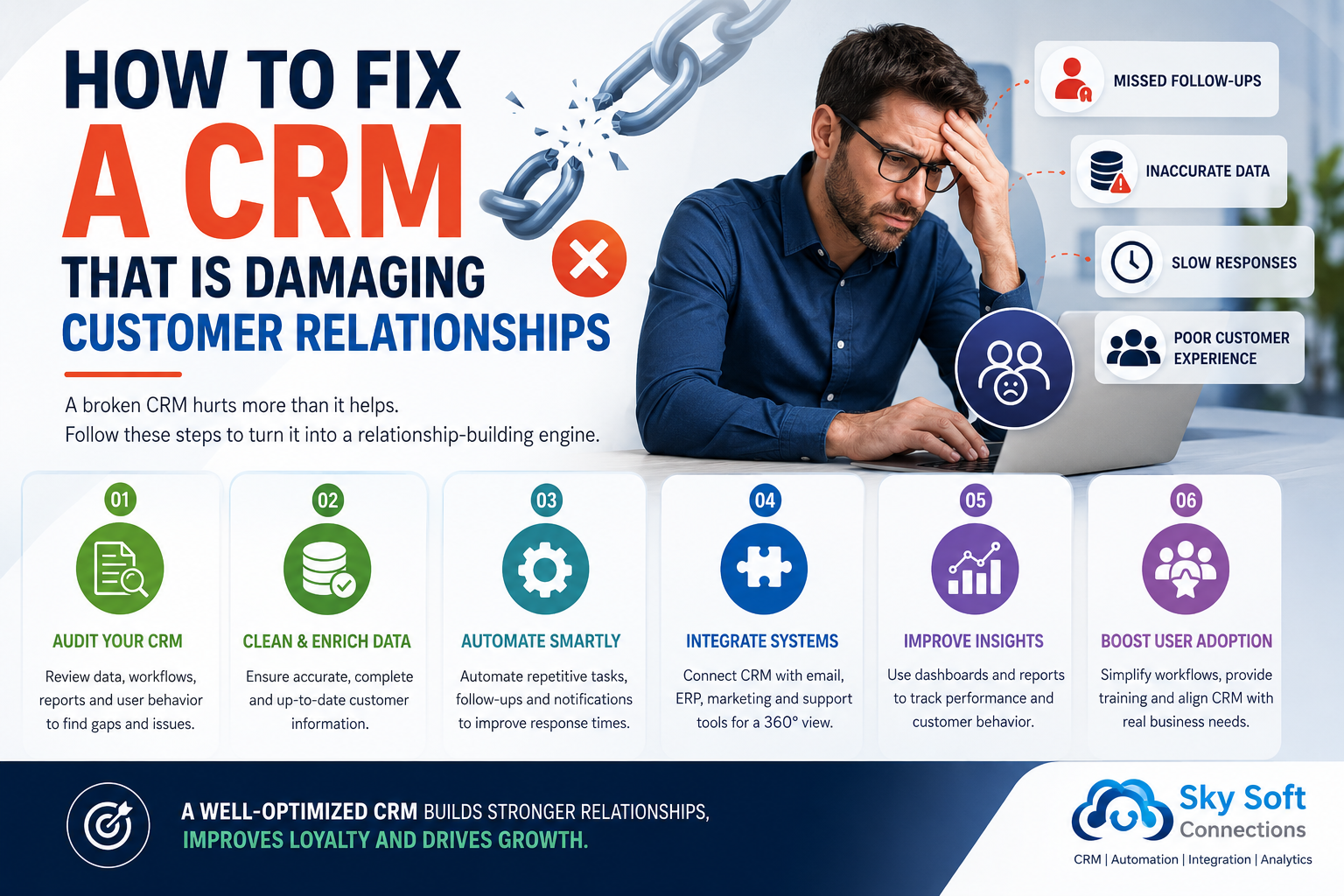
Step 1: Audit Your Current CRM System
Review:
- Data accuracy
- User adoption
- Existing workflows
- Reporting capabilities
- Integration issues
Step 2: Identify Process Gaps
Find areas where employees still rely on:
- Spreadsheets
- Manual approvals
- Duplicate systems
- Email-based processes
Step 3: Automate Repetitive Tasks
Use automation to reduce administrative workload and improve customer response times.
Step 4: Improve User Experience
Simplify dashboards, forms, and workflows based on employee requirements.
Step 5: Monitor and Improve Continuously
CRM optimization is not a one-time project. Regular improvements ensure long-term success.
Read more : CRM Data Rot: The Silent Killer Eating Your Pipeline Right Now
Frequently Asked Questions (FAQs)
Yes. A poorly configured CRM can create inaccurate data, slow responses, and inconsistent customer experiences.
Signs include low user adoption, duplicate records, poor reporting, manual processes, and customer complaints.
In many cases, CRM optimization is more cost-effective than replacing the entire system. Improving workflows, integrations, and data quality can significantly increase CRM value.
CRM automation helps businesses respond faster, personalize communication, reduce errors, and maintain consistent customer interactions.
Final Thoughts
Your CRM should strengthen customer relationships, not silently damage them.
However, outdated processes, poor data management, and disconnected systems can turn a powerful CRM platform into a business obstacle.
By optimizing your CRM strategy, improving automation, and aligning technology with business goals, you can create better customer experiences and improve operational efficiency.
With expert CRM consulting, customization, and automation services from Sky Soft Connections, businesses can transform their CRM from a simple database into a powerful customer relationship engine.