
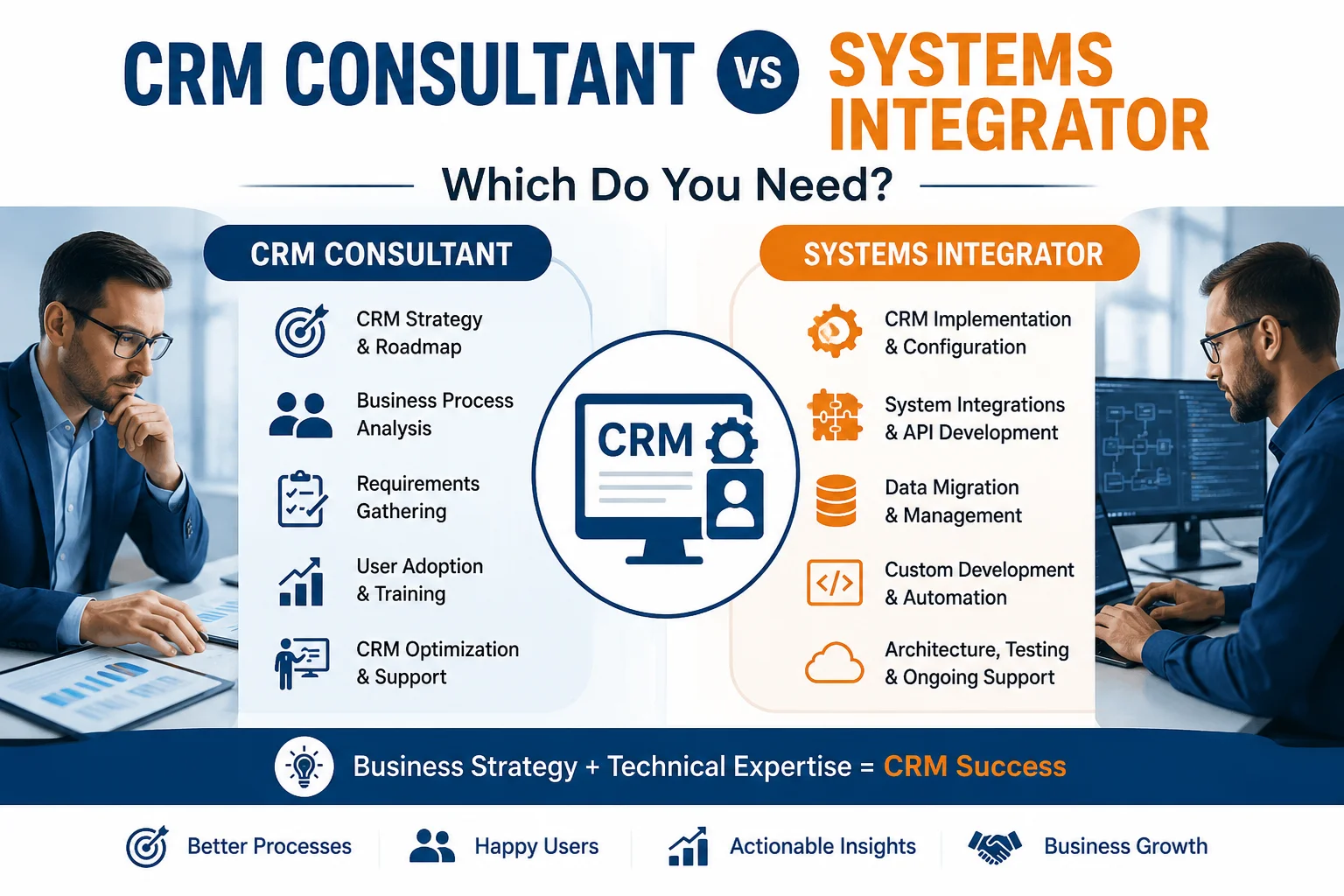
Choosing the right CRM partner can make or break your CRM implementation. However, many businesses struggle to understand the difference between a CRM consultant and a systems integrator.
Both can help you improve your CRM strategy, configure business processes, and get more value from platforms such as Microsoft Dynamics 365. However, their roles, responsibilities, and level of involvement can be very different.
So, do you need a CRM consultant, a systems integrator, or both?
This guide explains the difference, when to hire each, and how to choose the right CRM implementation partner for your business.
What Is a CRM Consultant?
A CRM consultant focuses primarily on your business requirements, CRM strategy, processes, and user needs.
Rather than starting with technology, a good CRM consultant first looks at how your business operates. They identify inefficiencies, understand your objectives, and recommend ways to improve your CRM environment.
A CRM consultant may help with:
- CRM strategy and roadmap development
- Business process analysis
- CRM requirements gathering
- Platform and module selection
- Workflow improvement
- User adoption and training
- CRM data and reporting requirements
- Change management
- CRM optimization
- Implementation planning
For example, if your sales team is managing leads through spreadsheets, emails, and disconnected systems, a CRM consultant can determine how those processes should work inside a CRM.
When Should You Hire a CRM Consultant?
A CRM consultant is particularly useful when you:
- Are selecting a CRM for the first time
- Need help defining CRM requirements
- Have inefficient sales or customer service processes
- Are struggling with CRM adoption
- Need a CRM strategy before implementation
- Want to improve an existing CRM
- Need an independent assessment of your current CRM
In short, a CRM consultant helps answer: “What should our CRM do, and why?”
What Is a Systems Integrator?
A systems integrator goes further into the technical implementation and integration of your business systems.
Instead of focusing only on CRM requirements, a systems integrator connects the CRM with the other technologies your business already uses.
For example, your CRM may need to communicate with:
- ERP systems
- Accounting platforms
- Marketing automation tools
- Customer portals
- Websites
- Data warehouses
- Microsoft 365
- Power BI
- Custom applications
- Third-party APIs
- Cloud services
A systems integrator designs and implements these connections so your technology ecosystem works as one connected environment.
What Does a Systems Integrator Do?
A systems integrator may handle:
- CRM implementation
- System architecture
- CRM customization
- API integrations
- Data migration
- Workflow automation
- Custom application development
- Cloud integration
- Business intelligence
- Security and user permissions
- Testing and deployment
- Ongoing technical support
Therefore, a systems integrator is usually more involved when your CRM project extends beyond the CRM platform itself.
A systems integrator helps answer: “How do we make all these systems work together?”
CRM Consultant vs Systems Integrator: Key Differences
Although there is some overlap, the main difference is their area of focus.
| Area | CRM Consultant | Systems Integrator |
|---|---|---|
| CRM strategy | Strong focus | Supporting role |
| Business requirements | Strong focus | Strong focus |
| Process analysis | Strong focus | Strong focus |
| CRM configuration | Often | Strong focus |
| Custom development | Limited | Strong focus |
| System integrations | Limited to moderate | Strong focus |
| Data migration | Planning/support | Implementation |
| API development | Usually limited | Strong focus |
| User training | Strong focus | Often included |
| System architecture | Moderate | Strong focus |
| Power Platform development | Sometimes | Often |
| Ongoing technical support | Sometimes | Usually available |
However, these roles are not always completely separate. Many experienced technology partners provide both CRM consulting and systems integration services.
CRM Consultant or Systems Integrator: Which One Do You Need?
The answer depends on the complexity of your project.
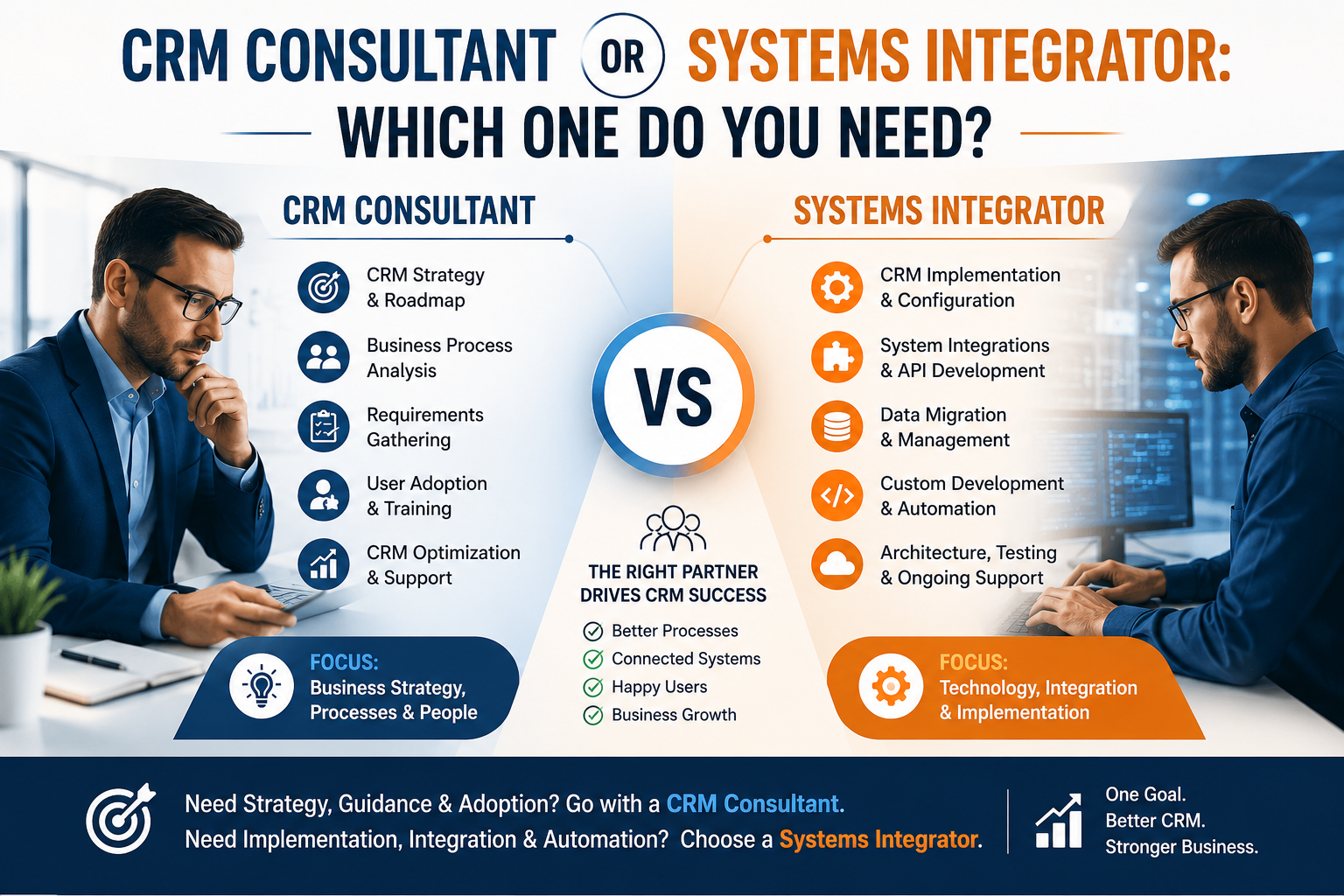
Choose a CRM Consultant If…
Your main challenge is business strategy and process improvement.
For example, you may need help answering:
- Which CRM platform should we choose?
- What CRM features do we actually need?
- How should our sales process work?
- Why are employees not using our CRM?
- How can we improve customer data quality?
- Which CRM reports should management receive?
In this situation, starting with a CRM consultant makes sense.
Choose a Systems Integrator If…
Your CRM project involves multiple systems or significant technical development.
For example:
Your company wants to implement Dynamics 365, migrate existing customer data, connect it with Business Central, automate workflows using Power Automate, and create management dashboards in Power BI.
That is more than a simple CRM configuration project.
You need a partner capable of handling CRM implementation, integration, automation, data migration, and technical architecture.
What If You Need Both?
For many medium-sized and enterprise businesses, the answer is both.
A CRM consultant can define the business requirements and implementation strategy. Then, a systems integrator can translate those requirements into a functioning technical environment.
The process can look like this:
Business Requirements → CRM Strategy → Solution Design → Implementation → Integration → Testing → Training → Optimization
When one experienced partner can handle the complete process, communication can become easier because business requirements and technical decisions remain aligned.
Why Systems Integration Matters in Modern CRM Projects
Today’s CRM systems rarely operate in isolation.
For example, a customer may enter your business through your website. Their information could then move into your CRM, trigger an automated workflow, appear in a sales dashboard, and eventually connect with an ERP or finance system.
Without integration, employees may have to manually transfer information between platforms.
That creates several problems:
- Duplicate data
- Manual entry
- Delayed updates
- Reporting errors
- Poor customer visibility
- Increased operational costs
With proper integration, information can move automatically between connected systems.
Therefore, when evaluating a CRM implementation partner, don’t only ask whether they can configure the CRM. Ask whether they understand your entire technology environment.
How Sky Soft Connections Can Help
At Sky Soft Connections, CRM projects can be approached from both the business and technical sides.
Our services cover Microsoft Dynamics 365 CRM, Microsoft Power Platform, custom .NET development, Azure, data migration, reporting, automation, and system integration.
Depending on your requirements, our team can help with:
Microsoft Dynamics 365 CRM
We help businesses implement and customize Dynamics 365 CRM around their actual sales, customer service, and operational processes.
Microsoft Power Platform
Our Power Platform capabilities include:
- Power Apps
- Power Automate
- Power BI
- Power Pages
- Power Virtual Agents
These tools can extend your CRM environment with custom applications, workflow automation, portals, dashboards, and AI-powered experiences.
Data Migration
Moving data from legacy CRMs, spreadsheets, databases, or other applications requires careful planning.
We can help with data mapping, transformation, migration, validation, and implementation for smooth Data migration.
Custom .NET Portals
When standard CRM functionality isn’t enough, custom .NET solutions can extend your platform and support specific business requirements.
Azure Solutions
Azure can support scalable cloud architectures, integrations, applications, and data solutions around your CRM environment.
SSRS and Business Reporting
CRM data becomes more valuable when decision-makers can easily understand it. Reporting and analytics solutions can provide better visibility into sales, customers, operations, and performance.
Questions to Ask Before Choosing a CRM Partner
Before hiring a CRM consultant or systems integrator, ask these questions:
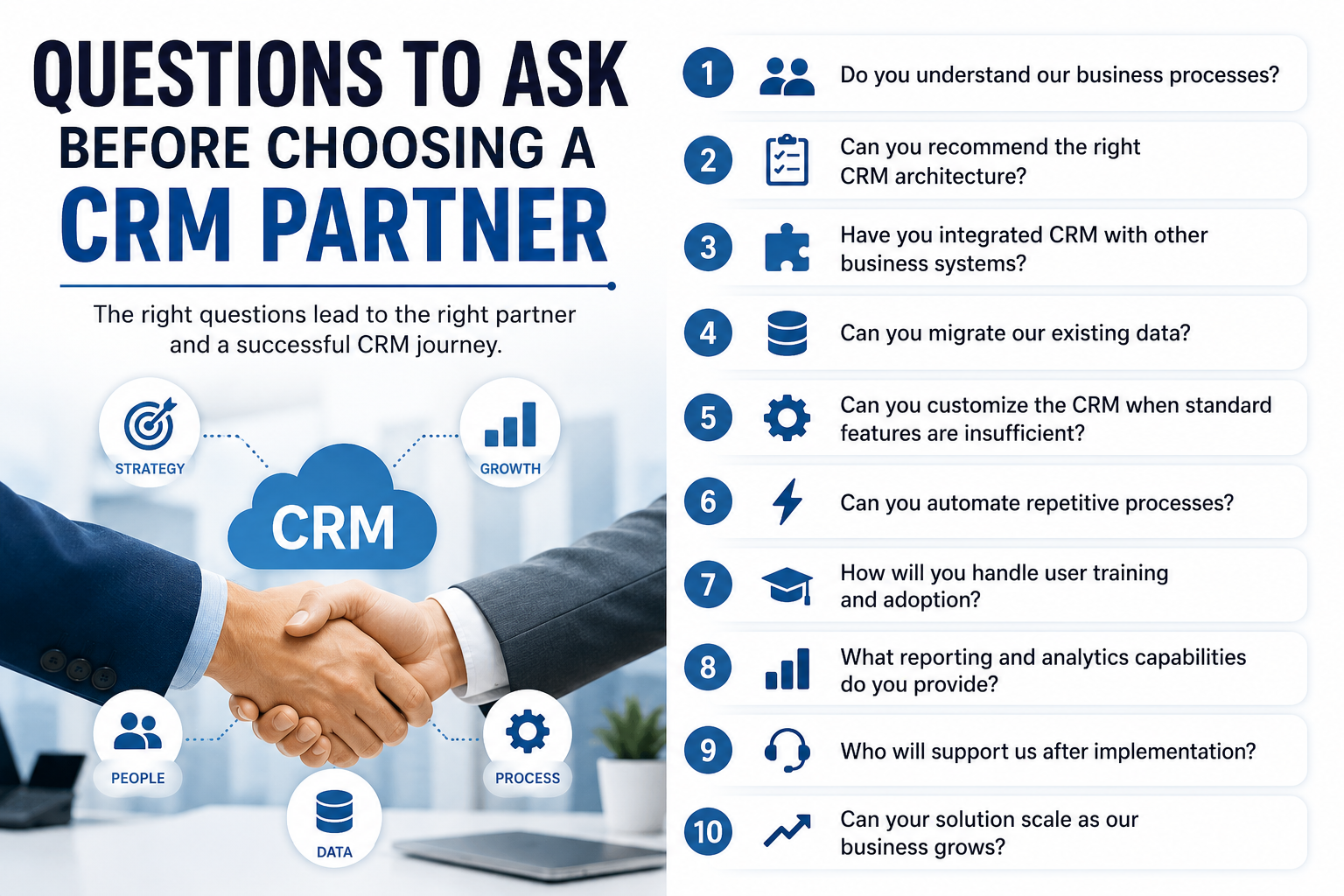
- Do you understand our business processes?
- Can you recommend the right CRM architecture?
- Have you integrated CRM with other business systems?
- Can you migrate our existing data?
- Can you customize the CRM when standard features are insufficient?
- Can you automate repetitive processes?
- How will you handle user training and adoption?
- What reporting and analytics capabilities do you provide?
- Who will support us after implementation?
- Can your solution scale as our business grows?
The goal is not simply to find a company that can install CRM software. Instead, look for a partner that understands your business, technology, users, data, and long-term goals.
Common Mistake: Choosing Based Only on CRM Expertise
A partner may have excellent CRM knowledge but limited experience with integrations, data architecture, or custom development.
Likewise, a technically strong systems integrator may build a sophisticated solution that doesn’t properly reflect your business processes.
That is why the best CRM projects start with both business understanding and technical expertise.
A successful implementation should balance:
People + Processes + Technology + Data
If one of these areas is ignored, the CRM may fail to deliver its expected value.
CRM Consultant vs Systems Integrator: Quick Decision Guide
Use this simple guide if you’re still unsure.
| Your Requirement | Best Fit |
|---|---|
| CRM strategy | CRM Consultant |
| Business process review | CRM Consultant |
| CRM platform selection | CRM Consultant |
| CRM implementation | Systems Integrator |
| Multiple system integration | Systems Integrator |
| Data migration | Systems Integrator |
| API development | Systems Integrator |
| CRM training | CRM Consultant |
| Workflow automation | Both |
| Power Platform development | Systems Integrator |
| Complex enterprise transformation | Both |
The Simple Rule
If your primary question is “What should our CRM look like?”, start with a CRM consultant.
If your question is “How do we connect and implement everything?”, you likely need a systems integrator.
If you are undertaking a complex CRM transformation, choosing a partner that can provide both capabilities can be the most practical approach.
Read more : Why Your CRM Documentation Is Already Out of Date (And How to Fix It)
Frequently Asked Questions
No. A CRM consultant generally focuses more on CRM strategy, business processes, requirements, and adoption. A systems integrator focuses more heavily on implementation, integrations, data, development, and technical architecture.
Not necessarily. If your systems integrator has strong CRM consulting capabilities, one partner can potentially manage both strategy and implementation.
Yes. Systems integrators can typically configure and customize Dynamics 365, develop integrations, migrate data, automate workflows, and connect other business applications.
The best partner depends on your requirements. Look for a provider with proven CRM expertise, integration capabilities, data migration experience, technical development skills, and a clear post-implementation support process.
Final Thoughts
The difference between a CRM consultant and a systems integrator ultimately comes down to focus.
A CRM consultant helps you understand what your business needs from CRM. A systems integrator helps you build, connect, automate, and deploy the technology required to deliver it.
However, modern CRM projects often require both.
If your organization is considering Microsoft Dynamics 365, Power Platform, CRM integration, data migration, automation, or custom business applications, Sky Soft Connections can help you move from CRM strategy to implementation and integration.
The right CRM partner should not simply deliver software. Instead, they should help you build a CRM environment that supports your people, processes, data, and long-term business goals.