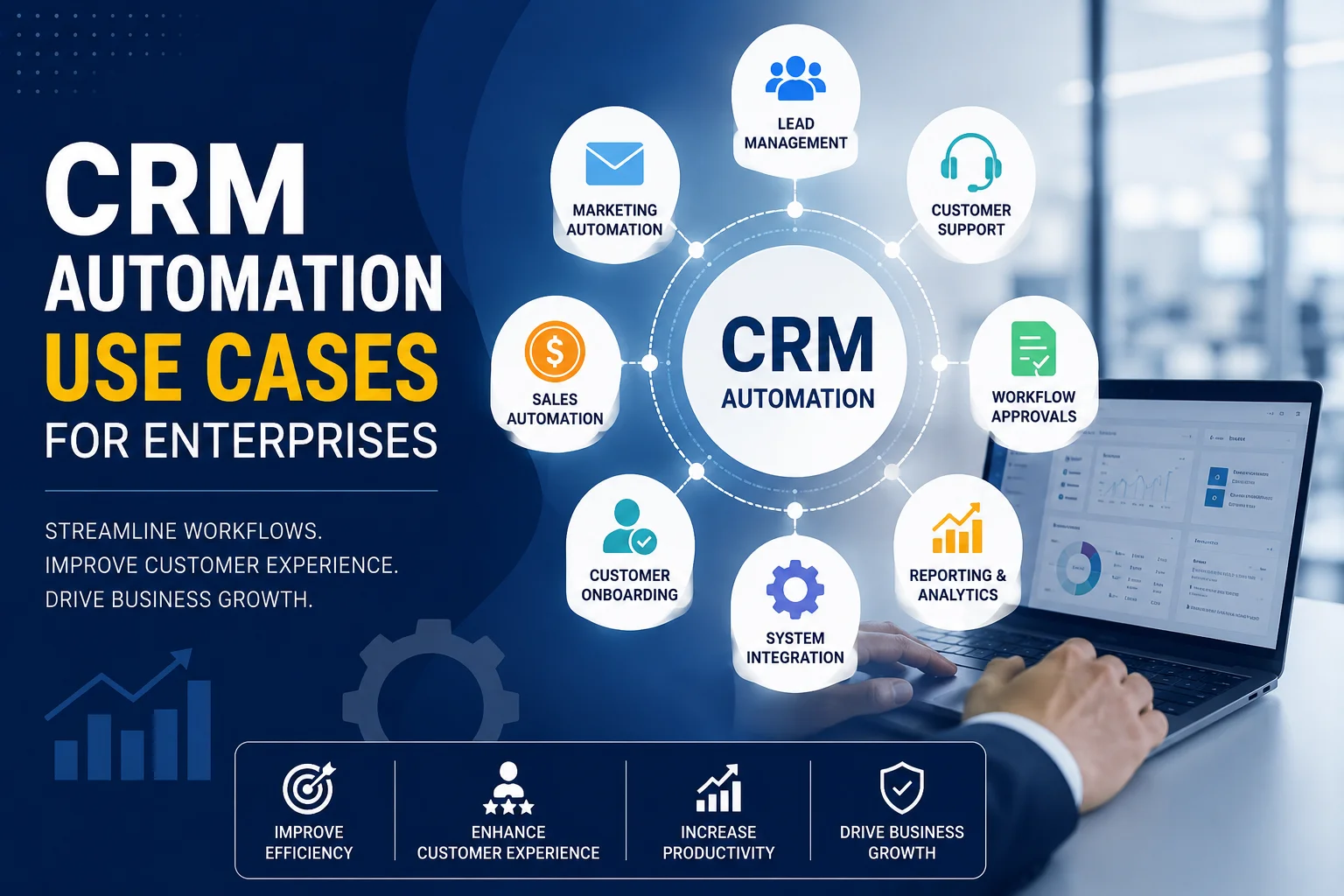
Enterprise businesses manage thousands of customer interactions, sales activities, support requests, and operational workflows every day. However, when these processes rely on manual handling, disconnected systems, or outdated CRM setups, productivity drops quickly. As a result, businesses face slower response times, inconsistent customer experiences, and operational inefficiencies.
This is where CRM automation becomes essential.
Modern CRM automation helps enterprises streamline operations, improve customer engagement, reduce repetitive work, and increase visibility across departments. More importantly, it allows teams to focus on strategic tasks instead of manual administration.
At Sky Soft Connection, businesses can implement customized CRM automation solutions using Microsoft Dynamics CRM, Power Platform, AI integrations, workflow automation, reporting dashboards, and enterprise portals tailored to operational goals.
What Is CRM Automation?
CRM automation refers to the use of technology to automate repetitive customer relationship management tasks. These tasks may include:
- Lead assignment
- Follow up emails
- Workflow approvals
- Customer onboarding
- Support ticket routing
- Reporting and analytics
- Data synchronization
- Sales notifications
- Marketing campaigns
Instead of relying on manual updates, automated CRM systems trigger actions based on predefined conditions and business rules.
As enterprises grow, automation becomes increasingly important because manual processes simply cannot scale efficiently.
Why Enterprises Need CRM Automation
Large organizations deal with multiple teams, departments, and customer touchpoints simultaneously. Therefore, maintaining operational consistency without automation becomes difficult.
Common Enterprise Challenges
| Challenge | Business Impact |
|---|---|
| Manual data entry | Increased human errors |
| Slow lead management | Lower conversion rates |
| Disconnected departments | Poor collaboration |
| Delayed reporting | Weak decision making |
| Repetitive administrative tasks | Reduced productivity |
| Inconsistent customer communication | Poor customer experience |
CRM automation solves these issues by creating faster, smarter, and more connected workflows.
Top CRM Automation Use Cases for Enterprises
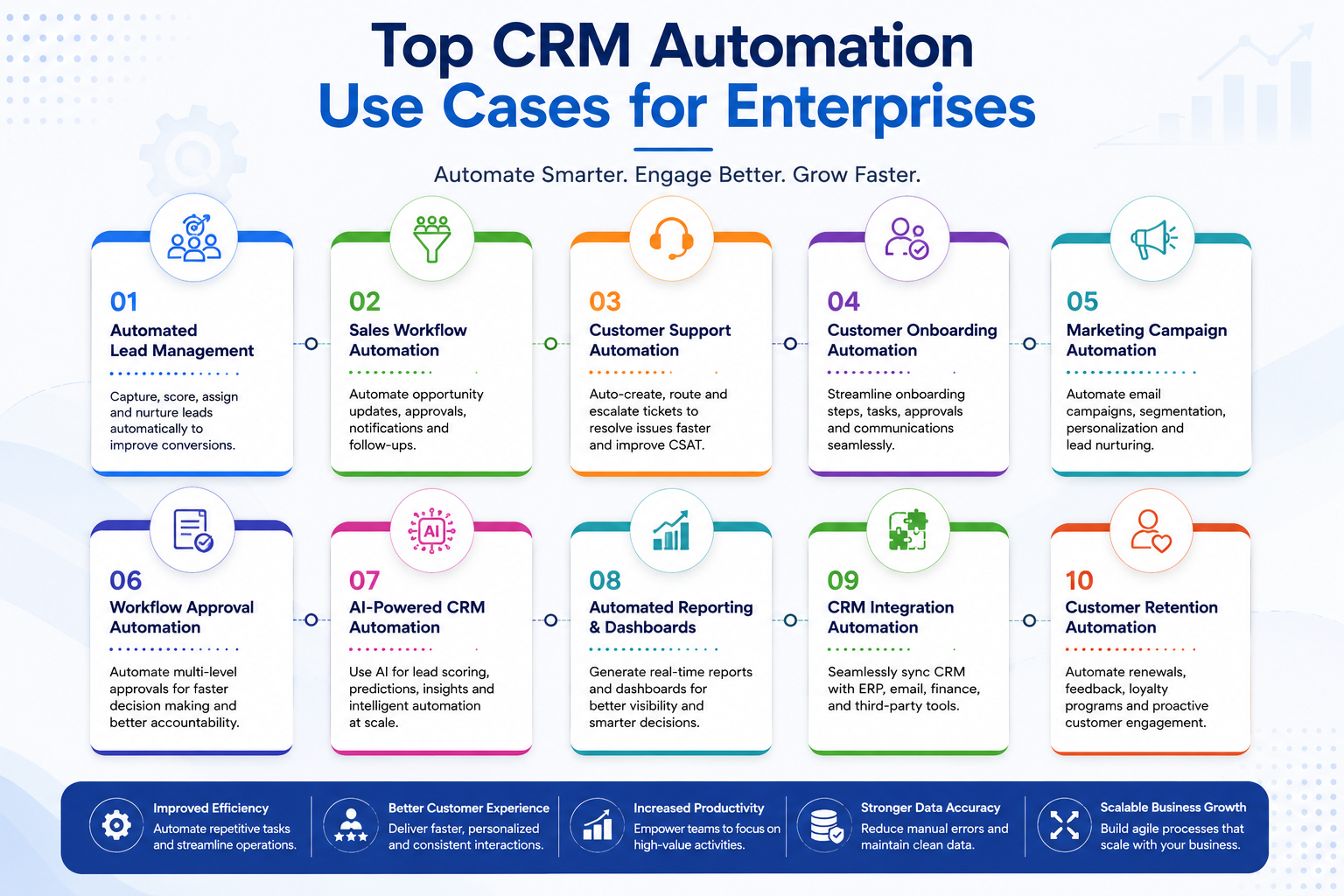
1. Automated Lead Management
Lead management is one of the most common CRM automation use cases.
Without automation, sales teams often struggle to manage lead distribution, follow ups, and prioritization. Consequently, valuable opportunities may be missed.
How CRM Automation Helps
- Automatically assign leads to sales representatives
- Trigger follow up emails instantly
- Score leads based on engagement
- Route enterprise leads to specialized departments
- Send reminders for pending actions
Benefits
- Faster response times
- Improved lead conversion
- Better sales pipeline visibility
- Reduced lead leakage
For enterprises handling high lead volumes, automated lead workflows significantly improve sales performance.
2. Sales Workflow Automation
Sales teams spend considerable time updating records, sending emails, and managing approvals manually. However, automation reduces this administrative burden.
Enterprise Sales Automation Examples
| Automation Area | Example |
|---|---|
| Opportunity updates | Automatic stage progression |
| Proposal approvals | Workflow based approval routing |
| Sales reminders | Automated notifications |
| Quote generation | Instant document creation |
| Meeting scheduling | Calendar integrations |
As a result, sales representatives can focus more on closing deals instead of performing repetitive tasks.
3. Customer Support Ticket Automation
Customer service teams often manage hundreds or even thousands of support requests daily. Therefore, ticket automation becomes essential for maintaining service quality.
CRM Support Automation Features
- Automatic ticket creation
- Priority based routing
- SLA tracking
- Escalation workflows
- Automated status updates
- AI powered response suggestions
Key Advantages
- Faster issue resolution
- Improved customer satisfaction
- Better support team productivity
- Reduced response delays
Enterprises that automate customer support workflows typically achieve better service consistency and operational efficiency.
4. Automated Customer Onboarding
Customer onboarding directly affects customer retention and long term satisfaction. However, manual onboarding processes can create delays and inconsistencies.
CRM automation simplifies onboarding by standardizing every step.
Automated Onboarding Workflow
- Customer registration
- Welcome email delivery
- Account setup tasks
- Document verification
- Internal team notifications
- Training resource sharing
- Follow up scheduling
Because the process becomes automated, enterprises deliver a smoother customer experience while reducing onboarding time.
5. Marketing Campaign Automation
Marketing teams require automation to manage enterprise scale campaigns effectively.
CRM automation allows businesses to personalize customer journeys while reducing manual effort.
Marketing Automation Use Cases
- Email campaign scheduling
- Customer segmentation
- Behavior based targeting
- Drip campaigns
- Event registrations
- Automated follow ups
- Campaign performance tracking
Benefits for Enterprises
- Better customer engagement
- Higher campaign efficiency
- Improved ROI tracking
- Personalized communication at scale
Additionally, CRM marketing automation improves alignment between sales and marketing teams.
6. Workflow Approval Automation
Large enterprises often require multiple approvals for sales, procurement, finance, or operational processes. Unfortunately, manual approvals slow down productivity.
CRM automation simplifies approval management.
Examples of Approval Workflows
| Department | Automated Approval Process |
|---|---|
| Finance | Invoice approvals |
| Sales | Discount approvals |
| HR | Employee onboarding approvals |
| Procurement | Vendor approvals |
| Operations | Service request approvals |
As workflows become digital and automated, businesses reduce delays and improve accountability.
7. AI Powered CRM Automation
Artificial intelligence is transforming enterprise CRM systems rapidly.
Modern CRM platforms now use AI to automate insights, predictions, and customer interactions.
AI CRM Automation Use Cases
- Predictive lead scoring
- Customer sentiment analysis
- AI chatbots
- Sales forecasting
- Automated recommendations
- Intelligent workflow triggers
At Sky Soft Connection, businesses can integrate AI capabilities into Microsoft Dynamics CRM and Power Platform solutions to create smarter enterprise workflows.
8. Automated Reporting and Dashboards
Reporting is critical for enterprise decision making. However, manual reporting consumes time and often produces outdated insights.
CRM automation enables real time reporting dashboards.
Key Reporting Automation Features
- Real time KPI tracking
- Automated report generation
- Department specific dashboards
- Executive performance summaries
- Custom analytics visualization
Enterprise Benefits
- Faster decision making
- Better operational visibility
- Improved forecasting accuracy
- Reduced manual reporting workload
9. CRM Integration Automation
Enterprises often use multiple systems including ERP, HR software, accounting platforms, and customer service tools.
CRM automation helps connect these systems seamlessly.
Common CRM Integrations
- ERP systems
- Microsoft Teams
- Outlook
- Accounting software
- Customer portals
- Power BI dashboards
- Inventory systems
Because information flows automatically between systems, businesses reduce duplication and improve data accuracy.
10. Customer Retention Automation
Retaining customers is more cost effective than acquiring new ones. Therefore, enterprises increasingly use CRM automation to improve customer retention.
Retention Automation Examples
- Renewal reminders
- Satisfaction surveys
- Loyalty campaigns
- Automated follow ups
- Customer health monitoring
- Proactive support alerts
These automated engagement strategies help enterprises strengthen long term customer relationships.
Benefits of CRM Automation for Enterprises
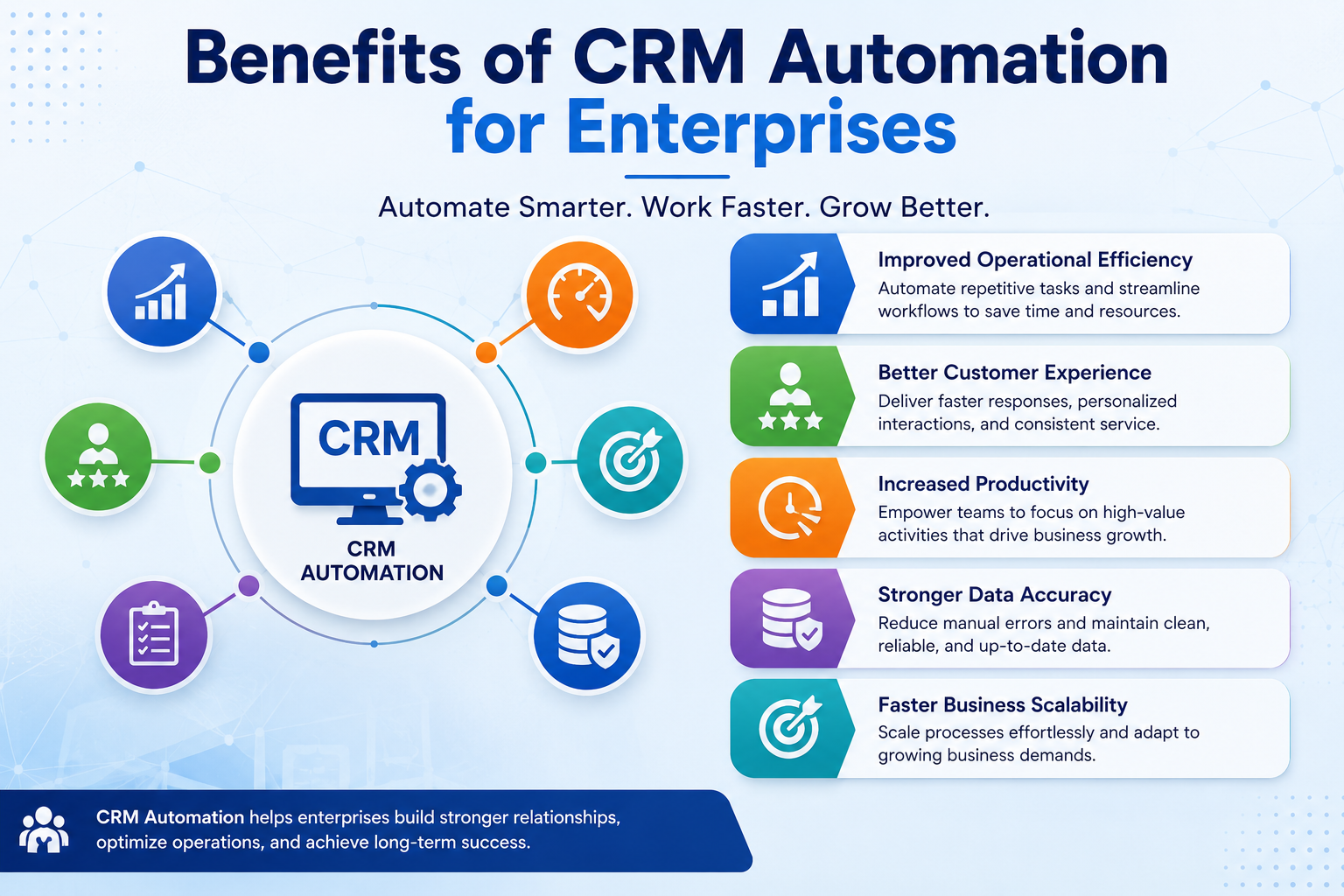
Improved Operational Efficiency
Automation removes repetitive tasks and speeds up workflows significantly.
Better Customer Experience
Customers receive faster responses, consistent communication, and improved support.
Increased Productivity
Employees spend more time on strategic work rather than administrative activities.
Stronger Data Accuracy
Automated systems reduce manual entry errors and improve reporting quality.
Faster Business Scalability
Enterprises can handle growing workloads without increasing operational complexity.
Best Practices for Successful CRM Automation
Define Clear Business Goals
Start by identifying which processes require automation and what outcomes the business expects.
Automate High Impact Tasks First
Focus on repetitive and time consuming tasks that directly affect productivity.
Ensure Proper CRM Architecture
A strong CRM foundation is essential for scalable automation.
Train Employees Properly
Teams should understand workflows, automation triggers, and reporting systems clearly.
Monitor and Optimize Workflows
Automation should continuously evolve based on business needs and operational feedback.
Why Enterprises Choose Sky Soft Connection
Sky Soft Connection provides enterprise CRM solutions designed to improve operational performance, customer management, and workflow automation.
Services Include
- Microsoft Dynamics CRM customization
- Power Apps development
- Power Automate workflows
- AI powered CRM integrations
- Customer portals
- Reporting dashboards
- Data migration services
- Enterprise workflow automation
The company helps enterprises build scalable CRM ecosystems that support long term digital transformation goals.
Final Thoughts
CRM automation is no longer optional for enterprises aiming to improve efficiency, customer experience, and scalability. As business operations become increasingly complex, automation provides the structure and intelligence required to manage workflows effectively.
From automated lead management and customer support to AI driven analytics and reporting dashboards, CRM automation delivers measurable business value across departments.
Businesses that invest in scalable CRM automation solutions today position themselves for stronger growth, better operational visibility, and improved customer relationships in the future.
Read more : Hidden Costs of Poor CRM Architecture
FAQ’s
CRM automation helps enterprises automate repetitive business tasks such as lead management, customer support, workflow approvals, reporting, and follow ups using CRM software and AI driven workflows.
CRM automation reduces manual work, improves response times, increases data accuracy, and streamlines workflows across sales, marketing, and customer service departments.
Many enterprises prefer solutions like Microsoft Dynamics 365 because it supports advanced workflow automation, AI integrations, reporting dashboards, and scalable business process management.