
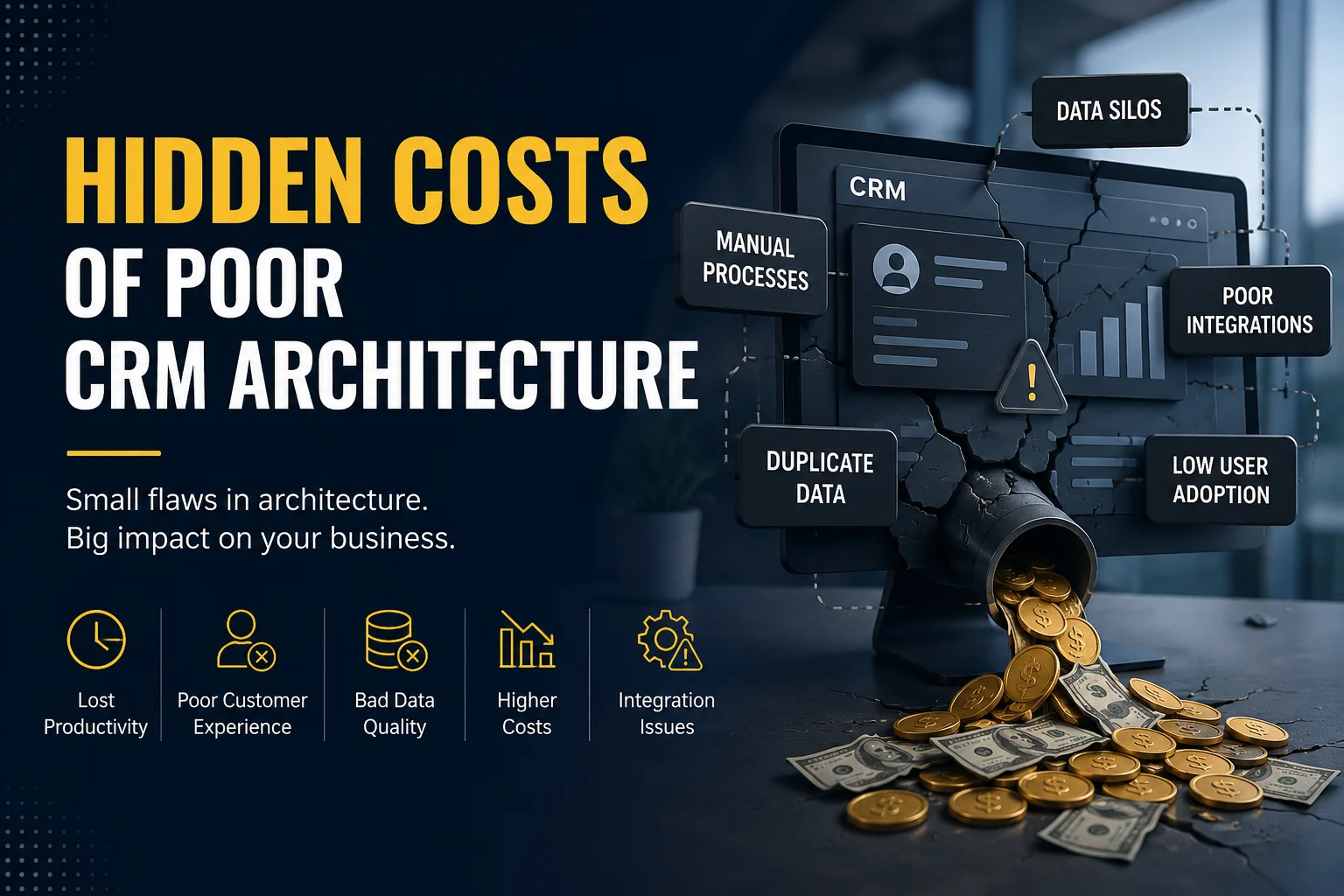
Modern businesses rely on CRM systems to manage sales, customer relationships, operations, and reporting. However, many companies focus only on implementing a CRM without paying attention to the underlying CRM architecture. As a result, they often face performance issues, operational delays, data problems, and rising costs over time.
A poorly designed CRM system may seem functional in the beginning. Yet, as the business grows, hidden inefficiencies start affecting productivity, customer experience, and decision making. Therefore, companies need a scalable and well structured CRM environment that supports automation, reporting, integrations, and long term business growth.
At Sky Soft Connections, businesses receive customized CRM architecture solutions using Microsoft Dynamics CRM, Power Platform, AI automation, and enterprise integrations designed for scalability and performance.
What Is CRM Architecture?
CRM architecture refers to the structure, design, integrations, workflows, databases, automation layers, and user management within a CRM system. It defines how information flows across departments and how efficiently the system supports business processes.
A strong CRM architecture ensures:
- Faster system performance
- Better data organization
- Easy automation
- Smooth third party integrations
- Accurate reporting
- Improved user adoption
- Scalability for future growth
On the other hand, poor CRM architecture creates long term operational and financial challenges.
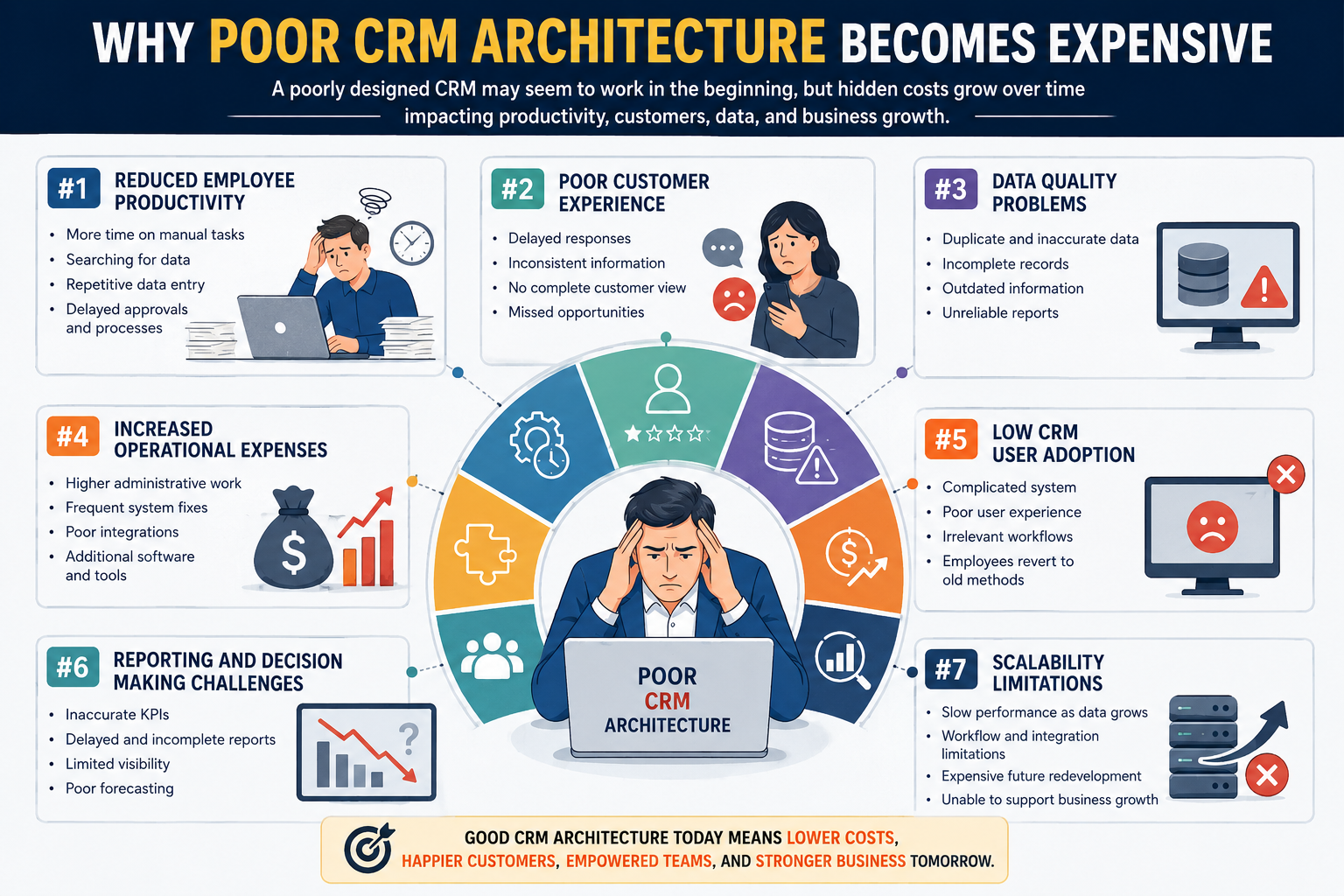
Why Poor CRM Architecture Becomes Expensive
Many organizations underestimate the cost of weak CRM planning. Initially, the problems may appear small. However, over time, they directly impact revenue, productivity, customer retention, and operational efficiency.
Common Causes of Poor CRM Architecture
| Problem Area | Impact on Business |
|---|---|
| Poor database structure | Duplicate and inconsistent records |
| Weak integrations | Data silos and communication gaps |
| Manual workflows | Increased operational workload |
| Lack of automation | Slow response times |
| Bad user experience | Low CRM adoption |
| Unstructured permissions | Security and compliance risks |
| Poor scalability planning | Expensive future redevelopment |
As businesses scale, these issues become harder and more expensive to fix.
#1: Reduced Employee Productivity
One of the biggest hidden costs of poor CRM architecture is lost productivity. Employees spend more time searching for information, updating records manually, and correcting errors.
Consequently, teams become slower and less efficient.
Signs of Productivity Loss
- Repetitive manual data entry
- Multiple spreadsheets outside the CRM
- Difficulty locating customer history
- Delayed approvals
- Slow workflow execution
- Duplicate tasks between departments
For example, if sales teams spend hours updating customer information manually, they have less time for actual selling activities.
A properly designed CRM architecture automates repetitive tasks and centralizes customer data. Therefore, employees can focus on high value business activities.
#2: Poor Customer Experience
Customers expect quick responses and personalized communication. However, disconnected CRM systems often create delays and inconsistent customer interactions.
As a result, businesses lose trust and customer satisfaction decreases.
How Poor CRM Architecture Affects Customers
Delayed Customer Responses
Without automation and centralized data, support and sales teams respond slowly.
Inconsistent Communication
Different departments may share conflicting information with customers.
Missing Customer History
Employees cannot view complete interaction history, causing repeated questions and frustration.
Weak Lead Management
Potential customers may get ignored because leads are not tracked properly.
Eventually, these problems reduce customer retention and damage brand reputation.
#3: Data Quality Problems
Data is one of the most valuable business assets. However, poor CRM architecture often leads to inaccurate, incomplete, or duplicate data.
Consequently, reporting and decision making become unreliable.
Common CRM Data Issues
- Duplicate contacts
- Missing customer details
- Incorrect reporting
- Outdated records
- Disconnected data sources
Businesses relying on inaccurate CRM data may make poor strategic decisions. Moreover, sales forecasting becomes unreliable.
Impact of Poor Data Quality
| Data Problem | Business Consequence |
|---|---|
| Duplicate records | Confused communication |
| Incomplete information | Weak customer insights |
| Inaccurate reporting | Poor decision making |
| Data silos | Limited operational visibility |
| Outdated records | Reduced sales efficiency |
Therefore, businesses must prioritize CRM data governance and architecture planning.
#4: Increased Operational Expenses
A poorly designed CRM system often increases operational costs instead of reducing them.
Although businesses invest in CRM technology to improve efficiency, weak architecture creates additional manual work and maintenance expenses.
Areas Where Costs Increase
Higher Administrative Work
Employees spend more time managing processes manually.
Repeated System Fixes
Frequent technical issues require ongoing developer support.
Integration Problems
Poor integrations create synchronization failures between systems.
Additional Software Purchases
Businesses often buy extra tools to compensate for missing CRM capabilities.
Over time, these unnecessary costs significantly impact profitability.
#5: Low CRM User Adoption
Even the most advanced CRM platform fails if employees do not use it properly.
Poor user experience is one of the biggest reasons for low CRM adoption.
Why Employees Avoid Poorly Designed CRM Systems
- Complex navigation
- Slow performance
- Too many manual steps
- Confusing dashboards
- Irrelevant workflows
- Lack of mobile accessibility
As a result, employees return to spreadsheets, emails, and disconnected systems.
A user friendly CRM architecture improves adoption because it simplifies daily operations.
#6: Reporting and Decision Making Challenges
Modern businesses depend on real time analytics and reporting. However, poor CRM architecture limits visibility into operations, sales, and customer activity.
Consequently, management teams struggle to make informed decisions.
Problems Caused by Weak Reporting Systems
- Inaccurate KPIs
- Delayed reports
- Missing sales insights
- Limited forecasting accuracy
- Poor customer analytics
Without reliable data, leadership teams cannot identify operational bottlenecks or growth opportunities effectively.
#7: Scalability Limitations
Many CRM systems are initially built without future growth planning. Although the setup may support current operations, it often struggles when the business expands.
Eventually, companies face expensive CRM redevelopment projects.
Scalability Issues Include
- Slow performance with larger datasets
- Workflow limitations
- Integration failures
- User management problems
- Reporting bottlenecks
Therefore, businesses should design CRM architecture with long term scalability in mind.
How Proper CRM Architecture Solves These Problems
A well planned CRM architecture creates a strong foundation for business operations, automation, and growth.
At Sky Soft Connections, CRM solutions are designed to improve operational efficiency, user adoption, reporting, and customer experience.
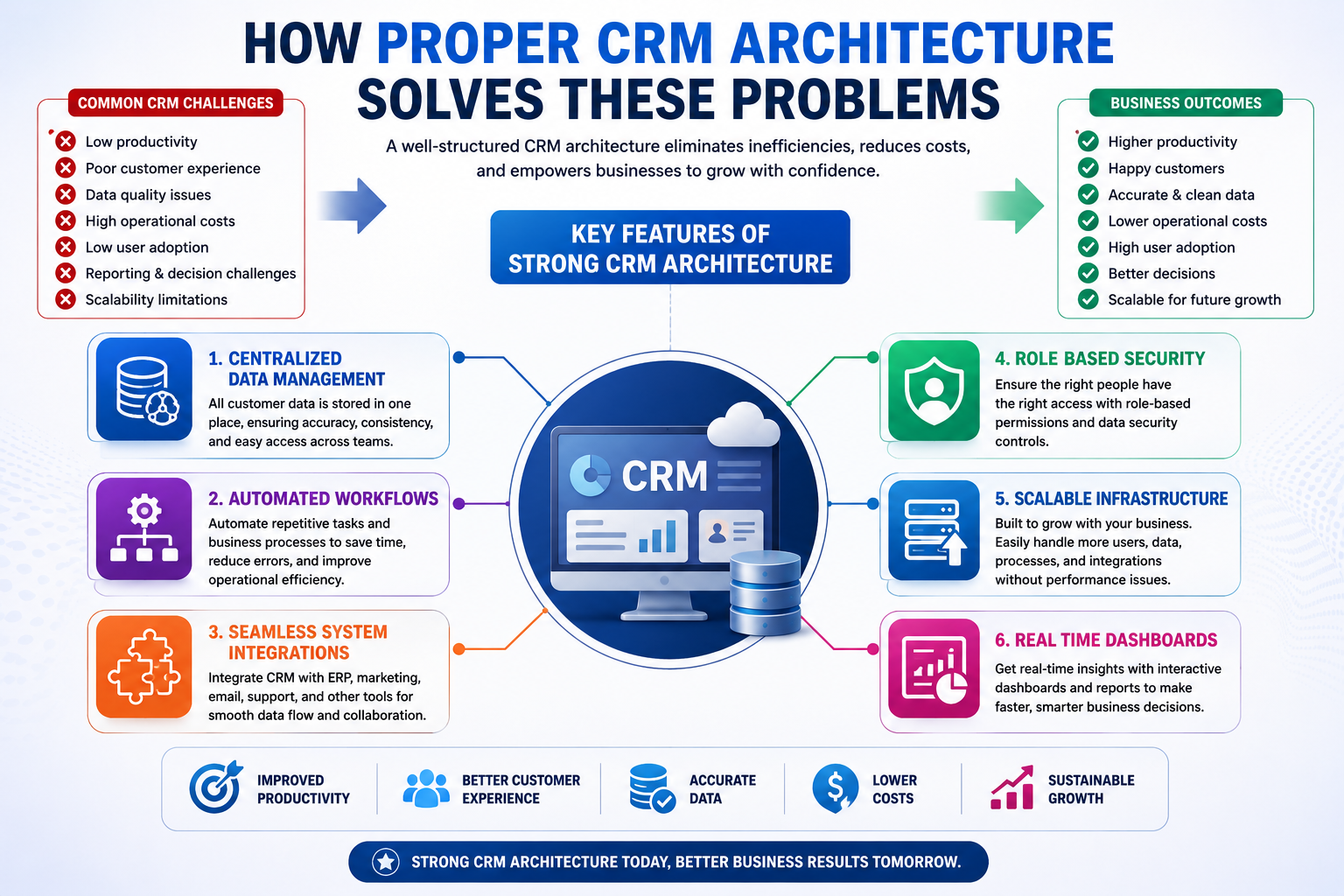
Key Features of Strong CRM Architecture
Centralized Data Management
All customer data remains organized and accessible.
Automated Workflows
Routine tasks become automated, reducing manual workload.
Seamless System Integrations
CRM connects smoothly with ERP systems, websites, marketing tools, and communication platforms.
Role Based Security
Proper access control improves compliance and data protection.
Scalable Infrastructure
The system supports future business growth without major redevelopment.
Real Time Dashboards
Management teams gain instant operational visibility.
Benefits of Optimized CRM Architecture
| Benefit | Business Outcome |
|---|---|
| Better automation | Increased efficiency |
| Improved reporting | Smarter decisions |
| Faster workflows | Higher productivity |
| Centralized customer data | Better customer experience |
| Strong integrations | Improved collaboration |
| Scalable design | Long term cost savings |
Why Businesses Choose Microsoft Dynamics CRM
Many organizations choose Microsoft Dynamics 365 because it supports advanced customization, automation, AI features, and enterprise scalability.
When implemented correctly, Dynamics CRM can:
- Improve lead management
- Automate sales processes
- Enhance customer engagement
- Provide advanced reporting
- Integrate with Microsoft tools
- Support AI driven workflows
However, successful implementation depends heavily on proper CRM architecture planning.
How Sky Soft Connections Helps Businesses
Sky Soft Connections provides CRM consulting, Microsoft Dynamics customization, Power Platform solutions, AI automation, and system integration services tailored to business requirements.
Their services include:
- CRM architecture planning
- Dynamics CRM customization
- Workflow automation
- Power Apps development
- Power Automate implementation
- AI based business automation
- Reporting dashboards
- Data migration and integration
As a result, businesses gain scalable and future ready CRM systems designed for operational efficiency.
Final Thoughts
The hidden costs of poor CRM architecture can quietly damage productivity, customer experience, operational efficiency, and business growth. Although many organizations focus only on CRM implementation, architecture planning is equally important.
A properly designed CRM system reduces manual work, improves reporting accuracy, enhances customer engagement, and supports long term scalability.
Therefore, businesses should invest in strong CRM architecture from the beginning instead of paying higher operational costs later.
With expert CRM solutions from Sky Soft Connections, companies can build scalable, automated, and high performance CRM systems that drive measurable business growth.
Read more : AI Process Automation for SMEs in CRM
FAQ’s
Poor CRM architecture can lead to reduced productivity, duplicate data, poor customer experience, weak reporting, integration issues, and increased operational costs over time.
A well structured CRM architecture supports automation, scalability, accurate reporting, and seamless integrations, which help businesses grow efficiently without major system limitations.
CRM optimization improves workflow efficiency, user adoption, customer management, and decision making while reducing manual work and long term maintenance costs.