
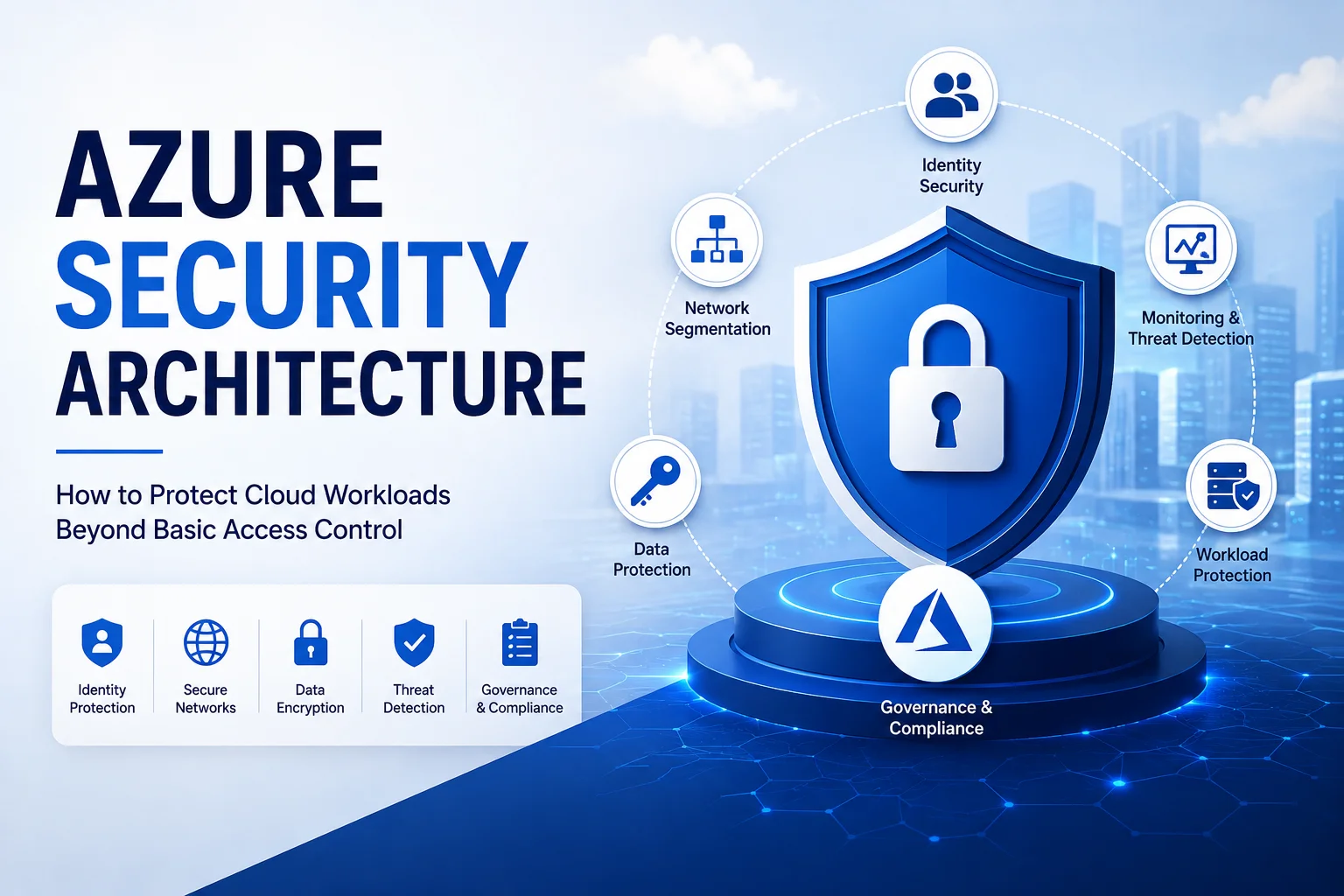
Cloud security is no longer just about controlling who can access an application. As organizations move critical workloads to Microsoft Azure, they also need to protect data, applications, identities, networks, endpoints, and cloud infrastructure from increasingly complex threats.
That is where Azure security architecture becomes essential.
A strong architecture combines identity security, network segmentation, encryption, monitoring, threat detection, workload protection, and governance. More importantly, these controls need to work together rather than operate as isolated security features.
In this guide, we explore how businesses can build a secure Azure environment that goes beyond basic access control while maintaining performance, scalability, and operational visibility.
What Is Azure Security Architecture?
Azure security architecture is the structured approach used to protect cloud workloads, applications, data, identities, and infrastructure running on Microsoft Azure.
Instead of relying on a single security layer, a mature architecture uses defense in depth. Therefore, if one control fails, additional security layers can help reduce the impact.
A typical Azure security architecture covers:
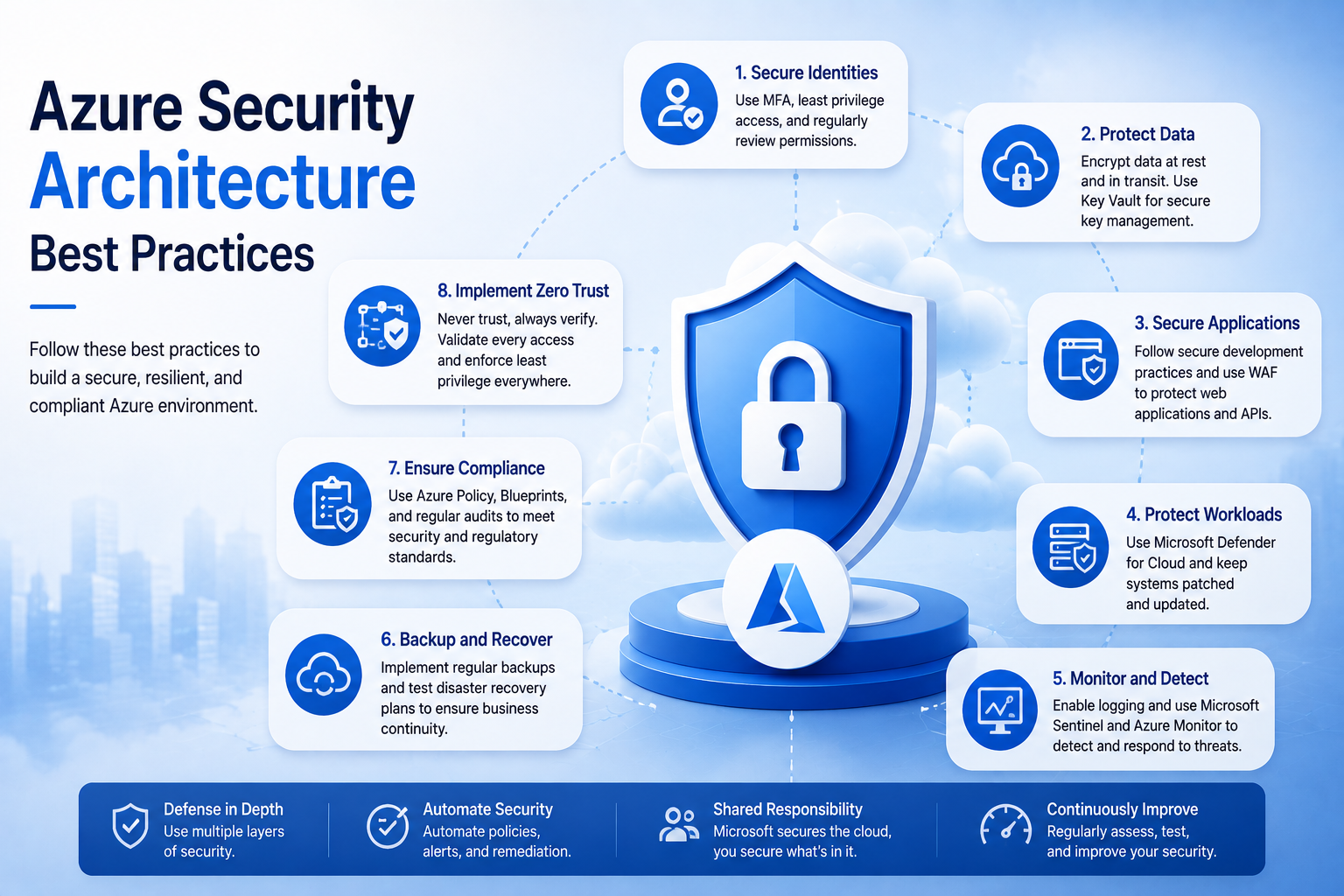
- Identity and access management
- Network security and segmentation
- Data protection and encryption
- Application security
- Workload protection
- Security monitoring and threat detection
- Backup and disaster recovery
- Security governance and compliance
- Vulnerability management
- Incident response
The goal is simple: reduce the attack surface while maintaining secure and reliable access to business workloads.
Why Basic Access Control Is Not Enough
Identity and access management is a critical foundation. However, authentication alone cannot protect an entire cloud environment.
For example, imagine an employee’s credentials are compromised. Even if the organization uses strong authentication, an attacker may still attempt to access applications, manipulate data, move across the network, or exploit vulnerable workloads.
That is why organizations should use multiple security layers.
| Security Layer | What It Protects | Examples |
|---|---|---|
| Identity | Users and privileged accounts | MFA, Conditional Access, RBAC |
| Network | Traffic and connectivity | Firewalls, NSGs, segmentation |
| Data | Sensitive information | Encryption, Key Vault |
| Applications | Software and APIs | Secure development, WAF |
| Workloads | VMs, containers and services | Defender capabilities |
| Monitoring | Security events | Microsoft Sentinel, Azure Monitor |
| Governance | Policies and configurations | Azure Policy, management groups |
| Recovery | Business continuity | Backup, disaster recovery |
Consequently, a secure Azure environment should not depend on one security control.
1. Build a Strong Identity Security Foundation
Identity is often considered the first line of defense in a cloud environment.
However, organizations should move beyond simple username-and-password authentication.
Use Multi-Factor Authentication
Multi-factor authentication (MFA) adds another verification layer when users sign in. As a result, stolen passwords become less useful to attackers.
Organizations should particularly enforce stronger authentication for:
- Administrators
- Developers
- Finance users
- Remote workers
- External users
- Privileged accounts
Apply Least-Privilege Access
Users and applications should receive only the permissions they actually need.
For example, a developer who needs access to application resources does not necessarily need administrative access to the entire Azure subscription.
Using Role-Based Access Control (RBAC) helps organizations implement this principle.
Protect Privileged Accounts
Privileged identities require additional controls because they can potentially change infrastructure, access sensitive data, or disable security controls.
Organizations should therefore consider:
- Just-in-time privileged access
- Separate administrator accounts
- Privileged Identity Management
- Regular access reviews
- Strong authentication policies
2. Design a Secure Azure Network Architecture
A secure identity strategy is important, but network security provides another critical layer.
Instead of allowing unrestricted communication between workloads, organizations should control how systems communicate with each other.
Use Network Segmentation
Azure workloads can be separated into different network segments based on their purpose and sensitivity.
For example:
Internet → Web Layer → Application Layer → Database Layer
This architecture limits unnecessary communication between systems.
If an attacker compromises a web server, segmentation can make it more difficult to directly reach sensitive databases.
Protect Internet-Facing Applications
For applications exposed to the internet, organizations can use services such as:
- Azure Application Gateway
- Web Application Firewall (WAF)
- Azure Firewall
- Network Security Groups
- DDoS protection capabilities
These controls can help identify, filter, and restrict unwanted traffic before it reaches critical workloads.
3. Protect Data With Encryption and Key Management
Data protection should cover information both at rest and in transit.
Encryption helps reduce the impact of unauthorized access because intercepted or stolen information is more difficult to use without the appropriate cryptographic keys.
Protect Encryption Keys
Key management is just as important as encryption itself.
Azure Key Vault can help organizations securely manage:
- Encryption keys
- Secrets
- Certificates
- Application credentials
Rather than storing sensitive credentials directly inside application code or configuration files, applications can retrieve secrets securely through appropriate identity-based access.
Classify Sensitive Data
Not every piece of information requires the same security controls.
Businesses should identify sensitive data such as:
- Customer information
- Financial records
- Employee information
- Intellectual property
- Authentication credentials
- Operational data
Then, security controls can be aligned with the sensitivity and regulatory requirements of that information.
4. Secure Azure Workloads and Applications
Cloud infrastructure can be securely configured, yet vulnerable applications can still create significant risks.
Therefore, application security should be part of the overall Azure security architecture.
Follow Secure Development Practices
Development teams should incorporate security throughout the software development lifecycle.
Important practices include:
- Code vulnerability scanning
- Dependency management
- Secret detection
- Secure API design
- Container image scanning
- Infrastructure-as-code security checks
- Security testing before deployment
Protect APIs
Modern applications frequently depend on APIs. Consequently, APIs should be authenticated, authorized, monitored, and appropriately rate-limited.
API security should include:
- Strong authentication
- Authorization controls
- Input validation
- Encryption
- Logging and monitoring
- Rate limiting where appropriate
5. Monitor Threats Across the Azure Environment
Security controls are only useful if organizations can identify suspicious activity.
This is where centralized monitoring becomes important.
Use Azure Monitor and Microsoft Sentinel
Azure Monitor provides visibility into Azure resources and workloads, while Microsoft Sentinel can provide broader security information and event management capabilities.
Security teams can use centralized monitoring to identify:
- Suspicious authentication attempts
- Unusual administrative activity
- Unexpected network traffic
- Configuration changes
- Potential malware activity
- Abnormal resource behavior
Furthermore, centralized logs can help security teams investigate incidents more efficiently.
Don’t Collect Logs Without a Purpose
More logs do not automatically mean better security.
Instead, organizations should identify which events are important for:
- Threat detection
- Compliance
- Incident investigation
- Performance monitoring
- Audit requirements
This approach can improve both visibility and operational efficiency.
6. Use Security Policies and Continuous Governance
Azure environments can change rapidly. New resources are created, applications are deployed, and permissions are modified.
Therefore, security cannot be treated as a one-time configuration task.
Establish Cloud Security Policies
Organizations can use governance mechanisms such as Azure Policy to help enforce security requirements.
For example, policies can help identify or prevent configurations such as:
- Publicly exposed resources
- Unapproved regions
- Missing security controls
- Weak configuration standards
- Unencrypted resources
As a result, governance becomes part of everyday cloud operations.
7. Protect Against Misconfiguration
Cloud security incidents are not always caused by sophisticated attacks. Sometimes, a simple configuration mistake creates the vulnerability.
Common examples include:
- Publicly accessible storage
- Excessive permissions
- Open network ports
- Unprotected secrets
- Unpatched workloads
- Poorly configured security groups
Regular security assessments can help identify these weaknesses before attackers exploit them.
A useful approach is to continuously review:
Identity → Network → Data → Applications → Workloads → Monitoring → Governance
8. Build Backup and Disaster Recovery Into the Architecture
Security is not only about preventing attacks. It is also about recovering when something goes wrong.
Ransomware, accidental deletion, infrastructure failures, and application outages can all affect business operations.
Therefore, organizations should develop a recovery strategy that considers:
- Backup frequency
- Recovery Point Objective (RPO)
- Recovery Time Objective (RTO)
- Geographic redundancy
- Backup protection
- Disaster recovery testing
Most importantly, backups should be tested regularly. A backup that has never been restored is not a fully validated recovery strategy.
Azure Security Architecture Best Practices
For organizations planning or reviewing their Azure security strategy, the following practices provide a strong foundation:
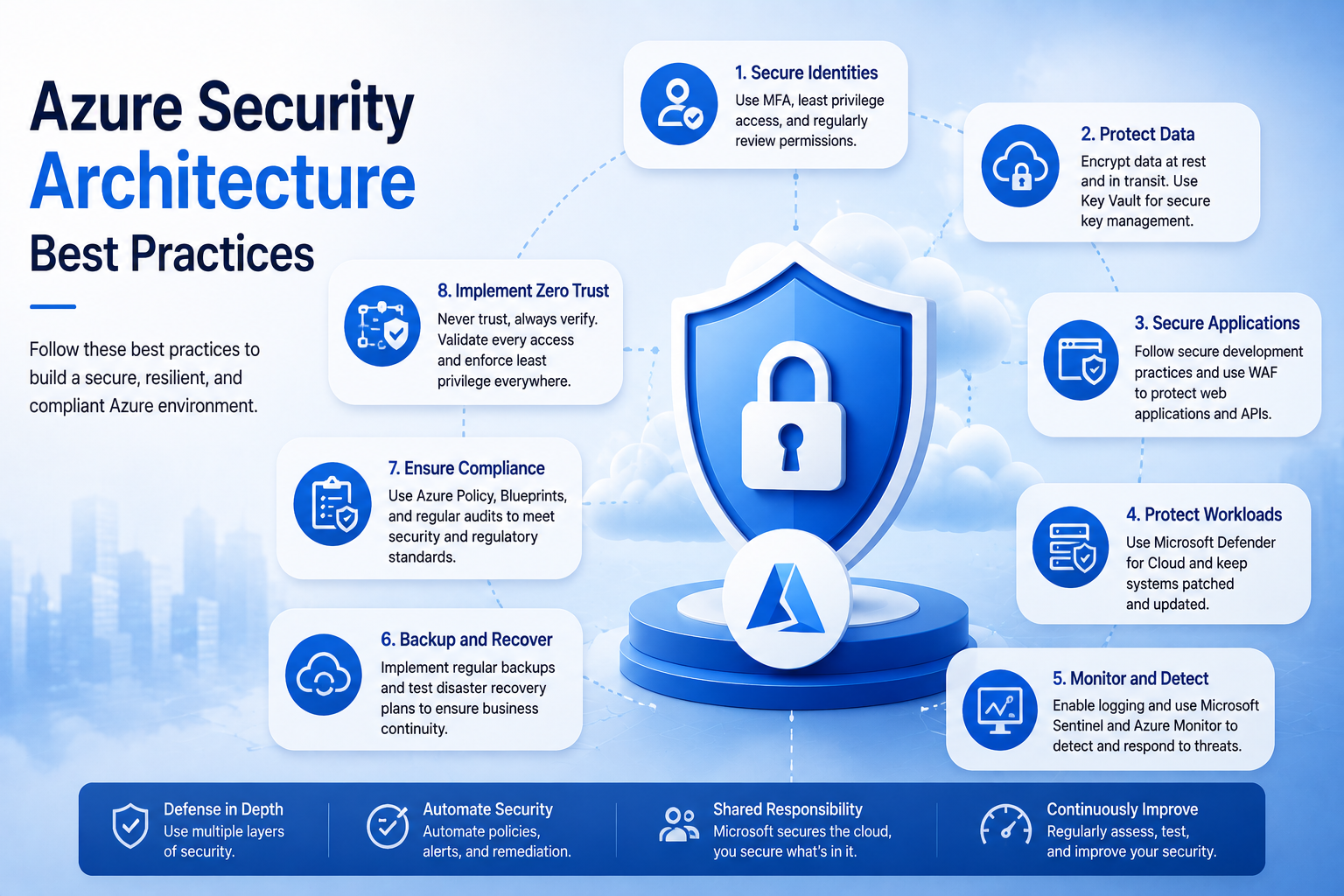
- Apply the principle of least privilege.
- Enable MFA for appropriate users and privileged accounts.
- Separate production and non-production environments.
- Segment critical workloads.
- Encrypt sensitive data.
- Secure secrets with centralized key management.
- Monitor security events continuously.
- Scan workloads for vulnerabilities.
- Apply cloud governance policies.
- Regularly review permissions.
- Keep workloads patched and updated.
- Protect and test backups.
- Develop an incident response plan.
- Regularly assess cloud configurations.
How Sky Soft Connections Can Help
Building a secure Azure environment requires more than enabling individual Microsoft services. The architecture needs to align with business requirements, application workloads, compliance needs, and long-term growth.
Sky Soft Connections helps businesses design and implement Microsoft cloud solutions with a focus on secure, scalable, and practical architectures.
Our Microsoft technology services include:
Microsoft Azure Services
We can help organizations plan and implement Azure environments, modernize workloads, and improve cloud infrastructure.
Microsoft Dynamics 365
For organizations running CRM and business applications, we help implement and customize Microsoft Dynamics 365 solutions while considering security, integration, and scalability.
Microsoft Power Platform
Our services cover:
- Power Apps
- Power Automate
- Power BI
- Power Pages
- Power Virtual Agents / Copilot solutions
These platforms can be integrated with broader Microsoft environments while applying appropriate governance and access controls.
Custom .NET and Azure Solutions
We also provide custom .NET portals, Azure solutions, data migration, SSRS, and Microsoft technology consulting, helping businesses connect applications and modernize their technology ecosystem.
The result is a more connected approach to cloud security, application development, business systems, and digital transformation.
Read more : Azure Virtual Machines vs Containers: Which Is Better for Modern Workloads?
Frequently Asked Questions About Azure Security Architecture
The main goal is to protect cloud workloads, identities, applications, networks, and data through multiple layers of security rather than relying only on access control.
Azure provides extensive built-in security capabilities. However, organizations are still responsible for securely configuring their workloads, identities, applications, data, and access policies according to the shared responsibility model.
Defense in depth means using multiple independent security layers. If one control is bypassed, additional controls can help prevent or limit unauthorized access and reduce the potential impact.
Businesses should combine identity protection, network segmentation, encryption, vulnerability management, workload security, monitoring, governance, backup, and incident response.
Not every organization requires the same security tooling. However, centralized security monitoring can significantly improve threat detection and investigation, particularly as an Azure environment grows.
Final Thoughts
A secure Azure environment requires more than strong passwords and access permissions.
Instead, organizations need a layered Azure security architecture that protects identities, networks, applications, workloads, data, and infrastructure while continuously monitoring changes and emerging threats.
The most effective strategy is therefore proactive: establish least-privilege access, segment workloads, encrypt sensitive information, monitor activity, enforce governance, and prepare for recovery before an incident occurs.
As cloud environments continue to evolve, security architecture should evolve with them. By combining Microsoft Azure security capabilities with sound architecture and governance practices, businesses can build cloud environments that are not only more secure but also scalable and resilient.
Looking to strengthen your Azure environment? Sky Soft Connections can help you assess, design, implement, and modernize Microsoft cloud solutions around your business requirements.