Table of Content
Managing multi-tenant Power Platform deployments can quickly become complex if environments are not structured correctly. Therefore, a well-defined Environment Group Strategy for Multi-Tenant Power Platform Deployments is essential for scalability, security, governance, and long-term success.
In this guide, you’ll learn how to design a robust environment strategy using Microsoft Power Platform, while ensuring tenant isolation, compliance, and operational efficiency. Moreover, we’ll share best practices, examples, and a clear framework you can actually implement.
What Is an Environment Group Strategy in Power Platform?
An environment group strategy defines how Power Platform environments are organized, secured, and managed across multiple tenants or business units.
In multi-tenant scenarios, this strategy becomes critical because:
- Each tenant has unique data, users, and compliance needs
- Governance must scale without slowing innovation
- Security boundaries must remain clearly enforced
Therefore, environment planning should never be an afterthought.
Why Environment Group Strategy Matters for Multi-Tenant Deployments
Without a clear strategy, Power Platform environments can become:
- Hard to govern
- Risky from a data security perspective
- Expensive to maintain
However, with the right approach, organizations gain better control and faster delivery.
Key Benefits at a Glance
- Clear tenant isolation and data security
- Simplified governance and access control
- Easier ALM (Application Lifecycle Management)
- Scalable growth without rework
- Improved performance and compliance
As a result, teams can innovate while staying compliant.
Core Principles of a Multi-Tenant Power Platform Environment Strategy
Before defining environments, it’s important to align on a few core principles.
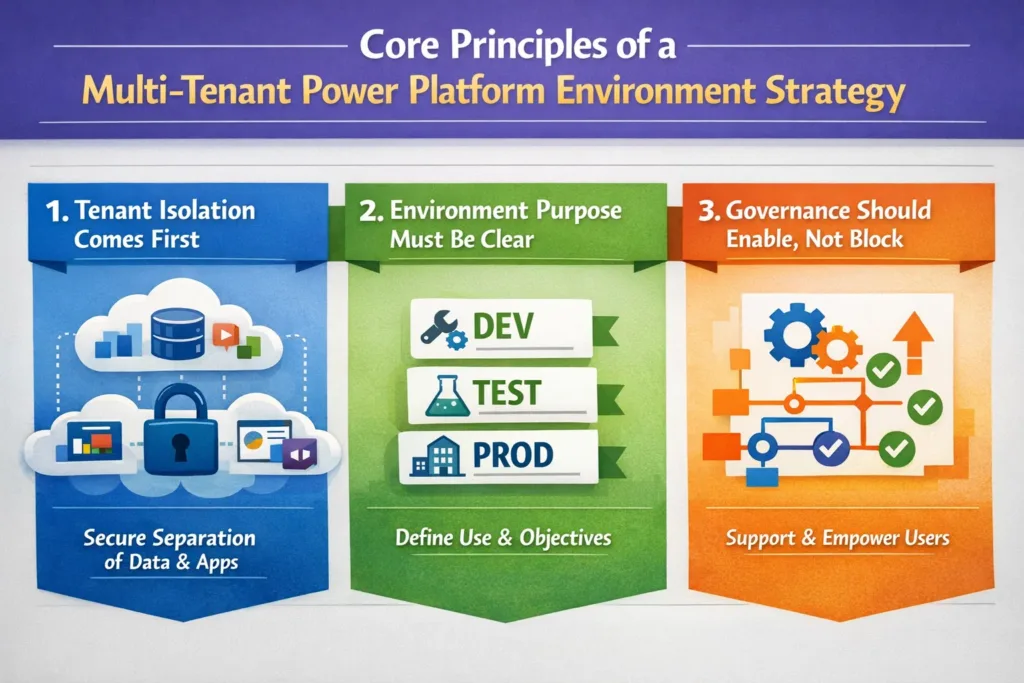
1. Tenant Isolation Comes First
Each tenant must remain logically and securely separated. Therefore, environments should never mix data across tenants.
2. Environment Purpose Must Be Clear
Every environment should exist for a defined purpose, such as:
- Development
- Testing
- UAT
- Production
This clarity prevents misuse and reduces risk.
3. Governance Should Enable, Not Block
Strong governance does not mean slowing teams down. Instead, it provides guardrails that encourage safe innovation.
Recommended Environment Group Structure
Below is a proven environment group model commonly used in multi-tenant Power Platform deployments.
Typical Environment Group Layout
| Environment Group | Purpose | Access Level |
|---|---|---|
| Tenant-Dev | App development & experimentation | Developers |
| Tenant-Test | Testing & validation | QA + Dev |
| Tenant-UAT | Business approval & sign-off | Business Users |
| Tenant-Prod | Live applications & data | Restricted |
| Shared-Services | Common integrations & APIs | Admin Only |
This structure ensures consistency while allowing flexibility.
Environment Strategy by Tenant Type
Different tenants often require different levels of isolation and control.
Small or Medium Tenants
- Fewer environments
- Shared governance model
- Limited integrations
Enterprise or Regulated Tenants
- Fully isolated environments
- Strict DLP (Data Loss Prevention) policies
- Dedicated ALM pipelines
Therefore, the environment strategy should always reflect tenant size and regulatory needs.
Governance and Security Best Practices
Strong governance is essential, especially in multi-tenant Power Platform deployments.
Recommended Governance Controls
- Role-based access control (RBAC)
- Environment-specific DLP policies
- Managed environments for production
- Centralized monitoring and auditing
Additionally, automation should be used to enforce policies consistently.
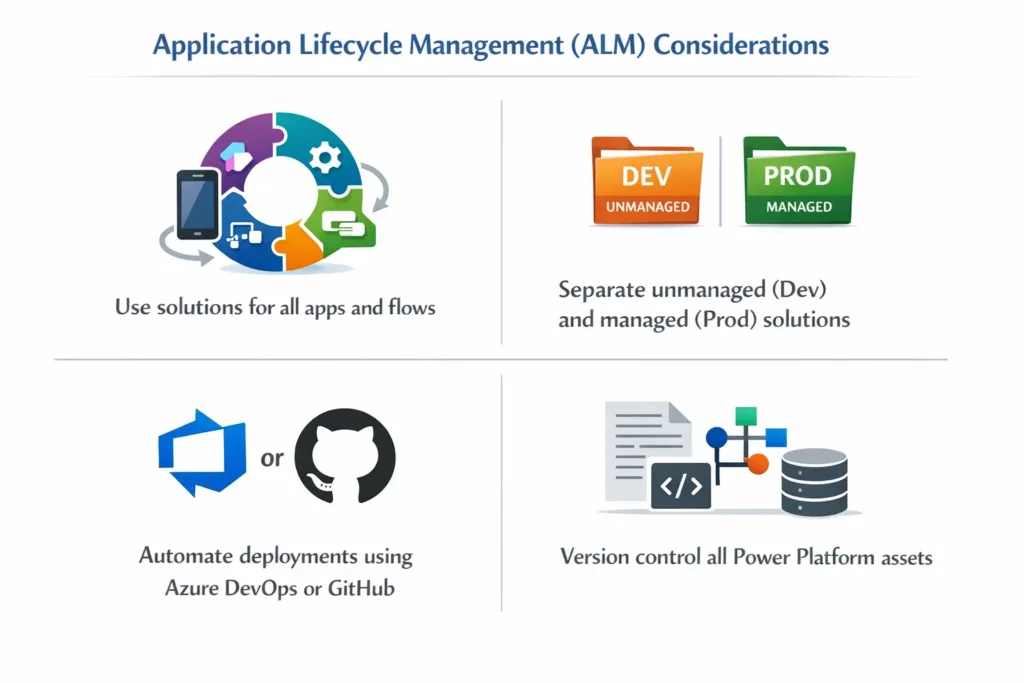
Application Lifecycle Management (ALM) Considerations
A solid ALM strategy ensures apps move safely between environments.
Best Practices for ALM
- Use solutions for all apps and flows
- Separate unmanaged (Dev) and managed (Prod) solutions
- Automate deployments using Azure DevOps or GitHub
- Version control all Power Platform assets
As a result, releases become predictable and risk-free.
Common Mistakes to Avoid
Even experienced teams make mistakes when scaling Power Platform.
Avoid These Pitfalls
- ❌ Mixing multiple tenants in one environment
- ❌ Granting broad admin access
- ❌ Skipping UAT environments
- ❌ Manually deploying solutions
- ❌ Ignoring environment documentation
Instead, invest time upfront in a clear strategy.
How Skysoft Connections Helps with Power Platform Environment Strategy
At Skysoft Connections, we specialize in designing and implementing scalable Power Platform architectures for multi-tenant deployments.
Our Power Platform Services Include:
- Environment strategy & governance design
- Multi-tenant Power Platform architecture
- Power Apps, Power Automate & Power BI solutions
- ALM automation & DevOps integration
- Security, compliance & DLP configuration
Because we focus on real-world use cases, our solutions are both practical and future-proof.
Final Thoughts
A well-planned Environment Group Strategy for Multi-Tenant Power Platform Deployments is not optional—it’s essential. When done correctly, it improves security, simplifies governance, and enables faster innovation.
Therefore, whether you’re scaling Power Platform across customers, departments, or regions, investing in the right environment strategy will save time, cost, and risk in the long run.
If you’re planning or already managing a multi-tenant Power Platform deployment, Skysoft Connections can help you design a strategy that truly scales.
Read more : vs code github copilot dataverse integration guide
FAQ’s
An environment group is a structured way to organize Power Platform environments by purpose, tenant, and access level to improve governance, security, and scalability.
It ensures tenant isolation, prevents data leakage, simplifies governance, and supports secure scaling across multiple customers or business units.
Typically, each tenant should have at least Development, Test/UAT, and Production environments, depending on compliance and operational needs.
Yes, when combined with solutions and ALM pipelines, environment groups enable safe and automated deployments across all Power Platform environments.
 is a software solution company that was established in 2016. Our quality services begin with experience and end with dedication. Our directors have more than 15 years of IT experience to handle various projects successfully. Our dedicated teams are available to help our clients streamline their business processes, enhance their customer support, automate their day-to-day tasks, and provide software solutions tailored to their specific needs. We are experts in Dynamics 365 and Power Platform services, whether you need Dynamics 365 implementation, customization, integration, data migration, training, or ongoing support.