Table of Content
- Introduction
- What Are Circular Dependencies?
- Why Circular Dependencies Are a Design Smell
- The “Immutable Law” of Circular Dependencies
- Real-World Impact of Logic Loops
- Signs Your Code Has Circular Dependencies
- Circular Dependencies vs Clean Architecture
- How to Break Circular Dependencies
- Best Practices to Avoid Logic Loops
- How Sky Soft Connections Helps You Build Clean Architecture
- Conclusion
- FAQ’s
Introduction
In modern software development, clean architecture is not just a best practice—it’s a necessity. Yet, many systems unknowingly fall into a critical trap: circular dependencies, also known as logic loops. At first glance, they may seem harmless. However, over time, they degrade code quality, reduce maintainability, and introduce hidden bugs.
So, why are circular dependencies considered a design smell? More importantly, how can you detect and eliminate them?
Let’s break it down in a practical, SEO-friendly, and easy-to-understand way.
What Are Circular Dependencies?
A circular dependency occurs when two or more modules depend on each other directly or indirectly.
Simple Example:
- Module A depends on Module B
- Module B depends on Module C
- Module C depends on Module A
This creates a logic loop, making the system tightly coupled and difficult to manage.
Why Circular Dependencies Are a Design Smell
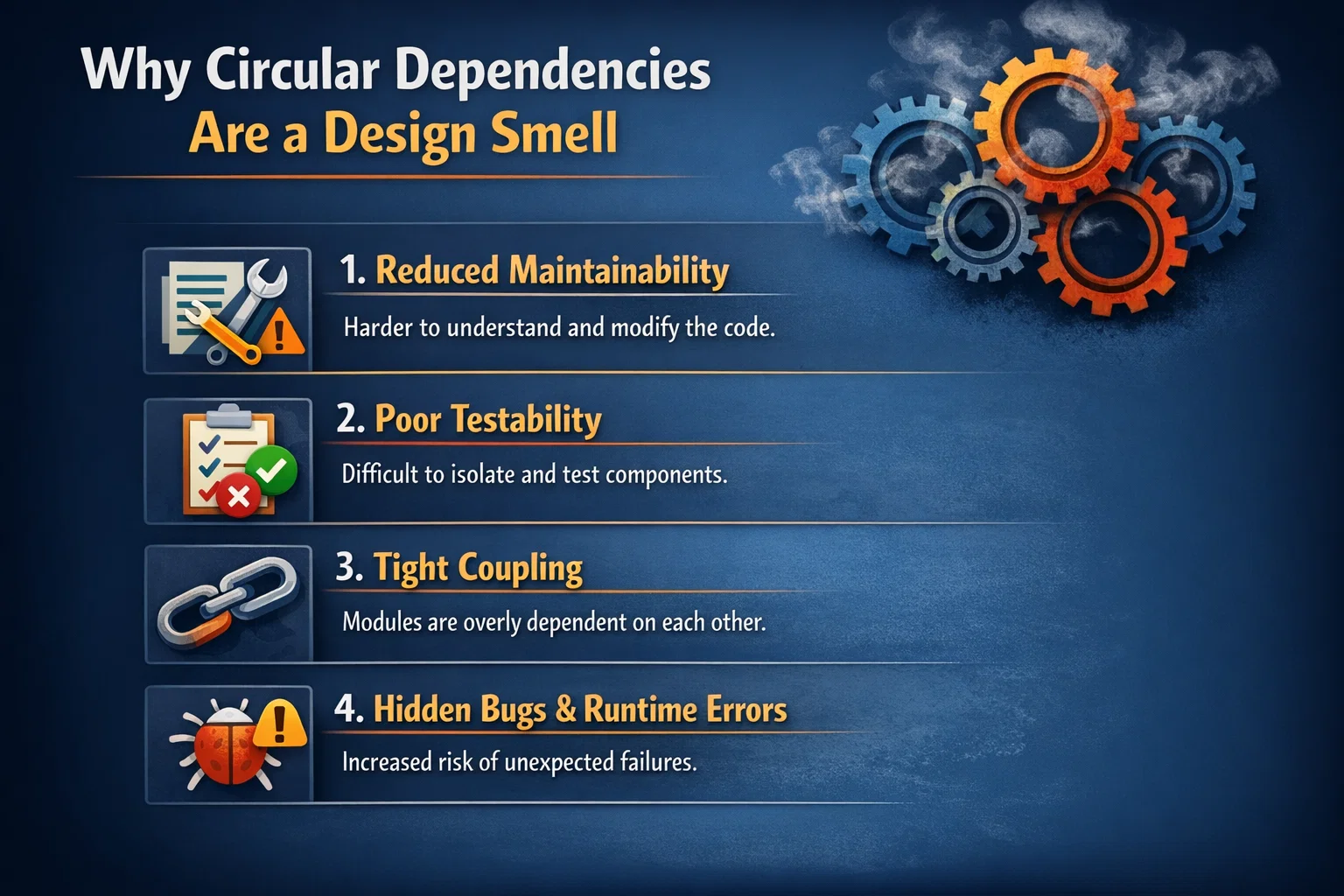
Circular dependencies violate core principles of software design. Therefore, they often signal deeper architectural issues.
1. Reduced Maintainability
When components depend on each other, changes in one module ripple across others. As a result, even small updates become risky.
2. Poor Testability
Testing becomes complicated because modules cannot be isolated. Consequently, writing unit tests becomes time-consuming.
3. Tight Coupling
Instead of modular design, your system becomes interdependent. This limits scalability and flexibility.
4. Hidden Bugs and Runtime Errors
Circular logic often leads to:
- Infinite loops
- Initialization issues
- Unexpected behavior
The “Immutable Law” of Circular Dependencies
The “immutable law” suggests this:
A well-designed system should always have a unidirectional flow of dependencies.
In other words, dependencies should move in one direction only—never in loops.
Real-World Impact of Logic Loops
Circular dependencies are not just theoretical issues. In real-world applications, they cause:
- Slower development cycles
- Increased debugging time
- Deployment failures
- Difficulty onboarding new developers
Signs Your Code Has Circular Dependencies
You might already have logic loops if you notice:
- Frequent import errors
- Modules that cannot function independently
- Difficulty refactoring code
- Excessive use of shared global states
Circular Dependencies vs Clean Architecture
| Aspect | Circular Dependencies ❌ | Clean Architecture ✅ |
|---|---|---|
| Dependency Direction | Bidirectional / Loop | Unidirectional |
| Maintainability | Low | High |
| Scalability | Limited | Flexible |
| Testing | Difficult | Easy |
| Code Clarity | Confusing | Clear |
How to Break Circular Dependencies
Fortunately, you can resolve circular dependencies using several proven techniques.
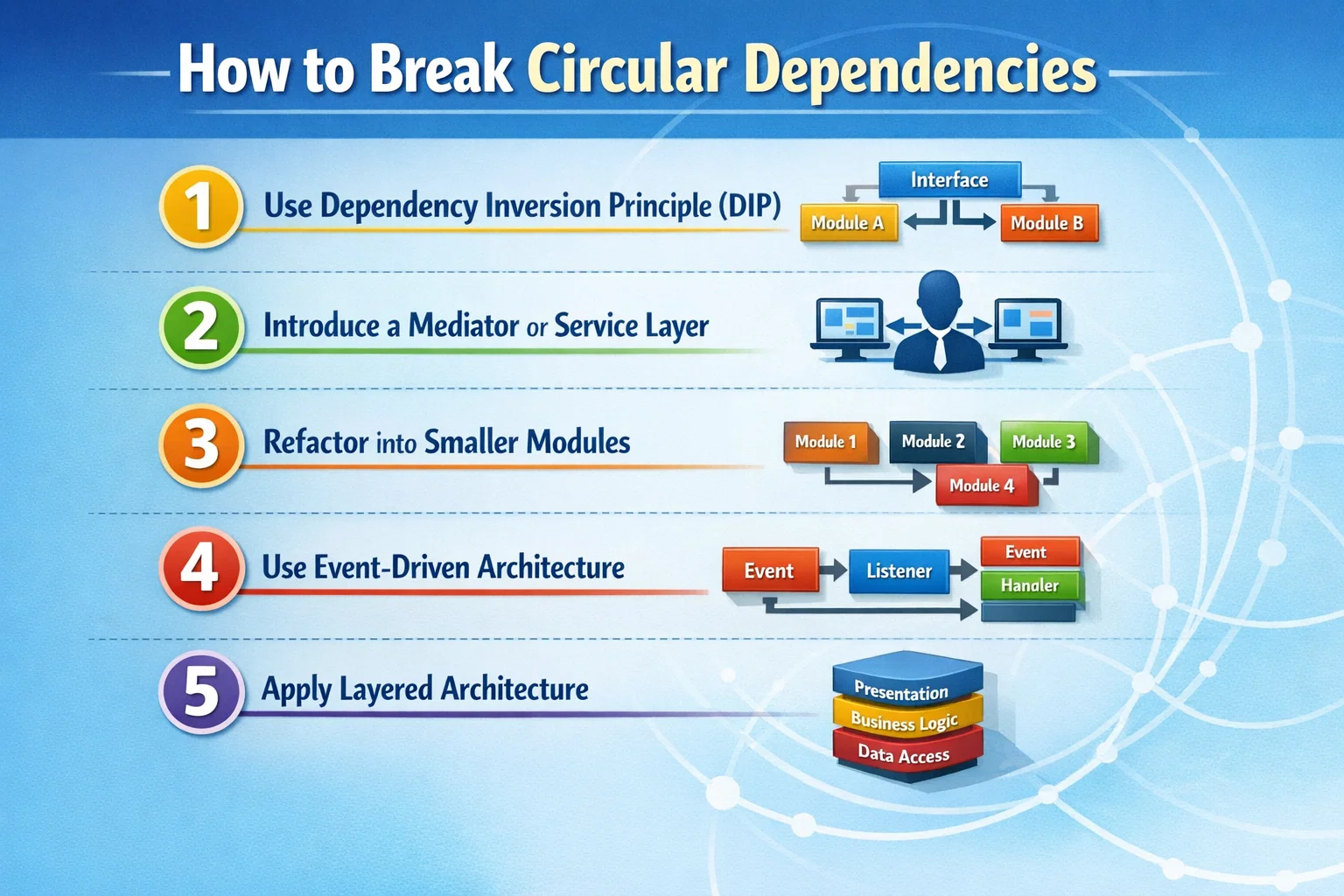
1. Use Dependency Inversion Principle (DIP)
Instead of direct dependencies, rely on abstractions.
Before:
- A → B
- B → A
After:
- A → Interface
- B → Interface
2. Introduce a Mediator or Service Layer
A third component can handle communication between modules.
Benefits:
- Decouples logic
- Improves maintainability
3. Refactor into Smaller Modules
Large modules often cause dependency issues. Therefore, splitting them into smaller units helps eliminate loops.
4. Use Event-Driven Architecture
Instead of direct calls, use events or messages.
Advantages:
- Loose coupling
- Better scalability
5. Apply Layered Architecture
Ensure dependencies only flow downward:
- UI Layer → Service Layer → Data Layer
Never reverse this flow.
Best Practices to Avoid Logic Loops
To prevent circular dependencies from the start:
- Design with clear boundaries
- Follow SOLID principles
- Use interface-based programming
- Keep modules independent and reusable
- Perform regular code reviews and audits
How Sky Soft Connections Helps You Build Clean Architecture
At Sky Soft Connections, we understand that poor architecture leads to long-term technical debt. Therefore, we help businesses design scalable and maintainable systems from the ground up.
Our Expertise Includes:
- Microsoft Power Platform (Power Apps, Power Automate, Power BI)
- Dynamics CRM Customization
- System Architecture & Refactoring
- Integration & Data Migration
- Performance Optimization
Why Choose Us?
- Proven track record with 40,000+ hours of successful delivery
- Clean, scalable, and future-ready solutions
- Deep expertise in enterprise-grade systems
As a result, your software remains robust, flexible, and easy to scale—without falling into the trap of circular dependencies.
Conclusion
Circular dependencies may seem like a small design flaw. However, they can quickly evolve into major architectural problems. That’s why they are rightly considered a design smell.
By enforcing unidirectional dependencies, applying best practices, and leveraging expert solutions, you can build systems that are:
- Scalable
- Maintainable
- Efficient
Ultimately, clean architecture is not optional it’s essential for long-term success.
Read more :event driven architecture beyond on save
FAQ’s
It’s when two or more modules depend on each other, forming a loop that complicates code structure.
They increase complexity, which leads to slower debugging, testing, and execution issues.
You can use static analysis tools, code reviews, or dependency graphs to identify loops.
 is a software solution company that was established in 2016. Our quality services begin with experience and end with dedication. Our directors have more than 15 years of IT experience to handle various projects successfully. Our dedicated teams are available to help our clients streamline their business processes, enhance their customer support, automate their day-to-day tasks, and provide software solutions tailored to their specific needs. We are experts in Dynamics 365 and Power Platform services, whether you need Dynamics 365 implementation, customization, integration, data migration, training, or ongoing support.