
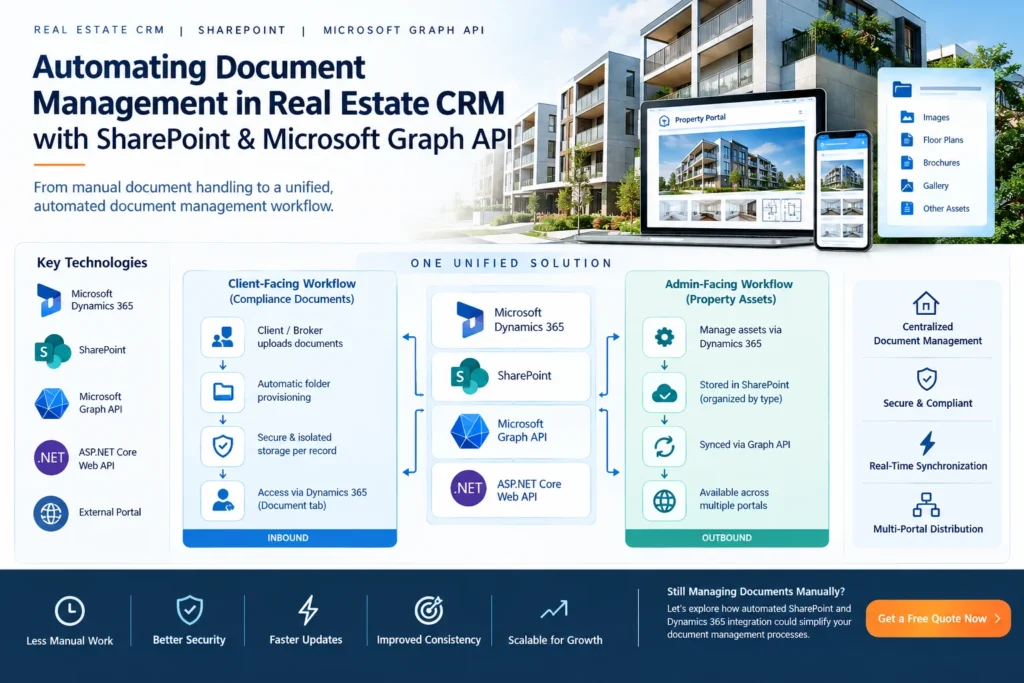
A real estate platform managing client onboarding and property sales required a reliable way to handle two critical document management processes.
The first involved collecting identity and compliance documents from clients and brokers while ensuring that every individual’s documents remained securely isolated within their own record.
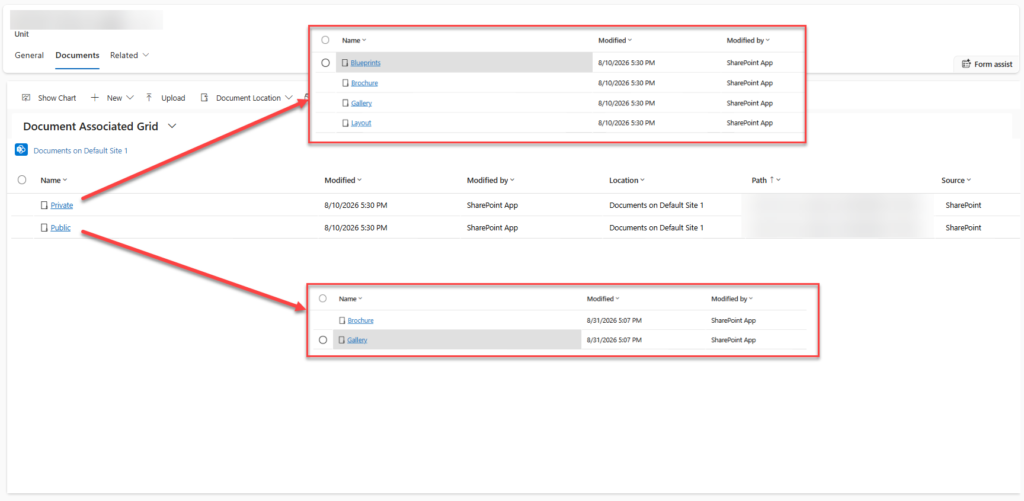
The second involved managing property images, floor plans, brochures, and gallery content that needed to remain synchronized across multiple external-facing portals
The existing approach relied on disconnected document management processes, creating operational friction and increasing the risk of inconsistent or incorrectly managed information.
Client: Fully anonymized
CRM Platform: Microsoft Dynamics 365
Business Function: Real Estate
Process: CRM record creation → Document provisioning → Document upload → Asset management → Portal distribution
Note: The client’s company name, industry, and employee names have been intentionally omitted.

Business Impact of the Existing Process
How the Automation Works
From CRM Record Creation to Synchronized Property Assets
The solution combines Microsoft technologies and custom development into a single integration architecture.
Technology & Integration Architecture
Microsoft Dynamics 365
Acts as the central business system for leads, client records, units, and document management.
Microsoft SharePoint
Provides structured document storage with dedicated folders for individual records and property units.
Microsoft Graph API
Provides programmatic control over SharePoint folders, files, uploads, and document access.
ASP.NET Core Web API & External Portal
Acts as the custom integration layer connecting Dynamics 365, SharePoint, the external portal, and property asset delivery.
Provides the client-facing interface through which users upload compliance documentation.
Reusability Across Real Estate Workflows
The underlying architecture can support multiple document-heavy processes within a real estate environment.
Client Onboarding
Automatically create secure document spaces when new clients or brokers are added.
Compliance Management
Store identity and verification documents in structured, record-specific locations.
Property Management
Centralize images, floor plans, brochures, and other property assets.
Multi-Portal Content Distribution
Keep property information synchronized across multiple external-facing portals.
Document-Based Workflows
Extend the same architecture to other processes that require structured document storage and controlled access.
Business Outcomes
Reduced Manual Document Handling
Document spaces are created automatically when records are created, eliminating routine manual folder setup.
Stronger Document Isolation
Each record receives its own dedicated document space, reducing the risk of cross-record access and supporting compliance requirements.
Automated Document Filing
User-uploaded compliance documents are automatically routed to the correct location without manual intervention.
Single Source of Truth
Property assets are managed centrally through Dynamics 365 and SharePoint rather than being maintained separately across multiple portals.
Faster Asset Updates
Changes made by administrators are reflected across connected portals without additional publishing or export steps.
Improved Consistency
Users across different portals receive the current version of property assets from the same underlying source.
Scalable Architecture
The event-driven folder provisioning model automatically creates the required document structure for every new record as the platform grows.