Table of Content
Introduction
When working with Microsoft Dataverse, one of the most misunderstood concepts is Activity Parties.They may not seem intuitive at first, yet they form the backbone of how Dataverse represents relationships between users, records, and activities.
In this blog, we’ll explore what Activity Parties are, why they exist, and how they can help you model complex relationships effectively. We’ll also show how Skysoft Connections, a Microsoft Dynamics and Power Platform expert, helps businesses design and optimize Dataverse structures for scalable CRM and data solutions.
What Are Activity Parties in Dataverse?
In Dataverse, an Activity (like an email, phone call, appointment, or task) can involve multiple people in different roles.
We call each of these roles — such as sender, recipient, organizer, or attendee — an Activity Party.
| Element | Description | Example |
|---|---|---|
| Activity | Represents an event or communication | Email, Task, Appointment |
| Activity Party | A participant linked to the activity | User, Contact, Lead, Account |
| Role (Party Type) | Defines the participant’s role | From, To, CC, Organizer, Required Attendee |
This structure allows Dataverse to manage many-to-many relationships between people and activities in a flexible way.
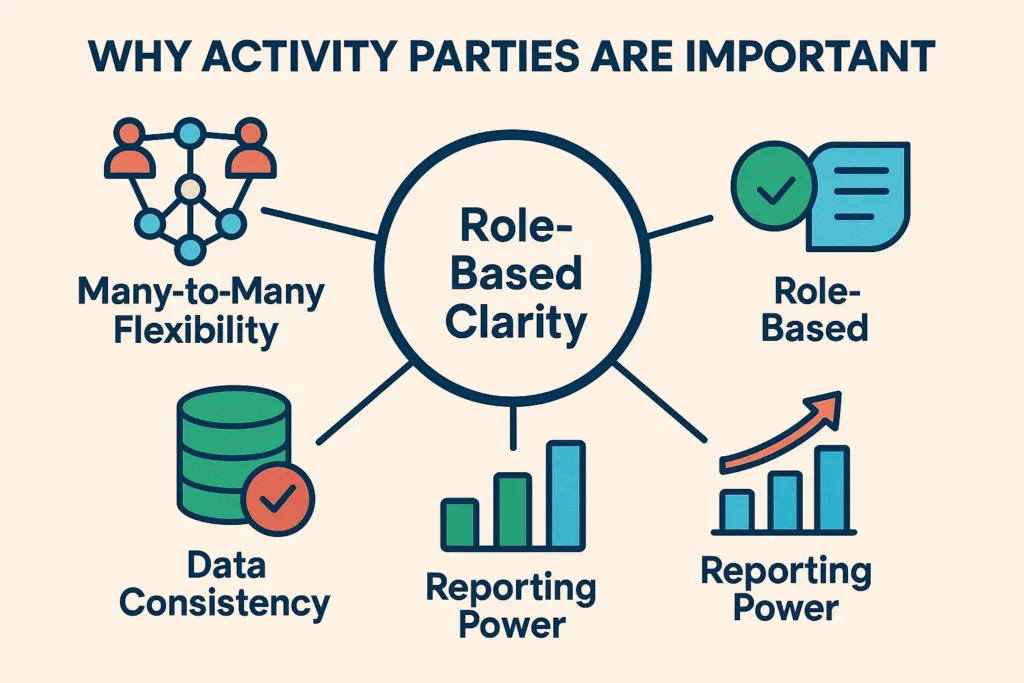
Why Activity Parties Are Important
Traditional relationship modeling in Dataverse uses lookup fields to link one table to another. However, activities like emails or meetings often require multiple participants in different roles — something lookups alone cannot handle.
That’s where Activity Parties come in. They enable a non-obvious but powerful relational model that supports real-world business scenarios.
Key Benefits
- ✅ Many-to-Many Flexibility – A single activity can link to multiple participants.
- ✅ Role-Based Clarity – Each participant’s purpose in the activity is clearly defined.
- ✅ Data Consistency – Keeps user, contact, and account records synchronized.
- ✅ Reporting Power – Makes it easier to analyze who is involved in what.
How Activity Parties Work (With Example)
Let’s say you send an email to three customers and CC your manager.
Instead of storing multiple “To” fields, Dataverse uses the ActivityParty table to connect:
- The Email activity
- Each participant (recipients, sender, CC)
- The role each participant plays
Example Relationship Structure:
| Email Activity | Activity Party Role | Linked Record |
|---|---|---|
| Email #101 | From | Emily (User) |
| Email #101 | To | Alex (Contact) |
| Email #101 | To | Jordan (Contact) |
| Email #101 | CC | Manager (User) |
This allows Dataverse to maintain a clean, normalized structure while providing flexibility for any communication pattern.
Activity Parties in Action: Modeling Relationships
When modeling your CRM or business data, understanding how Activity Parties work lets you:
- Create more dynamic relationship models
- Simplify activity reporting across departments
- Support multi-participant activities seamlessly
- Enable Power BI or Power Automate workflows to reference participants easily
By leveraging Activity Parties, you can move beyond basic lookups and design systems that truly reflect real-world collaboration.
Common Activity Party Roles in Dataverse
Here are some of the most common roles available in Dataverse:
| Role | Description |
|---|---|
| From | The sender or initiator of the activity |
| To | The main recipient(s) of the activity |
| CC/BCC | Secondary recipients |
| Organizer | The person responsible for scheduling or managing the activity |
| Required Attendee | Essential participants (e.g., meeting attendees) |
| Optional Attendee | Participants who are invited but not required |
| Regarding | The record or entity the activity is about |
Challenges Developers Face
While powerful, Activity Parties come with a few caveats:
- ⚙️ Complexity in Queries: FetchXML and OData queries involving Activity Parties can be tricky.
- 🧩 Customization Limits: Direct customization of the ActivityParty table is limited.
- 🔄 Integration Handling: External system integrations require careful mapping of participants and roles.
That’s where professional support can make all the difference.
How Skysoft Connections Can Help
At Skysoft Connections, we specialize in Microsoft Dataverse, Power Platform, and Dynamics 365 CRM development.
Our team helps businesses simplify complex relationship modeling — including Activity Party configurations — for better data management and reporting.
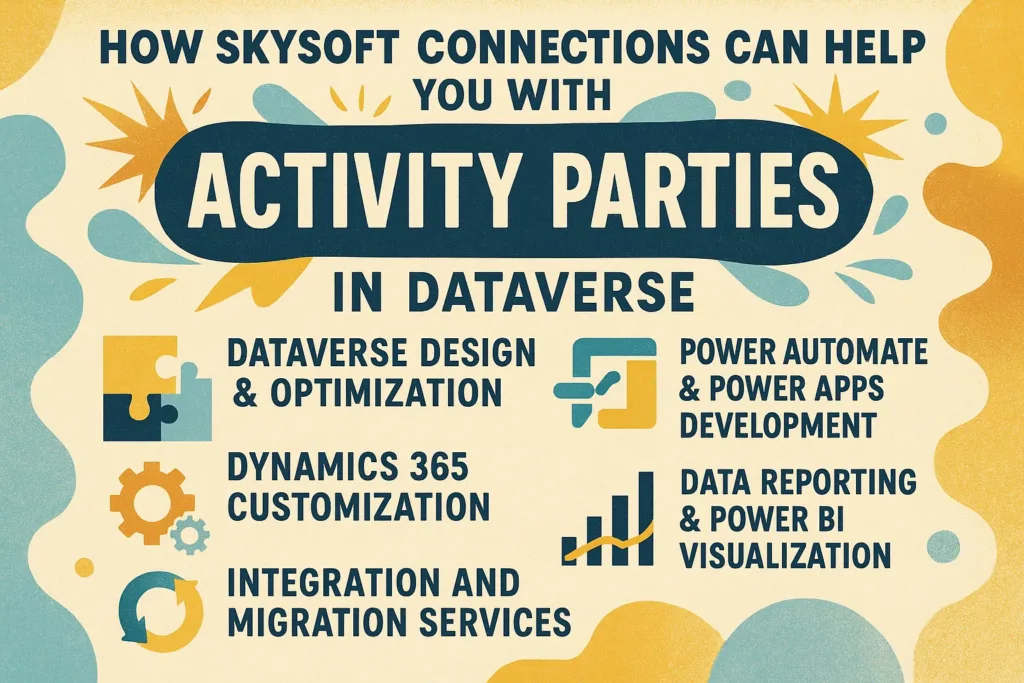
Our Expertise Includes:
- 🔹 Dataverse Design & Optimization
- 🔹 Dynamics 365 Customization
- 🔹 Power Automate & Power Apps Development
- 🔹 Data Reporting & Power BI Visualization
- 🔹 Integration and Migration Services
Whether you’re building a custom CRM solution or enhancing existing systems, Skysoft Connections ensures your Dataverse structure is efficient, scalable, and business-ready.
Conclusion
Activity Parties may not be the most obvious feature in Dataverse, but they’re essential for modeling realistic relationships between records and users.
By understanding how they work, you can unlock more flexible activity tracking, better reporting, and smoother workflows.
If you’re ready to leverage Activity Parties for smarter data relationships, Skysoft Connections can help you implement them effectively — from concept to execution.
Read more : common data model in d365
FAQ’s
An Activity Party represents a participant in an activity, like a sender, recipient, or attendee.
You can link multiple participants with different roles to the same activity, enabling complex relationships.
You can manage and extend functionality through Power Automate and model-driven apps, though direct customization is limited.
Skysoft Connections helps design Dataverse structures, build custom CRM systems, and optimize data relationships for enterprise scalability.
 is a software solution company that was established in 2016. Our quality services begin with experience and end with dedication. Our directors have more than 15 years of IT experience to handle various projects successfully. Our dedicated teams are available to help our clients streamline their business processes, enhance their customer support, automate their day-to-day tasks, and provide software solutions tailored to their specific needs. We are experts in Dynamics 365 and Power Platform services, whether you need Dynamics 365 implementation, customization, integration, data migration, training, or ongoing support.